Jeremiah 2:4-13
Hear the word of the Lord, O house of Jacob, and all the families of the house of Israel. Thus says the Lord:
What wrong did your ancestors find in me that they went far from me and went after worthless things and became worthless themselves? They did not say, “Where is the Lord, who brought us up from the land of Egypt, who led us in the wilderness, in a land of deserts and pits, in a land of drought and deep darkness, in a land that no one passes through, where no one lives?”
I brought you into a plentiful land to eat its fruits and its good things. But when you entered you defiled my land and made my heritage an abomination. The priests did not say, “Where is the Lord?” Those who handle the law did not know me; the rulers transgressed against me; the prophets prophesied by Baal and went after things that do not profit.
Therefore once more I accuse you, says the Lord, and I accuse your children’s children. Cross to the coasts of Cyprus and look; send to Kedar and examine with care; see if there has ever been such a thing. Has a nation changed its gods, even though they are no gods? But my people have changed their glory for something that does not profit.
Be appalled, O heavens, at this; be shocked; be utterly desolate, says the Lord, for my people have committed two evils: they have forsaken me, the fountain of living water, and dug out cisterns for themselves, cracked cisterns that can hold no water.
Sermon Text
I am out of town on vacation this week. Which means I get to write a sermon that will pretty much just exist between me and the couple dozen who read this blog. I like these moments, because I get to think about the sermon as a thing which is read, and not something I will have to say.
It is also an opportunity for me, as I get about once a year, to talk about the imagery of springs in Biblical Literature. Growing up in Berkeley Springs, WV, water bubbling up from underground is an essential part of my world. The springs, since the days of Francis Asbury, have been a place folks go to in search of peace, healing, and life itself. Within those tepid waters are a variety of microorganisms, tadpoles, guppies. The occasional bird flits down to visit the waters, to drink or to wet its feathers. Out of the aquifer just under the limestone, life itself is given to the surface.
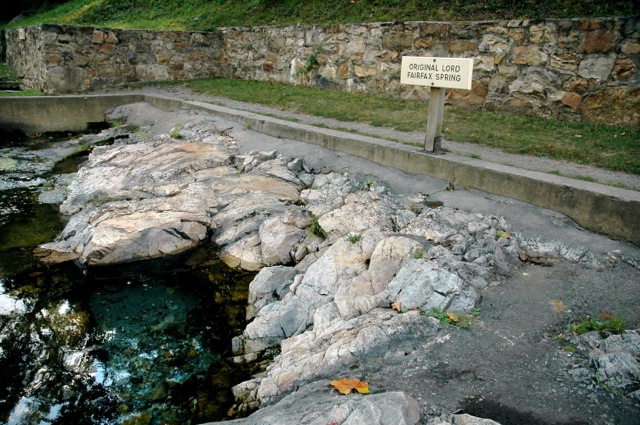
Springs like this occur in most parts of the world. Wherever an underground water deposit happens to get too close to the surface, such that it can be pushed up by pressure into a small pool or stream, there a spring will form. Like many springs, the springs at Bath are “warm springs,” maintaining a temperature of about 75 degrees all year round. They are beautiful, they are carved out of the earth, and they are permanently part of my being.
The scripture out of Jeremiah can give many lessons. It gives us a lens to the status of cultic worship in Jerusalem – the presence of Baal alongside Adonai is just taken for granted. Likewise, we cans see the concept of sin “spoiling,” the land – God’s position as the source of fertility is confirmed when the land does not give produce due to the repeated sins of God’s people. Yet, for myself today, I think that the image of springs and cisterns, specifically in terms of God’s people choosing “no gods,” is compelling.
There is a tension within the scriptures regarding the existence of deities other than the God of Israel. Paul in some letters of the New Testament implies that idols are just empty stone shells, elsewhere he seems to imply a spiritual reality to the Greco-Roman pantheon. Likewise, God is described in the Hebrew Bible as being the chief of the “Gods,” having taken his place at the summit of the universe and divvying up nations between the other Gods, choosing Israel for his own. He fights with Chemash at one point, he actively opposes Dagon in his sanctuary, he appropriates and subverts the language of Marduk. Yet, as Jeremiah shows us here, many other times the foreign Gods are treated as non-existent, as phantoms, as “no Gods.”
While I do not think this would be a helpful thread to follow in discussions of interfaith dialogue, I do think that this can be helpful to understanding a persistent problem within Christianity. We adore creating other Gods, in establishing pantheons of fear, all so that we can feel more secure in our own strength and abilities. We empower the circumstances of the world around us with supernatural agency and power and create Gods to fight against our own. While some may argue this creates a more compelling narrative of a “conquering king,” image for our God and Messiah, I think it weakens our witness in an attempt to secure our own positions and hegemonies.
I speak directly against the idea that this world is inhabited by “Spirits.” Constantly you hear folks in Church contexts use the term “Spirit,” to instill personality in problems. Depression is difficult, it exists at the crossroads of mental, behavioral, and environmental causes. A “Spirit of Depression,” which is easily rebuked by a faithful person requires no questions. Add “Spirit of,” to just about any problem and suddenly the day to day struggles we face become Spiritual battles. More than that, they can become battles that you can win, if you just assert your positive affirmation of faith over them. It’s The Secret, baptized and dressed up for Sunday Service.
I believe that spiritualizing these matters is not inherently problematic. Depression, division, doubt, and all manner of evils beyond this have a spiritual element to them. The problem is that these Spiritual conditions are not personified conditions. My depression impacts my spirituality, but an evil smoke monster does not sit on my shoulders and whisper bad things to me. In my mind, the modern formula of, “I rebuke the Spirit of X,” is the creation of a new kind of magic. We are using the language of religion to try and make God act at our discretion. We have created enemies for God to knock down, but often times the enemy is simply something we have invented.
A Spirit of Division is easier to oppose than the complex web of misunderstandings, egos, and legitimate concerns that cause Church conflict. A Jezebel Spirit is more marketable than telling a woman you disagree with to sit down and shut-up. So on and so forth, et cetera, et cetera. We take the complex web of human experience, human relationships, human sin and outsource them to invisible phantoms that we can claim to chase away with a single word. Do I believe in Spiritual Forces of Evil? Yes, but I cannot accept this phenomena in the Church honestly deals with those forces.
In establishing a complex web of demonic, anti-social Spirits we are ultimately committing the same superstitious mistake that the Medieval Church did. We are making new “Maleus Malifarcarum”s to identify witches in our midst. We write out exhaustive grimoires so that we can name the Spirits of our own invention and make them bend to our will. We come up with ritual and with incantations, to defend against the Gods of this world… The God who we must honestly confess are, “no Gods.”
Superstition is one of the primary dangers faced in the Church today. Having lacked a true Spiritual core, Protestants, Catholics, and all streams otherwise have fallen into lesser manifestations of spirituality. We are in a never ending Satanic Panic that sees the devil in every book, movie, stage performance, or opening ceremony. We fear that by accidentally misspeaking or striking a yoga pose a dark creature may enter our hearts. Yet, there was already a creature in our heart all along working evil within us. We are our own worst enemy, “The heart is devious above all else…”[1] We do not need an evil spirit to lurk on our shoulders, because our own evil and sin-sick spirit is capable of plenty of evil.
The reality of God’s existence, of the power that we are given over evil in this world, is most powerfully reflected in two things. Acknowledging, firstly, that there is no other source of life and truth except God. We may delude ourselves, may create self-aggrandizing narratives and incantations, but at the end of the day we are wholly dependent upon the God from whom we come and to whom we earnestly seek to return. We do not need to invent conflicts, because the conflict of God fighting the forces of sin and death to reclaim our souls is more than enough. It plays out in our hearts every day, God fights back evil within us every moment. The truth of God’s struggle for our heart is enough.
The second thing we must acknowledge about God’s reality is that we are the antagonists of the story. Whatever Spiritual Wickedness there is in the world, it does not constitute hob-goblins tricking you into pacts. The evils of this world are fed by our own human will and cognition. We choose evil, constantly, and we are left the lesser because of it. Humanity is the core driver of wickedness in this world, not the false Gods we wish to blame for it. In the mirror every day you see the image of God reflected back to you, and every day you have the choice to live like that image or against that image. We are the villains, Christ is the protagonist, and all of life is the story of how villainous humanity is redeemed.
Back to the initial imagery of springs. God tells Jeremiah that in worshipping the Baals, the people have traded a spring of living water for a muddy cistern, cracked and incapable of even holding water. I maintain that this is true of our Christianity when we tack on superstition to it. We trade a sacrificial faith that asks us to examine ourselves, to chase after the lifegiving waters of God’s instruction, grace, forgiveness, and blessing – we trade all that away for a series of spells and superstitions that satisfy our daily ennui, but fail to grow us as people. If I think all my problems are external, the work of Spirits that I have to constantly watch out for and say spells of protection against, then I will never look inside, never correct my own faults, never seek the true belief and true repentance I need to find life, and life abundant.
I have cast my life upon the altar of the one God of Heaven and Earth. I shall not elevate artificial divinities to that same level. No Spirit of human invention can overcome the One Spirit that dwells within me.[2] No manufactured tulpa is worth worrying over when I am earnestly struggling to see that my name, written by God’s grace in the Lamb’s Book of Life, is not written with an asterisk beside it attesting to my inability to become worthy of the call to which I am called.[3] When true Spiritual Evil appears in my life, I want to truly be prepared to face it, not left to the mercy of my own half-baked hero narrative. God is in his Heaven, and above all the “no Gods,” he holds his court. I shall not create a graven image to oppose him, I have shown myself opposition enough, time and time again. I want the springs of life, not that muddy pit… Amen.
[1] Jeremiah 17:9
[2] Luke 10:20 c.f. 1 John 4:4
[3] Revelation 20:12 c.f. Ephesians 4:1
 Teach us to Number our Days