Sermon 05/26/2024 – The New Birth

Romans 8:12-17

So then, brothers and sisters, we are obligated, not to the flesh, to live according to the flesh— for if you live according to the flesh, you will die, but if by the Spirit you put to death the deeds of the body, you will live. For all who are led by the Spirit of God are children of God. For you did not receive a spirit of slavery to fall back into fear, but you received a spirit of adoption. When we cry, “Abba! Father!” it is that very Spirit bearing witness with our spirit that we are children of God, and if children, then heirs: heirs of God and joint heirs with Christ, if we in fact suffer with him so that we may also be glorified with him.

Sermon Text

We worship a God of liberation. Every act of God is a act that brings freedom to the soul, freedom from the captivity of Sin and Death, and freedom for the joyful obedience that defines a life of faith. Christ described our entry into this new reality as a “new birth,” a transformation of who we are into who we can be. The New Birth is rarely given those exact terms, Christ uses it when he speaks to Nicodemus and scarcely elsewhere, yet the concept is discussed in a few different terms throughout scripture. For Paul, the author or Romans whom we read from this morning, the concept of New Birth is described in terms of our “adoption,” into Christ’s family.

For Paul the transformation that comes in the life of a Christian begins with our receiving the Holy Spirit and that reception is the moment of our “adoption,” or our “birth.” Here’s a question for those gathered here though… When is it that a person receives the Holy Spirit and is born again? What signs are there that this transformative process has begun?

Some people are likely to say “Baptism!” This moment where water is poured on the head or immersed around us, is a declaration of faith overseen by a minister of the Church, “I baptize you in the name of the Father, the Son, and the Holy Spirit,” and in this sacrament we join the Church and are given a special dose of God’s grace… Yet this is not the moment of the New Birth. We baptize infants after all, and baptism as an infant does not guarantee a life of faith – although it is an important start to one.

Other people expect some outward and physical sign of the Spirit’s reception. For those who have had exposure to the Pentecostal movement they look for “glossolalia,” an outpouring of seemingly nonsensical speech. Others, again tied to holiness churches, may look for fits of dancing, or spontaneous singing, or shaking! All of these could be a sign of the Spirit, I will not deny that they could be, but unless more lasting signs remain with them, they are just for show.

The Spirit arrives on its own time and in its own terms and so there is no rubric we can write to define when exactly the Spirit will arrive or how exactly it will manifest. Some people will have the Spirit come to them before they are baptized with water, other people the moment the water touches them, and still others years and years after they have found themselves in the Church. There are, however, only three definite things that define someone who has experienced the New Birth, and I admit wholeheartedly that I am taking these categories from a sermon by John Wesley – he just said it best, and who am I to perfect on perfection?[1] The three things that define a person who is born again are the virtues of faith, hope, and love.

Faith is the thing that undergirds our entire lives. In Greek the word for “faith,” (πιστις,) means “to be convinced.” We are convinced that God is good and active and present in our life and from that convincement we go forward to let ever aspect of our life be colored by our understanding of who God is. Yet, faith is not just saying you believe in all the right things in all the right ways, it is a change in the deepest parts of our soul and a reworking of our minds. Faith changes our mindset and allows us to see that God follows through on God’s promises – that the grace that has transformed other people’s lives is for us too! We can be free and we will be free!

Free from what though? Well, from sin and death! The hardest call in the Christian life is to abandon sin and to chase after righteousness. Again, this is a place we try hard to come up with lists of specific actions that define what is sinful and what is good. While there are obvious candidates – murder is bad and feeding people is good – there is a better way to address this. When we grow in faith, we grow in all virtues alongside them. Sin are those things motivated by anger and fear, by greed and lust, by cruelty and apathy. We know that we are being transformed by God’s grace when we are no longer acting based on these instincts, but on the greater virtues of humanity – love, joy, peace, kindness, generosity, faithfulness, gentleness, self-control. We do not need long rubrics of dos and do nots, we only need to know if we are acting on one instinct or the other.

The second sign of the New Birth is Hope. Hope is a hard thing to hold in our hearts. Emily Dickinson gives my favorite definition of Hope, “Hope” is the thing with feathers – That perches in the soul – And sings the tune without the words – And never stops – at all…”[2] Hope has been described in similar terms throughout history, something that is frail and that is always in danger of being snuffed out – but that does, and must persist. Hope for the person of faith carries a more definite form – we are hopeful because we have faith, and that faith feeds the fires of Hope. To go back to Dickinson, we truly believe that Hope never stops singing in our hearts, and we get better and better at listening to its song in the midst of life’s troubles.

The final sign of the New Birth is love – an authentic outpouring of care for those around us. It shouldn’t surprise us that the crowning virtue of all virtues comes from our acceptance of the others. As we grow in faith and escape the cycle of our own selfish sin because of it, we naturally grow better at caring for others. As we grow in hope, we do not give into the cynical dismissals of our fellow human beings and instead reach out to them with more and more love in our hearts. This love should not just be doing things for people, but actually changing how we see each other. In his Sermon, “On a Catholic Spirit,” Wesley put it this way,

“Love me… with the love that is long-suffering and kind; that is patient, –if I am ignorant or out of the way, bearing and not increasing my burden; and is tender, soft, and compassionate still; that envieth not, if at any time it please God to prosper me in his work even more than thee. Love me with the love that is not provoked, either at my follies or infirmities; or even at my acting (if it should sometimes so appear to thee) not according to the will of God. Love me so as to think no evil of me; to put away all jealousy and evil-surmising. Love me with the love that covereth all things; that never reveals either my faults or infirmities, –that believeth all things; is always willing to think the best, to put the fairest construction on all my words and actions, –that hopeth all things; either that the thing related was never done; or not done with such circumstances as are related; or, at least, that it was done with a good-intention, or in a sudden stress of temptation.”[3]

Love is something that is above all and through all, it is something we cannot escape in any interaction we have with one another. Love should be more than just something we say or do, it must be something that transforms us in our deepest parts. I am someone for whom love comes easily, I do not need much reason to care for another human beings, and for that I am thankful. Yet, I am also someone for whom faith is a hard won reality, and so someone for whom hope can sometimes feel quite fleeting… What I hope we can understand is that none of these three fruits are always one giving birth to the other in a straight line, nor are they constant.

We have peaks and valleys in our faith and sometimes the difference between one and the other can be extreme. Our hope in life is that we are constantly closing the gap between our highest highs and our lowest lows, constantly moving upward toward something better. Yet, the reality is sometimes we are hit by something that can demolish everything we thought we knew about God and about life… In those times it is hard to build back without a lot of help.

Yet, we worship a God who never stops moving and is always willing to build us back up. You may find yourself today in a place where you feel like you’ve never really known faith, hope, and love like the Spirit brings, or you may feel like it has been a long time since the Spirit worked all of them in you. There is good news for all of us… The God who gives the Spirit of Adoption, the New Birth that transforms us, gives it freely and fully. If we have cast off that gift, let us receive it once again. Let us chase forward to the goal, and find ourselves transformed by the work of the Spirit. – Amen.


[1] This sermon is an adaptation of John Wesley’s Sermon 18 – the Marks of the New Birth. Available at: https://www.resourceumc.org/en/content/sermon-18-the-marks-of-the-new-birth

[2] Emily Dickinson, “Hope is the Thing with Feathers” in The Complete Poems of Emily Dickinson. Ed. Tomas H. Johnson. (The Belknap Press of Harvard University Press: Cambridge, Massachucetts. 1951) Available at: https://poetryfoundation.org/poems/42889/hope-is-the-thing-with-feathers-314

[3] John Wesley. “Sermon 39 – On a Catholic Spirit” available at: https://www.resourceumc.org/en/content/sermon-39-catholic-spirit

Sermon 05/19/2024 – Church is: A Testimony

The New Testament Lesson                                                      Acts 4:5-12

When the day of Pentecost had come, they were all together in one place. And suddenly from heaven there came a sound like the rush of a violent wind, and it filled the entire house where they were sitting. Divided tongues, as of fire, appeared among them, and a tongue rested on each of them. All of them were filled with the Holy Spirit and began to speak in other languages, as the Spirit gave them ability.

Now there were devout Jews from every people under heaven living in Jerusalem. And at this sound the crowd gathered and was bewildered, because each one heard them speaking in the native language of each. Amazed and astonished, they asked, “Are not all these who are speaking Galileans? And how is it that we hear, each of us, in our own native language? Parthians, Medes, Elamites, and residents of Mesopotamia, Judea and Cappadocia, Pontus and Asia, Phrygia and Pamphylia, Egypt and the parts of Libya belonging to Cyrene, and visitors from Rome, both Jews and proselytes, Cretans and Arabs—in our own languages we hear them speaking about God’s deeds of power.” All were amazed and perplexed, saying to one another, “What does this mean?” But others sneered and said, “They are filled with new wine.”

But Peter, standing with the eleven, raised his voice and addressed them, “Fellow Jews and all who live in Jerusalem, let this be known to you, and listen to what I say. Indeed, these are not drunk, as you suppose, for it is only nine o’clock in the morning. No, this is what was spoken through the prophet Joel:

‘In the last days it will be, God declares, that I will pour out my Spirit upon all flesh, and your sons and your daughters shall prophesy, and your young men shall see visions, and your old men shall dream dreams.

Even upon my slaves, both men and women, in those days I will pour out my Spirit, and they shall prophesy. And I will show portents in the heaven above and signs on the earth below, blood, and fire, and smoky mist. The sun shall be turned to darkness and the moon to blood, before the coming of the Lord’s great and glorious day. Then everyone who calls on the name of the Lord shall be saved.’

Sermon Text

Pentecost is the sort of day that you can never run out of things to talk about. The Spirit shows up in a big way. Languages appear among God’s people and they are suddenly able to tell the story of Christ to people they’d never be able to reach before. We are not given any account of what the believers preached that day, only Peter’s explanation of why the miracle they are participating in is even possible. The words of Pentecost, the words made possible by the Holy Spirit, are ironically lost to time.

It seems that whatever was spoken was powerful enough to change hearts and minds all the same. The Testimony of the Gospel on that day was enough to light a fire in the hearts of the crowd such that, “daily,” people were joining the Church. Peter goes on, past where we stopped reading today, to give an overview of what the Gospel consists of. Christ came to live among us and showed his divinity in signs and wonders. Christ was then killed, something that did not stop God’s work through him, but that accomplished what God set out to do. Christ’s death was only a temporary state as he was soon raised from the dead and in that resurrection confirmed to be “Lord and Messiah.” We are called then to be baptized and repent in response to this show of God’s love. To be transformed and to find new life bursting within ourselves.

It is a very early presentation of the Gospel. It has no frills and does not try to do anything other than describe what had happened. Christ came to save us, Christ has saved us, and Christ will return to finalize that salvation at the end of all things. Until then, we have the Spirit to guide us, but not just to guide us, but to perfect us through repentance, and not just to perfect us, but to fill us with the means to share what God has done in our life. The whole existence of the Church is a testimony of God’s work. On Sinai, at the Cross, in the Resurrection, and in the continual pouring out of the Spirit. God is at work in all time and space.

I’m a historian at heart. My undergraduate work – the part that wasn’t chemistry – focused on historical theology. How do God’s people talk about God in different periods of history and what does that tell us? What have different eras revealed to us about God’s will and what are the universal truths that transcend the eras we find ourselves in? This attitude transfers over to every aspect of my life. I always want to know the, “Why,” of a text as much as I do what it says.

When I stand here in this Church, its history has decided a lot about what it is. Whether the foundation is Methodist Protestant or United Brethren, the roots of our theology go deeper than the sign on the front of the building. The local flavor always adds a twist to it too. The people that sit in the pews always affect more than anything else. Our stories, our legacy, they all change the trajectory of a church in ways larger forces never could. We are all wrapped up in the midst of rivers of time and culture, but we are steering the boat – that is always true.

What we do as a Church, every moment that we are working or teaching or proclaiming the word, is a testament to what God has done in our lives. In Greek the word for testimony is “Μαρτυριον (Marturion,) from which we get the word, “Martyr.” The idea was not just that you stand up and say something, but that every part of life became the story you told. To testify is to embody, proclaim, and live the life that we have received from Christ. Testimony as we know it, telling that story, is a part of the equation, but it cannot be the sum of the matter. We should be able to explain how we came to faith and what that faith has meant to us, but it should show in much more than just our words.

            With that being said, I would like to give you all my own testimony. Afterall, I should have hopefully demonstrated some fruits of the Spirit by now in other aspects of my life. However, the story of my faith itself, I’m not sure I’ve ever given to you all.

            I was born to two unmarried people, barely adults. I was not intended in any way shape or form. Yet, the two of them did their best for me, and had the support of my maternal family throughout my life. Eventually my parents split up, which was long overdue for both their sake and mine. My father would remarry, and I would be introduced, for the first time, to the Church. At First United Methodist Church of Berkeley Springs, my stepmother began the work of showing the Gospel to my unchurched self. It took time for the seeds to germinate, but by sixteen I was able to consider myself Christian and I was baptized just after my 15th birthday. I had a religious experience  – seeing God appear to me and promise I would see God fully one day, just “Not yet.” I had the zealous faith of a new convert, but that was short lived.

            Despite feeling that God was leading me to ministry, I shut myself up. I finished school and went to college to be an engineer. That was too much like business… So, I tried to be a teacher… That didn’t feel quite right either… In my personal life, I had stagnated. I still was faithful, I was still doing my best to live out my faith, but I wasn’t growing in my faith either. Finally, a professor of mine told me to follow my initial feelings of call – I went after it, and before I knew it, I was enrolled in seminary.

            This is when my life would reach its lowest point. I was in a toxic relationship and horrifically depressed, I had not yet escaped one or treated the other. My faith suffered, my family relationships suffered, I became increasingly cruel and critical. The light threatened to be snuffed out within me. Finally, I had a moment of complete despair. While take Greek and learning about Methodist History, I had a realization. “I’m not a good Methodist and I am hardly a Christian.” Sure, I’m in Seminary and I go to chapel every week, but I was just following the motions. I finally broke down, I wasn’t able to sleep for weeks, I was constantly violently sick to my stomach. The crisis pushed me to do what I needed to… I finally found a therapist to sort out my mind and I recommitted myself to my faith, because something had to change or I would be dead within the year – one way or another.

            My life began to grow again. Christ was able to break through the walls I’d been putting up. My heart began to soften again, and my prayers became more regular and earnest. I escaped the relationship that had been feeding my worst habits and I began to repair what I could between me and my family and those friends I had not completely alienated. I worked hard and, with God pushing me forward, I began to resemble what I had long ago wished to be. I took on a Church and my longtime friend, Grace, and I started dating. Within a year we would be engaged, and within three months of being engaged we would be married. Ministry worked at my heart alongside the Spirit, and I became more and more what I wanted to be.

            Since then, mostly, I have been with you all. You’ve been present for my growth since then. To the observers around me throughout all this, maybe the story would not seem as dramatic – except to those who knew me best. Yet, I can tell you that even in my short life I have seen rises and falls in my faith. I am thankful to God that I had the breakdown I did in Seminary, because it saved my soul and my life. I stand before you, not as someone with an especially dramatic story of faith, but one that nonetheless has been a result only of what God has set up in my life. I am here today because God is good, because Christ forgives sins, and because through all that – redemption is possible.

            In the early days of the faith, the disciples did not have the fullness of doctrine and history that we do. Christ had just ascended to Heaven, there wasn’t time yet to formulate complicated ideas of faith or doctrine. All they had was their story, their scripture, and the Spirit – and wouldn’t you know it, that was more than enough. I hope that we can begin to see God at work within us, can tell our stories without hesitation, and can proclaim Christ in word, in deed, and in prayer upon, upon prayer. People of God, we the people of God are a testimony to God’s goodness. Tell that testimony and live that testimony well. – Amen.

Sermon 05/12/2024 – Church is: A Verb

The New Testament  Lesson                                          Acts 1:15-17, 21-26

In those days Peter stood up among the brothers and sisters (together the crowd numbered about one hundred twenty persons) and said, “Brothers and sisters, the scripture had to be fulfilled, which the Holy Spirit through David foretold concerning Judas, who became a guide for those who arrested Jesus, for he was numbered among us and was allotted his share in this ministry.”

“So one of the men who have accompanied us during all the time that the Lord Jesus went in and out among us, beginning from the baptism of John until the day when he was taken up from us—one of these must become a witness with us to his resurrection.” So they proposed two, Joseph called Barsabbas, who was also known as Justus, and Matthias. Then they prayed and said, “Lord, you know everyone’s heart. Show us which one of these two you have chosen to take the place in this ministry and apostleship from which Judas turned aside to go to his own place.” And they cast lots for them, and the lot fell on Matthias, and he was added to the eleven apostles.                  

Sermon Text

When I read the scripture that we have before us today, I am made to wonder. What would have happened if Judas had turned back to God? What would it look like for the murderer of all murderers to chase after God’s forgiveness? If God’s mercy truly is infinite then the option to return was there for Judas and yet, as our scripture tells us, “[he] went his own way.” The ministry of Judas ended, but the mission of the church was not going to end, it could not end.

When the disciples gathered after Christ’s ascension, they did so with the desire to fill the ranks of the disciples once again. They saw a need to keep twelve leaders in those early days, an echo of the twelve tribes that once defined God’s people. They found someone who had been with the Church from the beginning. Finally settling on Matthias as a replacement for Judas. The title of apostle was passed on, the authority of the twelve rested on him, and, for my part, I believe even Judas’s coin purse – the funds that were given to those in need – passed to rest in his hands. The mission of the Church goes on, no matter who is present to do it.

There was a sad reality that set in at General Conference last week. The realization that, because we had not gathered in eight years, many of the faces that were present at these meetings for decades were no longer there. Time had taken its toll: delegates, agency members, and church people from all lands and positions had left the General Conference to join that Holy Conference in glory. There were people who could not be visibly present with the people called Methodists, and yet… the mission of the Church goes on.

Church, as it appears in scripture as ἐκκλησία (ecclesia,) means “those who are called out.” Called out from the world as it is into the world as it could be. From slavery to Sin and Death into abundant lives defined by joyful obedience. Called out, to go forward, and to transform this world with the Spirit ahead of us and the Cross as our banner.

The Church cannot be separated from the work it does and so today I put forward the idea that Church is really a verb. Sure, those of you who grew up diagraming sentences will proudly tell me that we aren’t even dealing with an adverb when we look at “Church,” but trust me when I say, you cannot rightly call anything “Church,” unless it is doing the work of a Church. The Church is a place that transforms, that builds up, that sends out!  We are always active in the Church because… the mission of the Church goes on.

Amidst the many calls of spectators throughout General Conference was the hope that God would be with the people who were there. I believe God was. In the midst of deep troubles and conflicts, the Church was able to gather together and praise God, do the hard work of budgeting and legislating and we managed throughout it all to mostly behave ourselves. Mostly. While the work was being done in the sessions, there were people who went to keyboards and cameras to cast all manner of dispersions on the work of the Conference. God, however, was present in the room. For those who were willing to follow the Spirit, there was a wellspring that bubbled up from the deep parts of our souls, a wellspring for eternal life.

It is hard to describe unless you were there. I do not know how much you heard last week about Conference, but let me tell you what happened this year. For the first time in living memory, people were gathered together and laughing and singing and praying throughout the conference. For the first time in living memory, people were sharing their hopes for what God was going to do with the Church, not worrying about whether or not people were going to rip it to pieces. For the first time in a long time, the worries of the present age and the struggles we face as a Church in a world that is so deeply broken, all seemed to melt away. We were the people of God, gathered to chart a way forward for the work of God. We knew we had to do this work, because with or without us… The mission of the Church goes on.

During General Conference, Bishop L. Jonathan Holston gave an episcopal address that covered a great deal of the anxiety of the Church. In just a few years we have seen wars and rumors of wars, a global pandemic, insurrections, growing radicalism, and division upon division – within and without the body of Christ. In the midst of all that, the Church never ceased to work! Globally, churches worked to provide housing for refugees fleeing war, educated people in places where education once was impossible, fed the hungry, clothed the naked, and met people in the midst of tragedy with love and open arms. Local churches and global institutions worked hard to do the work of God, even in the midst of hardships that seemed impossible. Why? Because the mission of the Church goes on.

We also saw in this General Conference big changes to how the Denomination talks about human sexuality. We no longer, as Methodists, mandate one view on matters of same sex relationships. The General Conference voted to remove all language condemning it, leaving the Discipline as a neutral document that allows for every Christian, every minister, every Church, to live as their conscience dictates. Like Paul long ago speaking to Corinthians about differences in opinion, the United Methodist Church has embraced allowing latitude on non-essential matters. About 720 people gathered from the four corners of the Earth – conservative, progressive, African, Asian, European, and American – all voted with an average approval rating of over 90% for these changes. Because it is time to move on from fighting toward the work of the Gospel.

It is naïve to think this change does no hit people differently. Some see it as capitulation to culture or betrayal of tradition, while others see it as a letting go of centuries of prejudice and an opening up of God’s grace. I should be honest and say that from the moment the first set of restrictive rules were voted out, I wept for joy, to see the Church I have always loved embracing what it could truly be, a place where all people have a home.

Yet, beyond my view or anyone else’s – both extremes and all people in-between, believe what they do while using the same book to justify their idea – our shared Holy Scripture. All are led by the same Spirit – the Holy Spirit. All are saved by the same Lord – Jesus Christ. Somehow in the midst of these extreme differences in this matter and all others, God is not divided or mocked. We alone are the ones who cast separation after separation between ourselves.

The episcopal address, having reviewed the various challenges we have all seen and the work the Church has to do at all times and in all places, put a question to the body that rocked our souls. “When was the last time you led someone to Christ? When was the last time you made a witness with your words and your life that led someone into relationship to Christ? Friends, if we are not doing this, then we are not being the Church. That is God’s purpose.” John Wesley made a similar point referring specifically to ministers. “The roads of Hell,” Wesley said, “are paved with the skulls, of ministers such as these.” If we as the Church are not able to bring people into a place where they know Christ, then we have been left behind – because the mission of the Church goes on…

When is the last time we saw fruit? Can you think of an example of someone finding faith because of what you have done? I struggle to think of one myself, in my six years of Pastoral Ministry, in my twenty-eight years of life, I can think of plenty of people I have been a part of bringing closer to God. I can think of people of God I have helped revive faith within. Yet I struggle to see how God has used me to be the spark that lit the fire of faith where it had never been before. I imagine many of us are in similar places. Maybe we raised some faithful children, maybe we have encouraged our faithful friends, but what have we done to bring those outside the faith, into the faith? We can sing “Rescue the Perishing,” we can talk about God’s “Amazing Grace,” but have we done anything to bring anyone to know what it feels like to be saved, really and truly?

I preached recently about how distracted we as the Church have been – obsessed with culture wars and petty differences. What have we lost in the mean time? Biblical Literacy is at an all time low. Even in this room, we have work to do. If we talk about Mephibosheth and King Asa do we have any idea who we’re talking about? What about the difference between our Spiritual existence and our Physical one – as Paul describes life before and after Christ? Doctrine is in an even dimmer place. Do we know why we see God as a trinity? Why we proclaim a God who gives us a choice to be saved? Why we believe that grace overcomes all evil and is found uniquely in the waters of baptism and the elements of the eucharist?

Our ministries have lost depth. We can feed and we can clothe, but what are we doing to embrace and to lift up? Do we know the names of the people who come through our doors? What about the people who walk up and down our street? Can we name our neighbors, and do we pray for their needs? For their hearts? For their souls? Are we comfortable telling people about Christ or are we only doing our best to trick them into sitting down on a Sunday, hoping that will do the trick? We are missing something vital in our work, the Spirit is here among us, but we must not be listening, because we are not doing the work of the Church in the irreplaceable way we ought to. We sit and wonder why the Church does not grow, but I sometimes think our desire to see it grow has a lot less to do with Christ and a lot more to do with our own pride.

We want the pews full, we want the choir loud, and we want the people singing all the songs we know and love. We want this for our own edification – for the pride of having a large and vibrant church. I would rather us seek this for the good of those we bring in and for the Kingdom which we are growing. If we had been focusing on that sort of ministry, that sort of development of self, that sort of willingness to do what God was calling us to… What wonders might we have achieved? It would have paid off a lot more than what we have been doing.

The United Methodist Church was founded in 1968 with the merger of the Evangelical United Brethren and the Methodist Church. This merger was a long time coming, after all the only reason that the Brethren was separate was because they originally spoke German. The theology and the Discipline the two shared was nearly identical. This family reunion was celebrated as a new beginning for our ministries. Yet, we immediately began to fight with one another. 1972 we added a clause to our Social Principles to make clear that while we believed all people deserved rights, “Homosexuality is incompatible with Christian Teaching.” In the 80s, as the AIDs Crisis raged – rather than extending more love and care – we doubled down. We added line after line to the discipline to make something clear – God may love gays, but the UMC did not.

This year we got rid of that language. We have not mandated any changes beyond a willingness to acknowledge that there are gay Christians and straight and that both are valid. Pastors do not have to marry anyone they do not want to, and if a Church really does not want a gay minister or to host gay weddings, then they are allowed that decision just like they always have been. In the next few years, plenty of churches will invest plenty of time into shutting up their doors in the face of a new era of the Church. Trustees will write building contracts to keep weddings out, ministers may be traded around to find ones that the congregation completely agrees with, and in the meantime the world will still keep spinning its old broken routines. We will hide ourselves away as good and holy Christians, we will create fortresses to keep the past locked up in our walls, and we will slowly atrophy and fade in the meantime. Because while we shut our eyes and clench our fists and lock our doors… The mission of the Church goes on.

In a moment we are going to take bread and juice in hand. We will drink God’s grace. The hands that took a cup before you did are the hands of people with different views. They may be the hands of people of another sexuality than you. They may be the hands of someone who will vote differently than you. They may be the hands of anyone and they will receive the same grace you do. Why? Because the hands that take the bread and give the cup are not important… The hands that matter are the ones that bore scars to cleanse us of our sins, the hands that hung on a cross and gave us hope for a resurrection.

I could go on and on, my mind is ablaze with how we might do more and better, but that is not the energy we should leave this moment on. Our scripture shows the Church dealing with replacing one of the most central positions it held, one of the twelve disciples. They did so following a period of worry, of fear, but that nonetheless ended with joy and resurrection. People of God, fear will be with us always, but God is greater than that fear. God is greater than our differences. God is greater than the squabbling we have taken part in over the past 52 years and beyond. God is greater than anything we can imagine, and God’s mission is marching forward toward the realization of God’s kingdom. Are we willing to take part in that? Or will we go on circling the same drain of conflicts, of hot takes, of controversy.

“When was the last time you brought someone to Christ?” Let that question motivate you more than any other, and you might find yourself taking steps toward that goal. We will be holier and kinder and more open and loving and Christ like, when our goal is demonstrating Christ’s love. I look at this room and I see the love that each of you holds. Let us work to perfect that love, let us put the past behind us, and let us charge forward – as Christians and as United Methodists – to do God’s will. – Amen.

Day 11 – Telos

I took a break from writing yesterday to rest. One of the unfortunate things about being in a city that you’re not used to is that the pollen is not of a variety that your immune system has any defense against. When you, like me, are allergic to just about everything, something as simple as a shift in pollen can ruin your day. Luckily the rain eventually fell and as evening came, my sinuses cleared. I was reminded of one of my favorite hymns,

“Sweet the rain’s new fall, Sunlit from Heaven.”

My one true enemy in life is tree-borne pollens.

Worship today was led by the first Indigenous Bishop on the Council, Bishop David Wilson. The timing of worship fell so that I missed his sermon, but as I wandered into the Press Conference room for our daily briefing I did so to the sound of hymns in Native Languages and exited the room to the same. The United Methodist Church has a checkered history with the Indigenous people around the world, it is hard to overstate the significance of an Indigenous Bishop presiding over a service prominently featuring Indigenous languages. The people and languages that this Church once worked to suppress are now celebrated – a statement of the power and potential of reconciliation.

This Conference has seen a variety of historic events. The removal of restrictive language around human sexuality allows churches and ministers to decide for themselves how they will handle matters of human sexuality; A new way of managing our Connection, one that focuses on regional governance and global collaboration; A new version of the Social Principles sets a baseline for the aspirational work of the Church as it navigates the world around it. These were what were given the name, “The Three Rs,” in the lead-up to Conference. The source of a great deal of conversation and stress leading up to General Conference these were considered to be what most of our discussion would circle around…

We were wrong. The final vote of the morning plenary saw 93% of the delegates from around the world approve the removal of exclusionary language. The most contentious matters relating to these pieces of legislation still passed in such a way that, even if the 120 delegates who were unable to attend for one reason or another universally opposed them (an impossibility really,) they would still have passed. The overwhelming witness of the Church in Europe, the Philippines, Africa, and the United States, is that the time to allow for latitude on contentious issues in the name of shared mission is here – and, really, has been for some time.

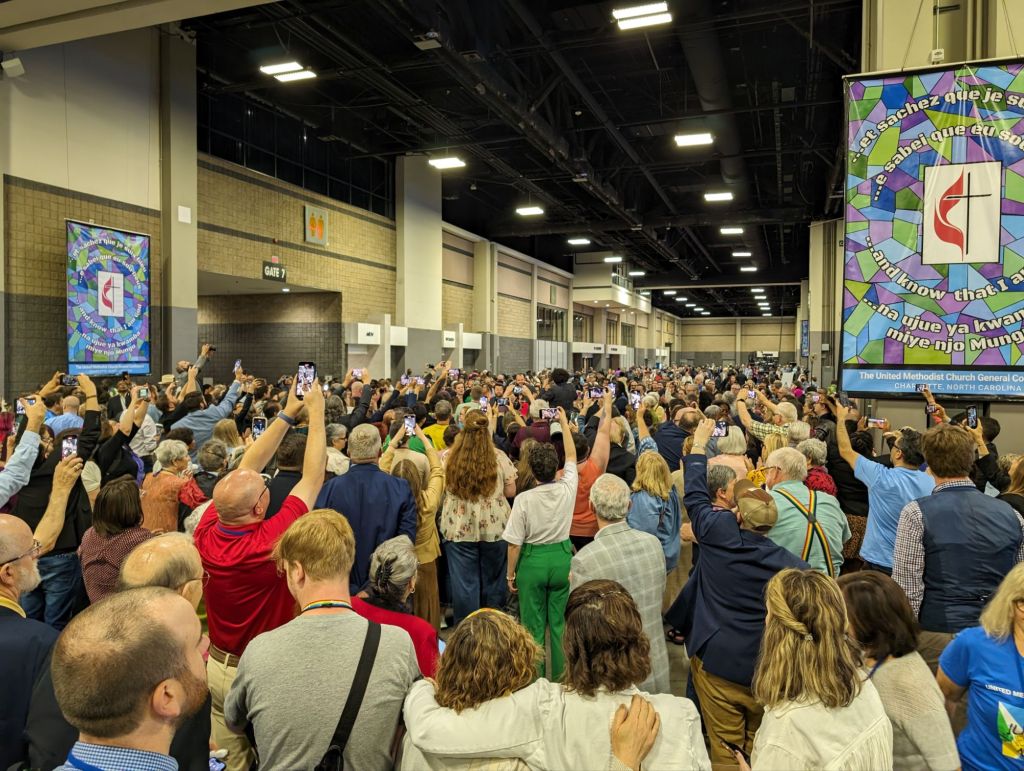
Delegates, observers, and others, celebrate following the passage of Calendar Item A05

The places where we did debate were focused on the ministries of the Church.

How do we fund education? How do we fund hospitals? How do we make sure that we can go out and do the work of the Church as the people of God? The Gospel needs to be preached! The work needs done! How will we go there? And who will do the work? These saw the majority of lengthy debates and close votes (these and retirement plans, but that always goes long… (Also a surprising amount of motions to turn down the air conditioning in the room?))

I do not know what the future holds. I think that some churches in the U.S. and some conferences in the world will choose to leave the UMC following the work we have undertaken this week. Yet, I have hope that going forward even those that leave will do so with a willingness to work together. We make the choice going forward whether we act in love or as agents of division. We make the choice if the Body of Christ is greater than even a matter as big as this.

There is a lot of work ahead of us, but it is necessary work. On one hand, we have to balance differences in opinion in a way we never have before, but on the other… We’ve been doing this for years already. We have been living as gay and straight, progressive and conservative for decades. We have just erased what made us live this way in whispers rather than out loud. The Gospel will still be proclaimed, the Word of God preached, and the means of grace richly poured out on a world that needs them more than ever.

A verse that has settled in my heart over the last year or so goes as follows,

Thus says the Lord, who makes a way in the sea, a path in the mighty waters, who brings forth chariot and horse, army and warrior; they lie down, they cannot rise,they are extinguished, quenched like a wick:

“Remember not the former things, nor consider the things of old. Behold, I am doing a new thing; now it springs forth, do you not perceive it? I will make a way in the wilderness and rivers in the desert. The wild beasts will honor me, the jackals and the ostriches, for I give water in the wilderness, rivers in the desert, to give drink to my chosen people, the people whom I formed for myself that they might declare my praise.”

As we go forward, let us do so as people who believe that God works through new things and not simply through the old. The Spirit of the Lord is alive and active and I plan to chase it wherever it leads me. May we see the fruits of the Spirit bursting from our midst as the dry parched lands find life and life abundant.

Day 9 – Oxōne

Today has been fairly quiet in terms of Conference Business. As the new week begins, there is lengthy discussion about the number of bishops that will serve within the African Conferences. This is very important legislation, but it is legislation that is not immediately applicable to my work in West Virginia. As such I have been digging through upcoming legislation while I watch the proceedings take place. I check to see if there is anything I should highlight which has implications for West Virginia. Mostly what is left for me to focus on – outside of matters of human sexuality, pension, and the final piece of regionalization – deals with the clarification and reworking of ordination requirements. It is all /very/ thrilling, let me tell you.

I would like, in the midst of a quieter day, to speak to the way that God brings small moments out of obscurity into something much more significant. A moment that began several years ago but that found a definite form yesterday.

Sometime in college, I’ll put a year to it of 2014, I was in a physics class during a summer term. It was as thrilling as you might expect a summer physics class to be. During the lab attached to that class, someone began to sing out loud. I was apparently impressed at their willingness to sing out in the middle of a class and that led to me choosing to sit with them in lecture. Soon, I had another friend in my life. As with so many friendships, we graduated and went into our graduate and career fields and lost touch outside of occasional interactions online.

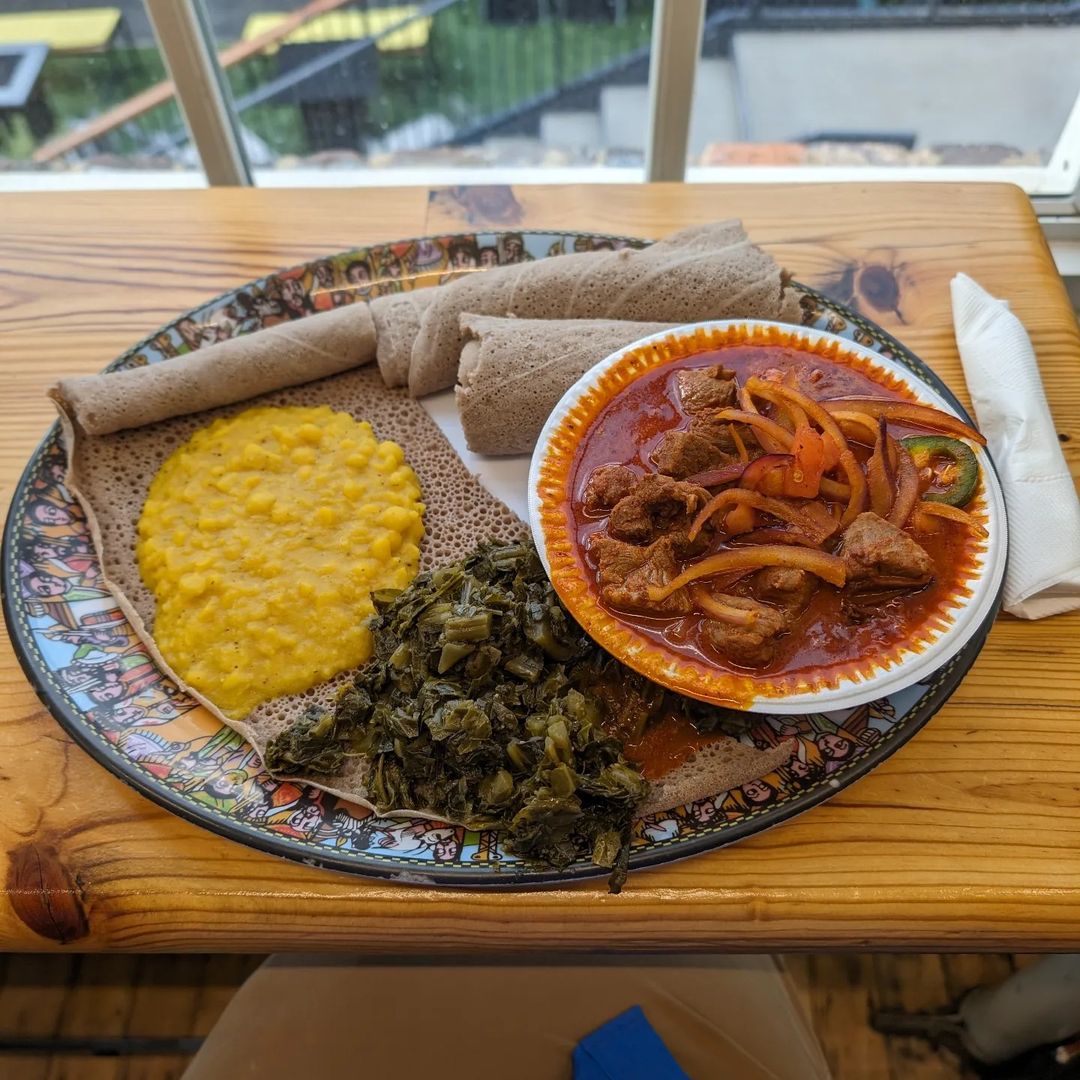
Enter in the delicious Ethiopian food I picked up the other day. Waiting for it to be ready, I recognized the person who walked by me. I called out her name! The person turned around! Sure enough, my old physics buddy is now a Crime Scene Investigator in Charlotte, NC. We made plans to get lunch and, yesterday, we did so!

Remember this? I sure do…

The conversation we had touched on many things. Catching up with the past five or six years, sharing stories of what happened back in college, and – of course – lengthy explanations of the United Methodist Church and its multi-layered polity. One takeaway, however, was the power of words.

We often speak without thought. We do not think about what our words will mean to the person we are speaking too. Scripture describes thoughtless speech as being like, “shooting flaming firebrands and arrows,” (Prov. 26:18-19,) and as an all-consuming fire that burns everything in its path. (James 3: 5-12)

Thoughtful words, however, can bring life, and life abundant. If you close your eyes, I bet you can think of something someone said to you, something kind, even if it was decades ago. Those little bits of encouragement and assurance keep us moving in a life that can often seem overwhelming.

For me, I remember the first time someone told me I had a future in ministry, the kind words that carried me through many years of doubt. I remember friends praying over me in Youth Group a long time ago, when I was offering a message. I remember the little signs of kindness – a bookmark made by hand, help picking things up I had dropped and abandoned, a joke in the midst of a rough day – all these things build us up into who we are today.

I also remember my failings. Especially in college, I made many mistakes with careless words. I said things that hurt people, I broke off friendships that were dear to me because of pressure from other people in my life. I failed again and again and again. Though I’m certain most people have forgotten my indiscretions, I know not everyone will have. Something I’ve said has almost certainly affected someone negatively to this day, a barb sticking into their memory of what once was a goodly thing.

However, I was told in our lunch meeting that there were enduring things, things I said that lingered with people for good. In particular, I was reminded of a way I used to talk about personalities and relationship dynamics that changed how my friend understood herself. As was apt for my undergraduate work, these words were a metaphor from chemistry. The truth is, the way we see ourselves in relationship with others is a lot like how carbonyl groups react… (Pause for dramatic ooohs and aaaahs.)

The essence of my teaching was simple – some people need greater support than others, but all people seek stability in life. Some people, like acidic halogens, do not do well on their own, and so do their best to stay in constant contact with others. Some people, like amides, are in relationships that allow them to stably exist in the midst of others or alone. The average person, like an organic acid, is neither prone to being alone or to being surrounded by others, they find equilibrium. However, there is another group – the ketone – that stands on their own, seeking only to be with those who prove themselves as worth the social energy.

The groups in question, labeled

I would describe my friend, frequently, as a ketone. She did not need constant socialization, but chose to be around those who were willing to put in the time to be a part of her life. She was a ketone, proud and strong, and she kept using this identification in her post-graduate life. She told me she would frequently tell people she had just started to get to know, “I’m a ketone!” Simple, esoteric, but to the point. As she told this story, she adjusted the sleeve of her shirt and showed me a tattoo on her shoulder… A ketone, a permanent mark of how she had chosen to see herself, and a term that I gave her through our friendship to describe herself.

Acetone, the Ketone tattooed on her shoulder.

I was shocked in the best possible way. I had impacted her life by giving support, being a friend worthy of being a part of her social circle. I spoke a kind word, affirming her personal strength and stability. Now that is part of her, quite literally a part of her, and it is something I had forgotten I had ever said.

Our words matter – the harmful things we choose to say and the encouraging things we choose to say. We have life or death at the tips of our fingers and on the tip of our tongues. Think before you speak, speak life into this parched world. You never know when you may be humbled to find that the words you have spoken to those in your life became the foundation of something deeply, personally important to them. Let our words speak life and let that life transform them into the most excellent manifestation of their truest self.

Day 8 – Periklesis

It is always a blessing as a minister to be able to sit at a service. I did not have to lead today as I sat with the people of First United Methodist Church, Charlotte.  I was overjoyed throughout the service to find that, beyond not having to lead, I was also just enjoying myself. Going through life, we often find ourselves lost in what we are doing, but the reality is that we are in need as much as anyone who we seek to serve.

Today I heard a message that called many things into question, not in terms of cynicism, but in terms of Hope. When we look at the story of Philip and the Ethiopian eunuch, we will look at the fact that the eunuch is not part of the people of Israel and see how the church was expanded by his presence. Today, Bishop Cedric Bridgeforth told us that there are many people who our actions in the church has disenfranchised, as he called it castrated. We were all called to reflect on the fact that we are not just people witnessing oppression but people actively participating in it.

One of the ongoing elephants in the room regarding this General Conference is the upcoming conversations regarding human sexuality. Though this is not a blog that is intended to cover events of general conference, I come to a point where I have to say something about what transpires in a given day. As I sat in a reconciling congregation, a congregation that has taken the leap into accepting queer folk fully, my mind naturally settles in the reality of what is ahead of us.

There was a time in my life where the idea of a Reconciling Congregation would have seemed completely alien. It would be almost contradictory to say that LGBT people have a place in the church other than one of repentance. But that is not the John Langenstein who lives today. I have seen too many people that were written off by the church, but through whom the Spirit moved. Too many people who /I/ once wrote off as too far away from the fold of the faith to have a part in it.

I cannot help but make explicit what is implied. I am somebody who looks for the day where the church fully embraces all people regardless of human sexuality, regardless of their gender identity, regardless of anything, except for the three things we put forward and our Eucharistic Invitation.

Do you seek to live at peace with one another? Do you love the Lord Jesus Christ? Do you earnestly repent of your sins?

Those are the only things that truly matter. The Lord has shown to me, again and again, that whether people are gay, or bisexual, or trans, non-binary, cis – whatever they may be – God is working within them. It is not within my job as a minister, as a person, as anything, to question the calling that God puts upon their heart.

I strive to do what is best for all people and all things. The fact is that, that purpose – this charge to do something that is right – requires me to take a stance from now and again. My stance is always towards the inclusion of more people, the love of more people, and the transformative gospel that makes us able to become the body of Christ, regardless of our material composition.

In Charlotte this week, there has been differences of opinion and in the coming week as we debate human sexuality, we will have a great many people with a great many opinions. However, I am earnest in my belief that we are a Church that goes beyond our petty squabbles. I see in the many different things we disagree about, something greater. While we may disagree on the cultural context of Paul’s teachings regarding human sexuality and while we may disagree on how they manifest in our daily life today, I hope that we all agree on a few core things:

Jesus Christ, our Lord and Savior, was God incarnate – fully God and fully man. God our savior lived among us. He did the good work of loving us who refused at times to love him. For the sin of loving all whom he met, Christ was killed on a Roman cross on an offence to all people who draw breath. This same Lord rose from the dead three days later and the same Lord advocates for us through the Holy Spirit and to our Holy Father.

If we as Christians can agree in the death, life and resurrection of Christ, why can’t we disagree on the smaller matters?

The first draft of this that I am writing is me speaking into a phone while I wait to meet with an old friend outside of a bakery (more on that tomorrow…) In this moment I felt the need to get my initial thoughts out.

Today, I heard a bishop speak to me about call and about the need to follow that call, wherever it goes. It would be wrong of me to deny that my call is towards a more inclusive church. A Church that includes dissenting voices and a Church that includes people no matter how they find themselves expressing who they are. The Church is broad enough to include all people. If it is not then it is useless. For I believe in a God who said that neither height nor depth nor length nor width nor life nor death, nor anything in heaven or Earth can get between us and the love of God. If I believe in such a God, it would be folly for me to deny that he has a place for all people.

May the Lord bless us in the midst of difference to advocate for justice. As has already been declared by the general conference of the United Methodist Church in the year of our Lord 2024 – All people are worthy of human and civil rights. As we go, it’ll be farther than we have ever been and yet Lord, I pray that we will see greater inclusion in the coming days.

For those who read this and disagree or are shocked to hear me speak so frankly, I simply ask you to think of what you know me by. You can read through every sermon that is posted on this blog and see I’m as Orthodox as they come, at least as Orthodox as I can be.

Disagree with me. Be willing to speak with me, even to argue with me… but let us continue to love one another as we have up to this point.

May God be with us this week. May God’s will be done in all that we do, in what legislation is passed. Let us remember that God values all people and that we as human beings are the only ones that seem to confused how exactly that manifests.

Day 7 – Koinonia

Opening Worship was magnificent today.

Scheduling demands that we in the Press room have to step out during part of the service for a press briefing. Usually it is just a five to ten minute talk to see what UM News is covering and if any of the Communicators present have anything to share with each other or the wider Church. As we were there, either during or immediately after we prayed, a chant was heard from on stage… What was said in that chant? I don’t know. Yet the music of the sung prayer was hauntingly beautiful. It filled the space. I was ready to hear more when I came back to my seat.

I would also lift up the whole of our sermon this morning. Bishop Eben Nhiwatiwa gave a message full of joy and hope and humor that speaks to the peculiarity of this significantly more genial conference we all have been taking part in. As he said, “I must be at the wrong General Conference!” None of us were prepared for how good we all feel walking and talking and living and serving together. (Sermon begins at 24 minutes into the stream.)

This is the last day that legislative committees meet to discuss the legislation before the body. The final amendments and edits to the petitions are coming together and the work of next week is being scheduled with each report that comes out of the committees. Today we passed the Social Principles contained in Paragraphs 164 and 165 of the Discipline. They attest to several important things, but most of all they attest to the rights of all people who walk this earth with explicit language. No people can be denied their civil and human rights, and we in the UMC made a big step toward affirming these innate rights in all people.

Coincidentally, this was also the day that I was photographing the communion service being held during lunch. Communion is my favorite ritual in the Church. Baptism may represent our new birth, but it is in Communion that we are given the energy to continue on in our new life. Bread and Wine (Unfermented or otherwise,) are blessed and it becomes for us the presence of Christ, the visible reality of his sacrifice for us. We share in that emblem of suffering and in it find life.

In West Virginia our Bishop, Sandra Steiner Ball, is overseeing the Susquehanna Annual Conference jointly with Bishop Cynthia Moore-Koikoi of the Western Pennsylvania Annual Conference. In partnership with our colleagues there, we decided we would help with story and photo coverage. The Church is relational in every aspect and so we have to strive to give tangible support to each other whenever we can. Also, it is just nice to be nice – sometimes you do not need a grand reason for it.

Bishops Cynthia Moore-Koikoi and Sandra Steiner Ball

A goodly amount of people were gathered in that hallway, (afull article with all more specific details will be posted later and I will share it when it is available.) It was a moment of peace in the midst of the busy rush of conference.

This year has been defined by a Spirit of peace and joy and celebration and I pray that this will continue to be our Spirit. Even a peaceful gathering is taxing on people though. You get tired and uncomfortable, you get the strange crud that everyone seems to be passing around right now. You just get worn down, little by little.

Enter the Eucharist, a small moment of Sabbath in the midst of the world and its constant demands for more and more of us. We receive the simple gifts of bread and of the vine and they become so much more for us. Visible signs of God’s grace, tangible to the point you can taste them.

Holy, holy, holy Lord – we praise you because you come near to us in this blessed sacrament, this holy mystery. Let the Spirit of Joy and of Peace carry us through next week as well.

Day 6 – Peripateo

I’ve done a lot of walking this week. From one end of the convention center to the other, to the train station, to the Airbnb, to the food mall (yes, that’s a thing and it is wonderful.) I’ve been averaging several miles a day alongside the notetaking, the video editing, and the staring at the conference session from the News Room… Somehow, I’ve felt more energized than I have in a long time in the midst of all that.

Food…
… Mall

As Christians, we believe that God dwells within us at all times, but to feel it fully we must be aware. Awareness requires activity and activity requires a goal – at least to do more than twiddle our thumbs. The Word of God is described in scripture as alive and active, sharper than any double edged sword. (Heb. 4:12.) This Word is not just scripture, but the source of life itself – Jesus Christ, the Incarnate Word. Incarnation, living, moving toward a goal – these are all actions the Spirit embodies through us.

Today’s session of the Conference had very little to it in terms of business. We had a few things to approve – mostly procedural – but the floor and the people were still active. The band which led us in opening worship was one of the best I’ve ever heard (I highly recommend watching this morning’s service even if you watch nothing else.) Tomorrow will be full from sunup to sundown, but today people had room to move around, even while doing legislative committees. In that movement there has been the opportunity to discover purpose. This, and of course, time to walk.

Many people in the Press Room where I have been living this week, are doing work here for the first time. Regardless of previous experience in Communications or Methodism, many of us have not covered a General Conference and have not spent much time together in the same room. That is rapidly changing. I find myself learning names (an accomplishment considering how forgetful I am,) and walking around to ask specific questions of people that I know, know better than me.

Annual Conferences are collaborating on projects and sharing resources where they can. Our own West Virginia Conference is working tightly with Western Pennsylvania, making sure we are doing all we can to tell the story of what God is doing at General Conference. Wandering around Charlotte and around the Convention Center, God is making sure people meet and seeing that those meetings are not just social exchanges.

My writing partner throughout this week has been the magnificent Audrey Stanton-Smith, Editor of the United Women in Faith’s Response Magazine. She attributed the success we have had in writing for Conference to “meeting the right people at the right time.” I have to agree. This has defined not only the work of covering Conference, but Conference itself.

Experts are all around me. For this I am blessed. Surprises are all around, like seeing an old friend from College at a restaurant just up the way. For this I am blessed. Stories are shared, laughter is heard, and hijinks ensue. For this. I. am. blessed.

We walk together in life. That is the substance of what I have to say today. We are never alone and life is so much better when we spend time intentionally living it together.

Day 5 – Oikos

I wrote a draft of this story that went down all kinds of rabbit holes. Weighing aspects of connectionality and what regionalization might mean in my context and beyond…

It was a horrible piece of writing. Principally it was bad because it betrayed the purpose of these letters. I am looking for beauty and the way that God is showing up at conference. While that certainly includes the plenary sessions… The legislation itself is just a tool and the session with it. The Spirit moves through them, but the Spirit is not contained there. I hope the difference is clear.

I have seen more prayer today than any other day – not to imply a lack of prayer anywhere else – but to testify to the amount of it today. People are worshipping and advocating and being the Church. Today that meant talking about regionalization. It also meant saying goodbye to the Eurasian Conference. Russia, the Ukraine, Belarus, and Khazakstan… All no longer part of the United Methodist Connection. Yet, sent off with love and prayer and on good terms with the body.

I think the thing we lost in the last few decades (lets be honest since 1968,) has been the reality that we are all supposed to be working for the good of one another. We say that is our goal, but we are all guilty of putting ourselves first, and not just occasionly. Particularly in the UMC, the US has always been at the center of everything – we cannot be that any longer. We are not the fulcrum on which the whole world must pivot, we are a part of a much larger whole.

I am frustrated at times with our treatment of conferences outside the US. We tend to treat international members allies or enemies as frequently as we treat them as family. A central conference member that supports traditionalist ideas is lauded by that camp and a central conference member who supports the progressive causes is lauded by another, and to a certain extent that is natural – we like people who agree with us! Yet we often find ourselves promoting the voices of those who are politically useful to us and ignoring others. If I have an enemy in another conference they may be lifted up to become a target and if I have an ally they may be lifted up to become an object in my arsenal – but if I do not see them as a person and a sibling in Christ all is lost.

Throughout the last extended quadrennium, Africa especially has been a chesspiece in a lot of discourse about the UMC. They are not partners in ministries and peoples made in the image of God, but polictio-theological ideas to be supported or opposed. When we dehumanize others, however we do so, we break something deep seated in both our humanities.

During the United Methodist Association of Communicators meeting, I was introduced to the social media of the South African Central Conference. I do not follow it religiously, but I do take time to go there now and again to see what is happening there. Church, it happens, is happening there. The people of God are gathered together and proclaiming salvation, serving one another in a Spirit of love, and striving toward perfection as only Methodists have the language to fully name.

Our collaboration with other conferences, with other people, even with our immediate neighbors, is not always done with complete agreement on important issues. Yet, if all people are genuinely seeking to do good, a way forward will present itself. It requires repentance, it requires self-reflection, and sometimes an acknowledgment of the frustratingly long arc toward justice… but it can be done.

The choir sings at morning worship in Charlotte. – Photo by Paul Jeffrey/UM News.

Regionalization will make it easier to be a global church, but we must not forget our international siblings or our immediate family in the midst these changes. We will still need to move beyond seeing others as political entities and not human beings.

As discussion of the constitutional amendment regarding regionalization came to a close, someone described our Church with a greek word – “oikos.” I have stolen that for the title of this entry. Oikos means “household,” or “dwelling place.” The word hit me as being apt for what the United Methodist Church is to me and many others. This is where we find ourselves fulfilled, where we are made into a family together. Home is the best word to describe what the UMC is.

We care and we fight and we fuss because it is our home. I would hope that as legislation continues to be discussed and as we continue to strive to work togehter for the good of all people, we do so as a family. I hope we come to embrace all members of that family – not ignoring any part because of who they are or where they are, but in all things regarding others as more significant than ourselves. Hopefully other parts of this conference’s work will establish the full extent of our call to love others in official writings and doctrine, but we will have to see…

I realize as I sit here, that I could never leave the United Methodist Church. Not just because I have no desire to, but because it is the place my heart has found rest. If home is where the heart is, I can never leave home. In the same way that I feel an overwhelming desire to be back among mountains and my own four walls and surrounded by cats and by my wife… I would always long for this Church if ever I tried ot leave it.

You know… like in Chess.

Day 3 – Epiclesis

The conference has begun properly. With song and with sacrament we have declared Charlotte to be a place where the Spirit is going to move and the Church is going to act. It is a day of celebration, of reflection, and of collaboration across every aspect of our connectional lives. I have seen so many people and talked to a significantly smaller number of them, but in my few interactions it has been clear that God has created an amazingly diverse body of people within the United Methodist Church. In the News Room, I sit just a little ways away from communicators for French, German, Korean and Portugese language publications. All around me are people from all backgrounds and locales around the world.

Outside the plenary hall, there are two things I have seen again and again. The first is between people on all levels of church leadership. One person sees another, a shout is raised over the crowd, and hugs immediately follow. So many people are seeing old colleagues and friends they may not have seen in decades, and yet we are brought together here. I myself have seen old seminary friends, Communicators I’d met previously at UMAC, and people tied to work I’ve done before I entered into pastoral ministry. Every day I’ve learned more and more people I know are here… and I really do not know that many people. The nature of our work demands that we stay in contact and we cannot resist that call.

The second sign is like it. One person sees a group of Bishops from across the room. They cry out, “Bishop!” and, more often than not, the bishop who turns around is their bishop. It isn’t magic, it isn’t 100%. However, I am made to remember the words of Christ. “My sheep know my voice…” Perhaps the other side of this is equally true, “A shepherd knows their sheep.” I am thankful for attentive bishops who know the sheep they shepherd.

Today has been busier, so I do not have quite as many reflections on the nature of life or a good bowl of curry. Still, in the midst of reading through legislation and typing drafts of articles, my mind is wrapping itself around the meaning of this gathering.

With the official start of the General Conference, the eyes of the world turn toward Charlotte. A consistent prayer is carried from the lips of onlookers, “Thy will be done.” This is among the most dangerous prayers we can pray, asking us to abandon what we want in favor of what Christ would have us do. It is a prayer we often pray. Yet, it is a prayer we seldom say in earnest.

“Thy will be done,” is usually a thing we say to mean, “God, you and I are simpatico, so let’s get this over with.” It is a far cry from what the words should actually mean. Even Christ, praying in the Garden, prayed “Thy will be done,” with the hope that God would relent from the price that was about to be paid. We pray “Thy will be done,” hoping that it will result in God bringing about what we wish to see… We seldom pray it and accept what comes as God working out God’s will on Earth. We are different from Christ in this.

We know something about God or else we would have no faith. We guide our life by principles we believe align with God, so why would we not have hopes of what is to come and believe that God will bring them about? Yet, if we believe in the prayer, “Thy will be done,” we have to be willing to accept that sometimes that means things will turn out differently.

When prayed in 2019 many of us were disappointed that the Traditionalist Plan passed. When it is prayed this year, if more progressive legislation passes, still others will be disappointed. Yet, what do we do, as people who believe God is active in the world? Do we think that only one outcome will be the will of God? Neither? Both? I do not rightly know, but I’m thinking about it this week.

We believe as United Methodists that God allows us to choose our own way through this life. Our salvation is not chosen for us and neither is our conduct. A saved person can sin and the unsaved can do right, God’s grace and liberty allow for both to be true. Institutions can likewise sin and can do what it is right. Simply because something passes at conference does not mean that it is good, just because it fails does not mean it was not good.

I have many opinions about things. I would say one of the most obvious things about me to those who know me is my ability to form opinions about things. It is a blessing and it is a curse. Yet, I believe firmly that as a Christian, a Methodist, and a Minister, we need to have cogent theological arguments for what we believe. That is why I am frustrated when I say, I have no ability to know what I am really asking when I say, “Thy will be done.”

We all strive to know God’s will, but until we see it erupt from the wellspring of the Spirit, we cannot truly discern it. We all strive to know God’s will, but the world has seen so much horror and sadness I cannot take every event in history to simply be, “The will of God.” We all strive to know God’s will, but I cannot imagine God would will any person be excluded from the family of God, simply for who they are. And yet… And yet… And yet…

Bishop Thomas Bickerton, the president of the Council of Bishops and West Virginia Native (woot woot!) preached during opening worship. His words were firm, they were beautiful, and they captured something of my own feelings as I sit here awaiting these two weeks. He introduced a practice of praying before each sermon he gives, “Oh God, remove me from me, and fill me with you.”

Before I sat down to write this I thought I would call this letter, “Kenosis,” a Greek word meaning “To empty.” It is used in Philippians to describe Christ taking on human form. However, the focus of the Bishop’s prayer is not the emptying, so much as the filling. Yes, we empty ourselves of our own desires – but if that were it we would be left as empty people. Instead, we empty ourselves with a purpose. We empty ourselves so that we can be filled with the Spirit. We ask God’s spirit to rest upon us, for an “Epiclesis,” not just to hollow us out in “Kenosis.”

When we pray, “Thy will be done,” we are doing something similar. We are asking the Spirit to come down and dwell within us. To guide us. To stop us or usher us forward. Yet, proud people that we are, we often keep running in the same direction no matter what.

I know what I want out of General Conference. I know what people who disagree with me want out of General Conference. Are we willing to accept that God’s desires might encompass those, go beyond them, or even contradict them… I will try and understand God’s will whether I get what I want or not. All I can do is ask for God to fill me with the Spirit, and follow that Spirit wherever it may lead me.