Lord over Death – 08/21/2022

John 19: 19-29

When it was evening on that day, the first day of the week, and the doors were locked where the disciples were, for fear of the Jews, Jesus came and stood among them and said, “Peace be with you.” After he said this, he showed them his hands and his side. Then the disciples rejoiced when they saw the Lord. Jesus said to them again, “Peace be with you. As the Father has sent me, so I send you.” When he had said this, he breathed on them and said to them, “Receive the Holy Spirit. If you forgive the sins of any, they are forgiven them; if you retain the sins of any, they are retained.”

But Thomas (who was called the Twin), one of the twelve, was not with them when Jesus came. So the other disciples told him, “We have seen the Lord.” But he said to them, “Unless I see the mark of the nails in his hands and put my finger in the mark of the nails and my hand in his side, I will not believe.”

A week later his disciples were again in the house, and Thomas was with them. Although the doors were shut, Jesus came and stood among them and said, “Peace be with you.” Then he said to Thomas, “Put your finger here and see my hands. Reach out your hand and put it in my side. Do not doubt but believe.” Thomas answered him, “My Lord and my God!” Jesus said to him, “Have you believed because you have seen me? Blessed are those who have not seen and yet have come to believe.”

1 Corinthians 15:35-49

          But someone will ask, “How are the dead raised? With what kind of body do they come?” Fool! What you sow does not come to life unless it dies. And as for what you sow, you do not sow the body that is to be but a bare seed, perhaps of wheat or of some other grain. But God gives it a body as he has chosen and to each kind of seed its own body. Not all flesh is alike, but there is one flesh for humans, another for animals, another for birds, and another for fish. There are both heavenly bodies and earthly bodies, but the glory of the heavenly is one thing, and that of the earthly is another. There is one glory of the sun and another glory of the moon and another glory of the stars; indeed, star differs from star in glory.

So it is with the resurrection of the dead. What is sown is perishable; what is raised is imperishable. It is sown in dishonor; it is raised in glory. It is sown in weakness; it is raised in power. It is sown a physical body; it is raised a spiritual body. If there is a physical body, there is also a spiritual body. Thus it is written, “The first man, Adam, became a living being”; the last Adam became a life-giving spirit. But it is not the spiritual that is first but the physical and then the spiritual. The first man was from the earth, made of dust; the second man is from heaven. As one of dust, so are those who are of the dust, and as one of heaven, so are those who are of heaven. Just as we have borne the image of the one of dust, we will also bear the image of the one of heaven.

Sermon Text

We all die. That is something as obvious to us as our own birth. We do not often make it far into life without experiencing death. Whether it is of a family member, a friend, an animal, or even an over watered plant, we have to face the fact of our limited lifespan at some time or another. We are some of the longest lived creatures on earth, with only turtles and a few marine creatures beating out our seventy some years of life. Yet, the slow degradation of our withering bones makes us face the end eventually. A final breath on one side of eternity bringing us into the other.

I was asked two questions about death that both tie into the scriptures we read a moment ago. The first question was, “What should we think about cremation?” and “What does the Bible actually say about reunions in Heaven?” I’ve changed the wording slightly for both of those but the substance is the same. As people who believe in bodily resurrection, how we treat our body after death is important. As people who believe in life after death, how and if we meet our loved ones in the hereafter is likewise on the forefront of our minds. The answer is found, not in any one sentence, but in a few places we can look at to get a good idea of things.

First, we can address the physical resurrection of the dead as an answer to cremation. Jesus shows us in his resurrection that body we live and die in is the body we carry into the next life. When Jesus goes to the disciples, he is definitely changed by having died and been raised back into life, but he is still the same Jesus. His hands still bear the scars of the nails that pierced him, his side still bore the marks of a spear that stabbed him. Jesus who died was Jesus who was raised, not just an imitation or spiritual facsimile.

This tells us that there is continuity between the state of the body at death and the resurrected body. This has led to a deep respect in Christian communities for bodily preservation. Like their Jewish siblings before them, Christians balked the Roman practice of cremation in exchange for bodily burial. The desire was to keep the body whole in expectation of its eventual resurrection. This was not because God would not be able to revivify a cremated person, but was an acknowledgement that God would someday raise the dead back into life.

I still think that there is something to preserving the body in death, but I am also an organ donor, so I know that the hospital will relieve me of several parts of my body ahead of any kind of burial I get. The respect for the sanctity of the human life is not something that means only those buried in a certain way with certain amounts of their body intact get to know the resurrection of the dead. Several saints were burned alive, beheaded, or generally mutilated in the process of dying. I find it hard to believe that they are locked out for that.

The fact is, if God can do the incredibly hard work of revivifying the dead, I do not see God having a problem resurrecting anyone no matter how their body is interred. I know there are programs now to have our bodies turned to compost, into diamonds, and into a nitrogenated slurry. What is important in death and in care of the dead, is that however we are interred it is done with respect for the life of the one who is being interred. For myself, I hope for a natural burial in a pine box. I do not want a vault, a casket, or any of that fancy stuff. Just something simple for me to return to the dust in.

For the Christian, Christ’s victory over death means that we honor those who die however we can. That is why we keep our graveyards and mausoleums well kept and preserve the names of the dead. Not that this is a uniquely Christian impulse, but it is something we have long honored. So, to answer our first question of the day – is cremation a thing we as a Church can support? Definitely.

The second question of the day is how we will recognize one another in the age to come. Paul is clear in our scripture that our resurrection is like that of Christ’s, and so anything we know about the resurrection we have to take from him and a few of his teachings. Jesus was recognizable to his disciples, but usually only after some event triggered their memory. For the disciples on Emmaus it was the breaking of bread, for the twelve it was the giving of peace and the catching of fish. Jesus was changed enough that it took some time to recognize him, but he was still very much Jesus.

Jesus carried with him the memories of his disciples, his love for them, the individual relationships he had with them. Jesus showed us that relationships went beyond the pall of death and into the eternity of God’s resurrection. In other words, there is a future we will have together in Heaven. There are some caveats to that though. Jesus is clear, for example, that marriage ends in death. We specifically have in our vows, “till death do us part,” because someday we will find ourselves cut off from our beloved and separated. Christ tells us that that separation makes us, no longer spouses, but fellow members of God’s eternal family.

Now, as I said we still retain our memories and life experiences and relationships. Therefore, I echo the sentiment of a liturgics professor I had once, who said, “In Heaven we are as angels, who do not marry, but I’m saving a seat for my husband right beside me even still!” Our relationships are transformed in resurrection, but they can never be erased. However, that works I am not worried, because I know I’ll be around those I love one way or another.

Heaven will, all the same, be populated with a countless multitude of people. We will be with saints from all time and space and from places we have never even heard of. All languages will be represented, all cultures, a diversity and numerousness we cannot begin to imagine. That means that we will not be in a room only of people we know, the whole of the New Jerusalem, of the new Heaven and Earth, will be opened up to us.

That means that the image of an immediate or organized reunion on the other side of this life is never mentioned in scripture. There is no singular, definite description of the saints we know sitting down together on the other side of this life. Yet, it seems impossible to me that God would keep people apart, or that in all of eternity we would not find one another again. If we want to give a quick and easy answer about how the Bible talks about what we will do, “When we all get to Heaven,” we will not find it. Yet a few things are clear.

God brings the dead to life, and God will have us all together in the new creation one day. This new life will include one another as a communion like what we know on Earth, albeit somewhat altered. We retain our personality in this new life, and given infinite time, it would be impossible to think we will not see each other again. Is there a welcoming committee in paradise of all our loved ones? I cannot say, but I know they are waiting for us, praying for us, and we will one day feast at the same table as them once more. That, in itself, is enough for me. – Amen.

The Details of the Devil – 08/14/2022

Genesis 3: 1-7

Now the serpent was more crafty than any other wild animal that the Lord God had made. He said to the woman, “Did God say, ‘You shall not eat from any tree in the garden’?” The woman said to the serpent, “We may eat of the fruit of the trees in the garden, but God said, ‘You shall not eat of the fruit of the tree that is in the middle of the garden, nor shall you touch it, or you shall die.’ ” But the serpent said to the woman, “You will not die, for God knows that when you eat of it your eyes will be opened, and you will be like God, knowing good and evil.” So when the woman saw that the tree was good for food and that it was a delight to the eyes and that the tree was to be desired to make one wise, she took of its fruit and ate, and she also gave some to her husband, who was with her, and he ate. Then the eyes of both were opened, and they knew that they were naked, and they sewed fig leaves together and made loincloths for themselves.

Job 1: 6-12

            One day the heavenly beings came to present themselves before the Lord, and the accuser (Ha Satan,) also came among them. The Lord said to the accuser, “Where have you come from?” The accuser answered the Lord, “From going to and fro on the earth and from walking up and down on it.” The Lord said to the accuser, “Have you considered my servant Job? There is no one like him on the earth, a blameless and upright man who fears God and turns away from evil.” Then the accuser answered the Lord, “Does Job fear God for nothing? Have you not put a fence around him and his house and all that he has, on every side? You have blessed the work of his hands, and his possessions have increased in the land. But stretch out your hand now, and touch all that he has, and he will curse you to your face.” The Lord said to the accuser, “Very well, all that he has is in your power; only do not stretch out your hand against him!” So the accuser went out from the presence of the Lord.

Mark 1: 12-13

          And the Spirit immediately drove [Jesus] out into the wilderness. He was in the wilderness forty days, tested by Satan, and he was with the wild beasts, and the angels waited on him.

Sermon Text

The Devil. Of all things I could talk about from the pulpit, Demonology is probably the one that can potentially rile the most feathers. We all have our way that we see evil in the universe, and many of us have strong feelings about just what kind of threat the Devil is in our life. Many of you will have lived through the Satanic Panic of the 1970s and ‘80s, in which just about everything was seen as a potential entryway for Satan into the hearts of humanity. Whether it was rock music, back masked metal albums, or horror films, there was an expectation of a war for the souls of humanity – waged in culture and in the Heavenly realms.

Yet, that image of a Devil who is secretly running the show is something largely alien to scripture. We have built a powerful image of Satan up in our minds and so we see him as much more than scripture has shown to us. The Devil is in the Details, and today we look at the Details of the Devil, as we plumb the depths of the Bible and beyond to see what we can make of the Father of Lies and Prince of the Spirits of the Air.

Firstly, we have to establish just how foundational our misunderstandings of the Devil are. Our first scripture was from Genesis, which is where most people see the Devil as rearing his ugly head. Yet, if you read the scripture and take it at its word, this snake is only a “beast of the field.” This is no devil, this is just a serpent that took issue with God’s limitations of human life. I’ll go further to say that no canonical book of scripture sees this snake as the Devil. There is one mention of Satan bringing death to the world in Ecclesiasticus, a book which we do not have in our Protestant Bibles. 1 Enoch says a different being named Gader’el took the form of the snake in the Garden. Even Revelation, which describes the Devil as an “Ancient Serpent,” uses a word (οφις/δρακων) which just as easily means dragon as it does literal snake. I say all this to point out, most of what we say about the Devil is not something God has told us, but something we have told ourselves.

The Devil next occurs, if we are looking just at page order, when David conducts a census in Israel and courts the wrath of God. The Chronicler says that Satan tempted David to do this, but it is interesting to note that 2 Samuel places the inspiration for the Census in God’s hands. Making God the architect of David’s own punishment. This vision of Satan as tempter shows up in his only other Old Testament appearance. In the book of Job, “Ha Satan,” the Adversary, is a member of God’s court. He serves as the inquisitor who walks the earth and tests humanity on behalf of God. For the pre-exilic community it seems that that is how they saw the Devil. God’s employee, a member of the Heavenly courts, but not as some grand evil working against humanity.

This view emerges in the post-exilic Jewish world. When God’s people are in Babylon they run into new religions that ask questions about where Evil comes from and how it is combatted. Judaism develops in diaspora alongside religions like Zoroastrianism and the various apocalyptic cults that emerge in the latter parts of the first millennium BCE. They all need to explain how trouble entered the world, and what God was fighting against, and so this sharing of religious language produces a new conception of evil. Personified evil begins to be a way to understand trouble, and this figure of personable evil is given many names. The most enduring in our minds are Satan – plucked straight from scripture “The adversary,” – and the Devil – a derivation of the Greek for “accuser.”

By the time the New Testament was written the Devil was seen as the source of all evil. Even in texts that make no attempt to place the Devil in Eden, this evil force is at least supportive of Adam’s sin against God. Enoch imagines a long list of demons that helped humanity found civilization, gifting them metal working and farming technology before finding themselves cast into Hell, leaving behind the spirits of their Nephilim children to haunt humanity.

It would be easy at this point, maybe even convenient, to suggest that the Devil was just an idea to explain how evil found its way into the world. That cannot be the case though, because as our Gospel passage explains, Jesus ran into the Devil. Revelation describes conflict with these Spiritual entities and Jesus frequently runs into people with demonic influences of one kind or another. To say that a person of faith can just wave off demons as a relic of the past is to put at risk a lot of our more spiritual beliefs. The truth is, even if the Devil and our understanding of it have changed over time, there is a reality to this personification of all things wicked. The problem comes that we take what scripture tells us, and we rewrite it to be more compelling.

The image of the Devil as a fallen angel, tragic in some ways, is something that comes from sources outside the Bible. Jude does describe the Devil and “his angels,” as being wrapped in chains awaiting Judgement, but that is borrowed from Enoch and its exact meaning is unclear. Revelation likewise describes a third of the stars falling from the sky when a tail swipes across the heavens, but nowhere in the Bible is there a description of a great angelic rebellion. This comes later as people take those different pieces of scripture and make them tell a single story.

Even our most popular name for the Devil, “Lucifer,” comes from us mixing our scriptural stories. Isaiah 14 begins, “You will take up this taunt against the King of Babylon,” and continues on later, “How you are fallen from heaven, O Morning Star, son of Dawn! How you are cut down to the ground, you who laid the nations low!” This title, “Morning Star,” became “ἑωσφόρος” (heosphoros,) in Greek and then “Lucifer” in Latin. The title became a name and the association with Nebuchadnezzar shifted to an association with the Devil. Dante would immortalize this connection in his Divine Comedy and John Milton would make it a solid part of the English literary and cultural canon when he wrote Paradise Lost.

Much of what we make of the Devil comes from the culture around us. We imagine hooves and pitchforks because that is what different societies over time gave to the Devil. The Devil could look like any other person for all we know, or like something completely inhuman. The vision of the Devil up till now in our discussion has been about the accidents of this being, not anything substantial to what he can and cannot do. So, let us cut to the chase, what impact does the Devil have on our daily life.

I would say, not much at all. Shocking I know, but I am not a man who lives in fear of the Devil. I do not think that if you watch horror movies a demon can sneak into your life, or that there are ways to accidentally align oneself with demonic entities. I would go further to say that there is no grand satanic conspiracy at work in the world – outside of the reality of sin and our capacity to participate in it. I believe that the devil has lost all power on this earth, and I believe that because of the cross of Calvary and the blood of Jesus Christ.

Paul describes us as having been freed from Sin and Death, and Satan’s only tool against us are those things. We cannot be compelled to sin by Satan, because we have been purchased for righteousness by Jesus Christ. Peter, in his epistle, describes the Devil as a lion waiting to pounce on our weakness, and I believe it, but I think we are not assailed by the Devil so much as by ourselves. We are not tempted except in the ways that Christ was tempted long ago, and like Christ, we are freed for freedom’s sake, to not give into the Devil.

The Devil, the old enemy of humanity, is a shadow to the Christian. The Light of Christ is sufficient to chase him away with a single word. There are not witches that can conjure him, nor demons lurking in the dark, nor any fear or oppression except what we take on ourselves. Fear not the darkness of the evil one, for we have a Lord in Jesus who has delivered us from all evil. – Amen

Why Does God Allow Illness? – 08/07/2022

Isaiah 45: 5-7 (NKJV)

I am the Lord, and there is no other; There is no God besides Me. I will gird you, though you have not known Me, that they may know from the rising of the sun to its setting That there is none besides Me. I am the Lord, and there is no other; I form the light and create darkness, I make peace and create calamity; I, the Lord, do all these things.’

Ecclesiastes 9: 11-12

Again I saw that under the sun the race is not to the swift, nor the battle to the strong, nor bread to the wise, nor riches to the intelligent, nor favor to the skillful; but time and chance happen to them all. For no one can anticipate the time of disaster. Like fish taken in a cruel net, and like birds caught in a snare, so mortals are snared at a time of calamity, when it suddenly falls upon them.

John 11: 1-6

Now a certain man was ill, Lazarus of Bethany, the village of Mary and her sister Martha. Mary was the one who anointed the Lord with perfume and wiped his feet with her hair; her brother Lazarus was ill. So the sisters sent a message to Jesus, “Lord, he whom you love is ill.” But when Jesus heard it, he said, “This illness does not lead to death; rather it is for God’s glory, so that the Son of God may be glorified through it.” Accordingly, though Jesus loved Martha and her sister and Lazarus, after having heard that Lazarus was ill, he stayed two days longer in the place where he was.

Philippians 2:5-11

Let the same mind be in you that was in Christ Jesus, who, though he was in the form of God, did not regard equality with God as something to be exploited, but emptied himself, taking the form of a slave, being born in human likeness. And being found in human form, he humbled himself and became obedient to the point of death—even death on a cross.

Therefore God also highly exalted him and gave him the name that is above every name, so that at the name of Jesus every knee should bend, in heaven and on earth and under the earth, and every tongue should confess that Jesus Christ is Lord, to the glory of God the Father.

Sermon Text

We begin another series on questions with a look at one of the most difficult questions I personally struggle with as a person of faith. Why does God allow disease, or more widely, why does God choose not to answer prayers when there is no reason for God not to want to help? Why do we not see people immediately healed of disease or injury when we lay hands on them? Why, in a word, is there suffering in a world with a good and infinite God?

I begin by saying that we do not have enough time to fully exhaust this question. There are people who have devoted their entire life to writing on this single question, and they have not come to a satisfying conclusion. We definitely are not going to come to a full examination of the problem of suffering in just the fifteen or twenty minutes we look at it today. However, I think we can start to understand the ways we can think about it and what each perspective can tell us about God.

The first perspective, one that I find completely unsatisfying, is the idea that Isaiah puts forward in our scripture for today. Isaiah wrote his prophecy at a time when a great deal of suffering was around him. Babylon had conquered and the people of God wanted answers. For some, the narrative coming out of Babylon that Nebuchadnezzar’s God had succeeded in conquering Israel’s God was compelling. Maybe the God of Abraham had been defeated, maybe they suffered because their divine patron was defeated or even worse, maybe that patron was dead.

Isaiah is clear that suffering is not the fault of some foreign divinity. There is no power in Heaven except for God. This means, from Isaiah’s perspective, that if anyone caused Judah to fall, it had to have been the God of Judah. In other words, God causes both the good and the bad in the universe. God heals the sick and also causes their sickness in the first place.

This idea is found a few places in scripture, but it is not a universe or undeniable truth. In modern belief, it is mostly a Calvinist idea that disease is caused by God directly. I have in my hand here a book that was sent to me, randomly, by John Piper’s ministry “Desiring God,” at the start of the Pandemic. In it, Piper alleges that while we cannot speculate as to what will happen during a pandemic, God controls it. Some people will get sick as punishment, some because God has allowed it to happen, and some for reasons no one can know. I don’t like this book. I do not think God sends disease to make us learn or suffer, and I think putting the full responsibility for suffering on God’s head, while reassuring to some, does nothing for me.

A second perspective in scripture as to why people suffer is found in Ecclesiastes, and it speaks to me as a more likely explanation of most trouble we face. The race of life is not to the best equipped person or the strongest or the kindest, but simply to how random chance positions us. I might not get sick from something that makes someone just like me sick. I might not hydroplane and crash a car while the vehicle next to me will. There does not have to be a deeper meaning to these bad events than that they happened. The problem with this, of course, is that it makes God a passive participant in history. If God is just sitting around seeing what happens, then what is the point?

A third perspective comes from John, where Jesus looks at the sickness and death of Lazarus as a means by which God’s glory can be shown to the world. This is similar to how John Piper presented things. God brings sickness and healing both as a testimony to how powerful God is on one hand and good God is on the other. I am not about to argue with Jesus, but I think that Lazarus specifically was an example of something happening so that God could show who Jesus was, and not so much that all suffering and death is just an example that God can use to show off. I don’t want a God who sees me as a chance to flex, I want a God who shows me love.

Now, those are three different perspectives, and I hope that each has shown you that there is no one answer that scripture gives about why there is suffering. More than just these, there are hundreds of stories that describe these conflicts in their own terms. Sometimes God is seen as being behind trouble, sometimes as being the remedy to something that nature or humanity has caused apart from God. Sometimes God highlights the moment as a chance to show the glory and love of Heaven and sometimes it seems to just be a thing that happened and that someone wrote down.

Job, having faced all the trouble in the world despite never doing anything to deserve it asked God hundreds of different ways why things happened the way they did. God looked down and showed Job that he was capable of taking care of things, not to worry, and even that did not satisfy Job. Job, like we often do, stopped questioning and started trusting, but he never says that he is satisfied with the lack of an answer. He repents of sack cloth and ashes, but not of questioning. In fact, God lifts Job up and says that he alone, among all those who speak throughout the book, honored God in questioning how a good God could allow so much trouble.

I’ll make things a bit more personally. My wife is chronically ill. Grace suffers from severe arthritis, persistent migraines, and a variety of other ailments that sometimes seem to have no end in sight and no obvious cause. She suffers so much pain and discomfort, so many nights of lost sleep and days of lost potential, and nothing seems to fix it. Treatment helps, but the thing about chronic illness is that there will never be a moment that it just gets fixed, where the trouble just disappears. I have prayed fervently for something to happen, asked for miracle after miracle. Still, she suffers pain, still she loses sleep, still I am left raging at a God who seems to be unwilling to move on behalf of someone so sick and so in pain.

I do not know why my prayers go unanswered. I do know, however, that God is not ignoring me. Beyond any abstract feeling of being heard, I know that God is on my side and by Grace’s side. Her pain is not ignored because God felt pain just like hers. I will be honest with you today and say that I can only continue on in my faith, only stand up and proclaim the Gospel like I do, because the questions and uncertainties, the various perspectives of pain that scripture express, are given something tangible and powerful in the person of Jesus Christ.

Our final scripture, from Philippians, is my favorite passage in the entire Bible. Here Paul recounts a hymn older than the New Testament itself. Jesus Christ, existent from the beginning and in very nature God, did not see fit to stay in the perfection of Heaven and the power of the Godhead. Instead, Christ took on human form and suffered with us. Christ felt the heat of a fever, the pain of bruises, and the awful pain of physical injury. Christ felt all sickness and all pain so that God could never let someone go unhealed without having felt the exact same thing they are left to suffer. I cannot give you a completely satisfying answer to why sickness is allowed to continue, but I can tell you that Christ is with us as we go through it.

We continue to pray for healing, and we trust in God to bring it. We know that God is in control somehow, even when we do not see our prayers answered like we would like or in the way we might. We know that God can show the glory of Heaven in our sickness and our Health. We know all this, not because of sheer force of real or ignorance to the reality of suffering, but because Jesus Christ came and lived and suffered among us. I may not understand why sickness has to continue on earth, why pain is allowed to reign in our life, but I know that God signed on to suffer alongside us in the midst of it all. It does not make everything instantly better just to acknowledge that, but it shows what God is willing to do to be with us and to show us God’s love. It may not make every question go away, but it is good enough for me. – Amen.

Profile of a Prophet: Anna – 07/31/2022

Luke 2: 36-40

There was also a prophet, Anna the daughter of Phanuel, of the tribe of Asher. She was of a great age, having lived with her husband seven years after her marriage, then as a widow to the age of eighty-four. She never left the temple but worshiped there with fasting and prayer night and day. At that moment she came and began to praise God and to speak about the child [Jesus] to all who were looking for the redemption of Jerusalem.

When they had finished everything required by the law of the Lord, they returned to Galilee, to their own town of Nazareth. The child grew and became strong, filled with wisdom, and the favor of God was upon him.

Sermon Text

We close our look at the Prophets with one of the final prophets named in scripture. While a few more crop up in Acts, they are given even more passing a mention than Anna is given here. Anna is a prophet, a daughter of Phanuel, and a member of the tribe of Asher. She is given no voice in scripture, and yet we know her name and lineage and that she was among the first to publicly proclaim the work that Jesus was going to begin, some thirty years before any of it took place. Anna, Prophet of the Most High God, holds less than a paragraph of space in our gospel, but she must take an important place in our discussion of what a prophet is.

A prophet is the one who tells us to turn before we fall. They reveal the name and nature of God. They show us God’s very own emotions. They tell us the mysteries that even they can only begin to grasp. The final revelation of a prophet, at least that we will be discussing in our series, is just as important as all others. The Prophet reveals to us, the width and breadth and all-consuming nature of God’s love. This is achieved, not only in what the prophet says, but who the prophet is. Anna, Prophet of God, shows us that God calls people of all backgrounds and places in life to bring about Heaven on Earth.

Anna is described as being the daughter of Phanuel, the name doesn’t point to any specific person we know from history, but it is an interesting name to have. Phanuel, is a Greek spelling of the Hebrew Panuel, or “The face of God.” It is one of those names that shows God’s closeness to us. Not only is Anna’s father mentioned in her background, but that she is from the tribe of Asher, a Northern tribe. One of the things we come up to again and again in our discussion of scripture is the disappearance of the Northern tribe after the Assyrian conquest. Her family survived that conquest, and she stands as a descendant of those lost tribes.

The identification of Anna with the Northern Kingdom probably seems incidental to us. As people who do not hold tightly to our locative self-definitions, place is just a thing we find ourselves in. However, in the ancient world, place was one of the most important things a person held onto. When you were born in a town and probably never left it, then the most minute separation between one area and another had profound meaning. To tie the history of a person to something lost to the original audience of the gospels, of a people long dispersed and all but erased, is to tie Anna to something far older and far beyond the present troubles of the Roman occupation.

More than that, Anna is ancient herself. The Greek is unclear, and so she may be 87 years old or have lived 87 as a widow, in which case she’d be well over 100 years old at the time of Jesus’s visit to the Temple as an infant. Either way, she would remember when Judah was free from Rome, when it lived as an independent people. She would have been told the stories of her people, Asher, and life before the monarchy split and the monarchy fell. She was a great holder of lore that would define the people of God’s struggle now, in the past, and forever more. She dreamt of the day God would bring back, not a free Judah like in her youth, but a complete restoration of God’s people.

The people of God closest to her, at least by relation, were probably Samaritans, those people in what once was the Northern Kingdom. It is unclear how many of the Samaritans were Israelite or were shipped in by Assyria after the conquest, but they were people of Israel, or Samaria as the Assyrians, Babylonians, and many others called it. It was not till Ezra’s tenure as scribe in Judea that they were considered a separate people to the exilic community. So even in her identification here, she brings yet another community closer to God through her work as a prophet seated in the temple day after day, after day.

Anna also completes Luke’s tendency of uplifting women, while also highlighting his bad habit of stealing their words. Luke speaks more about women than any other Gospel, but he also will give things that women say in other Gospels to male speakers. He is a great collector of stories, but it seems that when a woman spoke, he sometimes doubted her eloquence could belong to her, and so shifted her voice to someone else in the scene. Anna is a prophet, defined by her speaking God’s word, and yet Luke tells us nothing that she said. Maybe Simeon, a prophet who speaks just before her, did not say every good word Luke puts in his mouth after all.

I could go on about Anna and the many hats that she wears, but I think I have made my point. She brings together different categories of gender, ethnicity, familial status, income, place, et cetera, et cetera. In her is an inflection point, a fulcrum, on which the Gospel must turn. God does not use one kind of person to bring about God’s will, but all people in all ways. We cannot begin to understand the largeness of God if we do not also consider the wideness of God’s love. There is no one who is not called and no one who cannot answer God’s call.

Now here, we may start saying, “God can use, even me!” And I want us to stop with the word, “Even.” Though God’s love is astounding in its inclusivity and its ability to make holy what was once mundane, I do not think it is helpful to say, “God can use, even,” anything. The call of God to all people is equalizing, and that means that it truly makes equitable what the world has made hierarchical. Anna is a poor widow, and a prophet of God. Full stop. God is not calling, “Even a poor widow!” He is calling a prophet who is a poor widow. You see what I mean? Our identity matters, our stories must be told, but if we demean ourselves in the process of celebrating God’s great love and strength and mercy, then we ultimately work against what God is trying to do in the world.

There is room to be honest, and to, like Paul, cry out, “Sinner that I am, who can free me from this body of death?!” But only insomuch as we acknowledge our present faults, and not see our inherent being or circumstance as any reason to mourn. God did not call a woman despite her womanhood, but because she was a woman. God does not call any of us, despite ourselves, but because of who we are. This woman, of the tribe of Asher, widowed at a young age, and now older than most anyone around her, was called to be a prophet because of each of those things, and not one of them was any less valuable or precious a status to God.

We all face unique challenges in life because of who we are, some more than others, and all at the whims of society and culture. Some of us are blessed to face very little opposition, others do not have that privilege. There are many still who are in danger simply for being who they are, and until we live in a world where the essential nature and the momentary circumstances of a person’s life are not seen as elevating or denigrating their dignity, there will always be work to do to draw the circle wider. Justice is a difficult thing, and the restoration of our Edenic bliss will not be found in anything but the restoration of all people to a place where they are seen as beloved of God, for nothing other than the fact that God so chooses to love the world, and in so doing gives us the only Begotten Son.

Let Anna, and her words that we can only imagine, be for us a call to take on the roles of the prophet as God calls us to do. Some to proclaim mystery, so to warn against idolatry, and some still simply to testify the name of a God who calls himself Jesus. Wherever the prophetic call leads, know the Spirit of God blazes a path on ahead of us. May we all find our way, not despite, but because of what God has called us to be in this world. – Amen.

Profile of a Prophet: Ezekiel – 07/24/2022

Ezekiel 1: 1-14

In the thirtieth year, in the fourth month, on the fifth day of the month, as I was among the exiles by the River Chebar, the heavens were opened, and I saw visions of God. On the fifth day of the month (it was the fifth year of the exile of King Jehoiachin), the word of the Lord came to the priest Ezekiel son of Buzi in the land of the Chaldeans by the River Chebar, and the hand of the Lord was on him there.

As I looked, a stormy wind came out of the north: a great cloud with brightness around it and fire flashing forth continually and in the middle of the fire something like gleaming amber. In the middle of it was something like four living creatures. This was their appearance: they were of human form. Each had four faces, and each of them had four wings. Their legs were straight, and the soles of their feet were like the sole of a calf’s foot, and they sparkled like burnished bronze. Under their wings on their four sides they had human hands.

And the four had their faces and their wings thus: their wings touched one another; each of them moved straight ahead, without turning as they moved. As for the appearance of their faces: the four had the face of a human being, the face of a lion on the right side, the face of an ox on the left side, and the face of an eagle; such were their faces. Their wings were spread out above; each creature had two wings, each of which touched the wing of another, while two covered their bodies. Each moved straight ahead; wherever the spirit would go, they went, without turning as they went. In the middle of the living creatures there was something that looked like burning coals of fire, like torches moving to and fro among the living creatures; the fire was bright, and lightning issued from the fire. The living creatures darted to and fro, like a flash of lightning.

Sermon Text

I am a fan of a genre known as “Cosmic Horror.” In these stories the absolute smallness of humanity is compared with the grandness of the universe, and in the incredible dissonance, the mind begins to shatter. We cannot conceive of the size of some of the most distant stars from us, nor of the age of the universe that surrounds us. We who live our three score and ten on a single mote of dust in the sunbeam of a middle-sized star, cannot conceive of infinite time and space sprawling all around us. Thus, some of us find a strange comfort in personifying that terror in the form of unimaginable monsters and sleeping cities of strange geometry.

One of things I threatened throughout seminary, and might still someday do, is to take some serious time and compare how religious experience compares to cosmic terror. Afterall, we worship a God, “of which nothing greater can be conceived.” For such a being to enter our consciousness, we must be forced to imagine something larger than even the unimaginable stars distant from us. Something older than the universe whose foundations such a being set in place. To encounter God is to come to grips with the absolute finitude of the self and the absolute magnitude of the Divine.

Today we look at a prophetic vision that incorporates the terrible wonder of God with the knowledge of all the other aspects of God the prophets have shown us so far in our journey through their lives. The same God who is constantly making known the nature of God, that is revealing their own truth and oneness, and that is a Divine Personality we can know and feel alongside, is also something far beyond our scope of ever fully understanding. In this moment, God sends forward a collection of heavenly creatures as a welcoming committee, or perhaps a forward guard. The descriptions we read are bizarre, almost nonsensical, and they carry a great deal of power behind them.

Four creatures with multiple heads, their eyes locked in different directions and their wings spread out around them. They are vaguely person shaped, but are seemingly made of bronze, and covered in some kind of leather. Any attempt to draw them falls short of really capturing what this passage describes, and in our attempts to imagine them, we inevitably take a short cut to make them a little more intelligible. The reality is that what Ezekiel describes here is probably not terribly accurate to what he would have seen. His mind was grasping at straws to draw parallels in this world to something that was distinctly of another world. This first vision of several was already beyond his power of comprehension, and he had not even yet seen the wheels within wheels covered in eyes upon eyes.

Ezekiel is a prophet who has one primary purpose – to show the people in exile that there is a future ahead of them more wonderful than the past that they are nostalgic for. This is accomplished through a variety of visions – visions of a new Jerusalem and a temple at its center, visions of heavenly beings like no other, and visions of God as a man wreathed in flame and cast in metal. Nothing in this vision should be literal to us, it is simply an attempt of our faculties to grasp something beyond ourselves. Yet, it shows us something interesting about God. God’s immense nature, terrifying at first glance, eventually allows us feel secure. If such a deity, so great and terrifying to behold, so far beyond our own ability to even imagine, is on our side, then the extremity of the world’s troubles are suddenly much more moderate.

When we hear the wonders of Heaven revealed in Ezekiel, we are not being given literal diagrams of Heaven or of angelic ways of being, nor do we see them in Daniel or Revelation. Instead, we are being given a glimpse of something much larger than we are. This largeness manifests in one of two reactions. The first reaction is to try and constrain God, to make the descriptions Ezekiel gives exact and literal, and so constrain God. The second is much more exciting.

In this second reality we let the mystery of God continue to grow and thrive within us. The image of God, the image of the angels, the image of Heaven breaking through! These are not pictures of a moment captured and delivered perfectly to us, but are instead the shadow, as in a mirror darkly, of what glory we might one day know. There is light bursting out every moment in the dim recollections of our eyes, but that light is always filtered through a variety of prisms. We are able to engage and wonder at what God offers us, but there is always more to know and to see and to comprehend.

When we come together on Sunday we somehow join together with the entire Church everywhere and every time. If we try and turn make that something we can easily imagine, we lose it completely. When we take bread and juice and pray together to celebrate the Holy Eucharist we somehow, spiritually, eat Jesus’s flesh and blood. If we try to make that into something easily understood, then we become weird vampiric cannibals. The entire nature of the Church, from how we are baptized into death and simultaneously resurrection, to something as simple as prayers that never leave our lips but somehow land in the ear of God, all of it is mystery that we can never truly give solid form to.

One of the things I wanted to test out with this service was to see what the raw textual description of these beings in Ezekiel would look like if I asked an image generator to draw it. So the cover of our bulletin this week reflects what a non-human intelligence does with the raw words that are given in scripture. Looking at that, I’m not confident it is what Ezekiel saw, but I can’t say that it is wrong in terms of trying to put the description of these beings into something a bit more solid.

Computers, with their dedicated processors oriented toward the one goal of painting images, cannot begin to understand the nature of the divine. We with our much stronger, but much more involved organic processes cannot ever grasp an image of divinity for very long. Yet, in what Ezekiel, what Isaiah, what every prophetic voice in all of scripture gives us, is a glimpse into something greater. By them writing down what they saw we all can see, even for a moment, what heavenly wonders exist just beyond the veil of this life. As we encounter God, there are always moments like this, moments of liminality where the separation between what is visible and what is invisible seems inconsequential.

About the time I properly converted to the faith, I was in a worship service and had a religious experience that was not completely unlike Ezekiel’s. Gathered in that group of people, I saw all the world around me fall away, so that I stood on a single pillar of earth. From the pit below me rose a gleaming prism, a shapeless form that still kept some degree of form. I knew it was something magnificent, I knew that the Elders of Israel were granted to see the feet of God at the base of the throne. I asked that radiant shape in front of me to let me see even that, and a voice echoed through my mind to say, “Not yet.” That “Not yet.” Has sustained me throughout my life, because in the mystery of that moment, I was told that while presently I do not see glory, I will someday have it near to me.

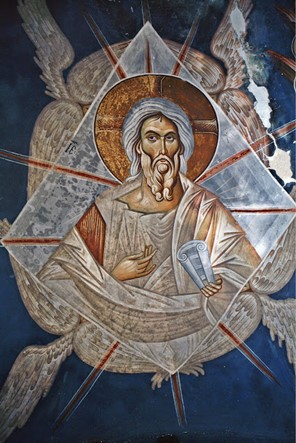
Fast forward many years, and I found an icon, a devotional image, that had God the gather, throned among the Cherubim, and surrounded by a prism of light. I wasn’t alone in glimpsing a mystery quite like this, and I will not be the last. So see today, in your life and the life of the prophets, something beyond description. Rather than shrinking the wonder that you see, let is overwhelm and consume you. Finite as we are, we like Ezekiel are testaments to the infinite that sits just beyond our view. – Amen.

AI generated 4 Living Creatures

The Ancient of Days, a 14th-century fresco from Ubisi, Georgia

Profile of a Prophet: Jeremiah – 07/10/2022

Jeremiah 9:1-11

O that my head were a spring of water and my eyes a fountain of tears, so that I might weep day and night for the slain of the daughter of my people! O that I had in the desert a traveler’s lodging place, that I might leave my people and go away from them! For they are all adulterers, a band of traitors. They bend their tongues like bows; they have grown strong in the land for falsehood and not for truth, for they proceed from evil to evil, and they do not know me, says the Lord.

Beware of your neighbors, and put no trust in any of your kin, for all your kin are supplanters, and every neighbor goes around like a slanderer. They all deceive their neighbors, and no one speaks the truth; they have taught their tongues to speak lies; they commit iniquity and are too weary to repent. Oppression upon oppression, deceit upon deceit! They refuse to know me, says the Lord.

Therefore thus says the Lord of hosts: I will now refine and test them, for what else can I do with the daughter of my people? Their tongue is a deadly arrow; it speaks deceit through the mouth. They all speak friendly words to their neighbors but inwardly are planning to lay an ambush. Shall I not punish them for these things? says the Lord, and shall I not bring retribution on a nation such as this?

Take up weeping and wailing for the mountains and a lamentation for the pastures of the wilderness, because they are laid waste so that no one passes through,  and the lowing of cattle is not heard; both the birds of the air and the animals have fled and are gone. I will make Jerusalem a heap of ruins, a lair of jackals, and I will make the towns of Judah a desolation, without inhabitant.

Sermon Text

We are on our third week of talking about Prophets and what they bring to God’s people. We began with Moses, and how the Prophetic Voice reveals who God is to us. We turned to Elijah and saw the prophet steering us away from false gods, and toward our true God. Now, we take up the call of Jeremiah, the prophet closest to my heart, as he cries out the agony that God feels on behalf of the people of God. We know that God has heard the cries of the needy, but it is in Jeremiah that we see just what hearing us suffering does to God’s emotional state – not a static, unfeeling position, but a tumult of pain and deep sorrow.

Jeremiah begins his ministry at the end of Judah’s existence as even a vassal-state of any other power. Being called to testify to the evil of his own people, Jeremiah is often reluctant to take up the sword of prophecy. Yet, without fail his hesitation is turned into zealotry as God’s judgment is shown to be true in his own life. God warns him that people are laying plots against him, and then soon the trap is set and sprung. God tells Jeremiah that there is scarcely any good left in the city, and Jeremiah’s optimism is destroyed as he, like Diogenes, searches the city for a single honest person and finds no one.

Jeremiah is faced with all his preconceived notions of how the world should be and has each aspect of life systematically ripped apart. He thinks for a moment that the poor are more prone to evil, and then is shown the trickle down economy of evil that begins in the rich and sees its fulfillment among their oppressed. He hopes that the temple would be a bastion against the evils of the world, but finds himself called to preach on its steps against those who enter it. He becomes the great pessimist, decrying optimism itself as he stands in ruins, and suffers in mud-pits, and even is made to move to Egypt as guardian of the refugees that fled there. Jeremiah is perpetually spinning round, an inverted figure looking for truth in an upside down world.

The most striking aspect of the book of Jeremiah is how God speaks through the prophet. In other prophetic literature the prophet is usually clear in separating their speech from God’s. The mark of the prophet is their use of the term, “Thus says the Lord,” (כֹּה אָמַר יְהוָה). Usually, this occurs at the beginning of a prophetic statement. Frequently in Jeremiah it does. Yet, as this passage we just read shows, the separation between the speech of a prophet and their prophetic speech is not always clear. From verse 1 to verse 5 we see someone begging that they had springs in place of tear ducts, that they could weep without running out of tears. Our first thought is that Jeremiah is weeping because he is thinking of his people and the suffering they are and will go through, but it is equally possible the person speaking is God.

Jeremiah shows such a synchronicity with God that the voices of the two often overlap. One moment Jeremiah will begin a sentence, and then seemingly God steps in to end it. We hear about the desire to weep for the fate of God’s people, we read about a strong and dry wind blowing across the world and making it a wasteland – a wind that both comes from God and toward God. Jeremiah at one point looks out to see the world completely unmade, as if God had never organized it in the primordial sea of creation. God’s burning words are like a fire in the prophet’s stomach, but the smoke and tears and anger and sorrow are not unique to Jeremiah – God feels every emotion he is rushing into the vessel that is his prophet.

The prophets serve an important role by personifying God. I don’t want to say humanizing here, because while we can get into some complicated discussion of Jesus as equally God and human, here I want to keep some distance between the two for clarity’s sake. When we pray to God, when we share our pain and our suffering, when we see the news stories spread out and shake us to our core – God is not unmoved by any of these things. Jesus wept in the garden because he was human, but the divine can weep just as powerfully, God is not a static being.

I am someone who is adamant about keeping the Old and New Testaments close to one another. We cannot understand the New Testament without the Old, and to understand why we have access to the Old we need the New. It is common that the differences between the two are put up as integral to the nature of God. In this framing, one day God woke up and decided to speak Greek and be a lot more about love and inclusion than back in the day when he spoke Hebrew. That is a bad way to see God and scripture, it suggests we worship two Gods instead of one, something we already established is not good. Yet, as with many misunderstandings, it begins not with a falsehood, but a misapplication of truth.

The context of the Hebrew Bible and its writings was very different from the Greek Bible. In its earliest days, the Hebrew Bible was written alongside stories of gods that were very human in their nature. They got Jealous, the fought, the had political aspirations and alliances. The language of the Hebrew Bible, then, is much more fixated on the discussion of God as a person, actively engaged with the world and expressing emotion and feeling and preferences even. The language shaped the character of God, as did the context of the people writing it.

The New Testament, being in Greek, was more philosophical in its approach. While constantly rooted in the humanity of Jesus, we see the New Testament arguing philosophically about the nature of God. When those texts were handed off to the first generation of theologians, they went further than Paul or John ever did and completely melded Greek Philosophy and Christianity – for good and for ill. The result was an emphasis on the unchanging, static, God-as-Prime-Mover, and a downplaying of the personal divinity that felt and fought and raged and wept. Jesus the Human might weep, but God the Divine Trinity was unmoved as something that was before and above all things.

We imagine God as a blank slate, perpetually looking out at us with the eyes of a Warner Sallman painting – unmoving, mildly positive, and still capable of stoic and unfeeling wrath. That is not the God of scripture, not the God revealed in the life of Christ or the prophets. The God we worship feels deeply, the God we worship weeps at the injustices of the world. The God we worship is sitting beside us in our darkest moments, and feeling what we might feel. This does not make God a reflection of our emotion, but it does mean that the closer to God we become, the more alike our emotional state will be.

Bob Pierce, founder of Samaritan’s Purse and World Vision, once said, “Let my heart be broken by the things that break the heart of God.” That understanding of God’s emotional state is something we should all strive for. Not to make God into an echo chamber that affirms and denies everything in the same way we do, but to truly understand the nature and desires of God. When we can tie ourselves closely to the work of God in the world, when we can become compassionate toward all people we meet, then we begin to know what it is like to inhabit a prophetic role. When we become a vessel for the emotions of God, the love that pours out like rivers of tears, then we know what it is to bring the Word of God to the People of God.

So, our challenge in light of God’s prophetic message to us all, is to be transformed into emotional creatures. To give up stoicism in the face of adversity and care deeply for the hurt, the lost, those in every kind of need. We come to our God and we behold so many wonderful things, but I think most wonderful of all are the precious tears that are shed by the God of this universe on our behalf. Be cheered today, and mourn tomorrow, that we too can feel as deeply as God does. – Amen.

Profile of a Prophet: Elijah

1 Kings 18: 20-40

So Ahab sent to all the Israelites and assembled the prophets at Mount Carmel. Elijah then came near to all the people and said, “How long will you go limping with two different opinions? If the Lord is God, follow him, but if Baal, then follow him.” The people did not answer him a word. Then Elijah said to the people, “I, even I only, am left a prophet of the Lord, but Baal’s prophets number four hundred fifty. Let two bulls be given to us; let them choose one bull for themselves, cut it in pieces, and lay it on the wood but put no fire to it; I will prepare the other bull and lay it on the wood but put no fire to it. Then you call on the name of your god, and I will call on the name of the Lord; the god who answers by fire is indeed God.” All the people answered, “Well spoken!” Then Elijah said to the prophets of Baal, “Choose for yourselves one bull and prepare it first, for you are many; then call on the name of your god, but put no fire to it.” So they took the bull that was given them, prepared it, and called on the name of Baal from morning until noon, crying, “O Baal, answer us!” But there was no voice and no answer. They limped about the altar that they had made. At noon Elijah mocked them, saying, “Cry aloud! Surely he is a god; either he is meditating, or he has wandered away, or he is on a journey, or perhaps he is asleep and must be awakened.” Then they cried aloud, and, as was their custom, they cut themselves with swords and lances until the blood gushed out over them. As midday passed, they raved on until the time of the offering of the oblation, but there was no voice, no answer, and no response.

Then Elijah said to all the people, “Come closer to me,” and all the people came closer to him. First he repaired the altar of the Lord that had been thrown down; Elijah took twelve stones, according to the number of the tribes of the sons of Jacob, to whom the word of the Lord came, saying, “Israel shall be your name”; with the stones he built an altar in the name of the Lord. Then he made a trench around the altar, large enough to contain two measures of seed. Next he put the wood in order, cut the bull in pieces, and laid it on the wood. He said, “Fill four jars with water and pour it on the burnt offering and on the wood.”

Then he said, “Do it a second time,” and they did it a second time. Again he said, “Do it a third time,” and they did it a third time, so that the water ran all around the altar and filled the trench also with water.

At the time of the offering of the oblation, the prophet Elijah came near and said, “O Lord, God of Abraham, Isaac, and Israel, let it be known this day that you are God in Israel, that I am your servant, and that I have done all these things at your bidding. Answer me, O Lord, answer me, so that this people may know that you, O Lord, are God and that you have turned their hearts back.” Then the fire of the Lord fell and consumed the burnt offering, the wood, the stones, and the dust and even licked up the water that was in the trench. When all the people saw it, they fell on their faces and said, “The Lord indeed is God; the Lord indeed is God.” Elijah said to them, “Seize the prophets of Baal; do not let one of them escape.” Then they seized them, and Elijah brought them down to the Wadi Kishon and killed them there.

Sermon Text

Fire from Heaven! Now that is something worth talking about. I think that this is a passage that speaks for itself on many levels. The challenge to the prophets of Baal is simple, make this offering disappear. No amount of prophesying or ritual could accomplish the act, but for Elijah it only took an earnest prayer to bring God’s presence down among them. The “Fire of the Lord,” was strong enough to consume everything it touched. Stone, water, wood, and flesh turned into vapor in a moment. The show of power was done, the proof of which God reigned supreme was now obvious. In the hearts of those present, there was no longer Baal standing alongside the God of Abraham, but Abraham’s God standing far above any ruler of Heaven or Earth.

The prophet was not just, as we talked about last week, a way for the people to know that God was present with them, but a means for the people to be brought back out of the trouble they found themselves in. Next week we’ll dig into Jeremiah and how he shows us another side of this trait – appealing there to God’s care for us. Here the message is different, God is supreme in power in majesty, and nothing can compare to what God has to offer us. The fire from Heaven here is not something we see as common in the Biblical record, and definitely not in human history, but it takes other forms in every age. The burning message of the Gospel that spilled out of the first Christians on Pentecost, the pious longing of believers of all ages, the passion for righteousness still seen today in every place people call upon the name of God.

Not as dramatic, I know, and we get disappointed by that sometimes I know. Still, God is active among us and asking us as a prophetic voice to show God’s glory. If we cannot do so with a rain of fire? Then what are we to do? Moreover, what do we do to fight idolatry? Sacrificial competition on mountains feels… Not viable, so what are we to do?

The first thing is that we have to identify what our idols are today. This is a popular place to talk about phones or media or any old thing that someone might do other than sit at home and read the bible. Don’t get me wrong, there’s something to be said for our lack of attention these days, but pointing fingers and every little thing and saying it might be an idol feel a little Reverend Parris to me. No, we need to celebrate as something as serious as idolatry from our devotional skills (or lack thereof.) I suggest that the best way we can identify idols is to dig into the image that Elijah uses at the start of our text. The NRSV renders it, “How long will you go limping with two different opinions?” highlighting the way that our idolatry actively hurts us. However, I prefer Robert Alter’s translation, even if I think it is a little literal. “How long will you keep leaping between the two crevices?” [1]

In other words, here is one reality, the one where you follow God and live in peace and love with all around you, and over here you abandon God and live for yourself and what you want. For the people of Israel that meant finding an excuse in Baal and his cult. Baal wasn’t that different from the God of Israel on paper, a storm God and ruler of the cycle of seasons and crop growth, king of his own pantheon. Both had a mountain they called holy, both had a court of heavenly beings at their disposal. Most people were polytheistic, so why not? Solomon did it, David toyed with it, and even Jacob long ago was not willing to give it up totally.

There’s the rub though. It is easy to justify the death by a thousand cuts that is our slide into idolatry. We worship a God who is always a little less than the God of Heaven. A God who isn’t as loving as the God of Israel, because that would mean we’d have to love our enemies like God does. A God that isn’t as powerful as the God of Israel, because then the moments our prayers go unanswered would hurt even more. A God that isn’t as just as the God of Israel, because then the little ways we hurt each other would add up to mean a lot more than we would like them to.

Baal was not radically different in the eyes of most to the God that Abraham had known, but Elijah made it clear there was a massive gulf between the two. We don’t have the exact dichotomy today, but I think we suffer a similar problem. I worship a God who is radically different than the God that other Christians claim to know, and that can cause some trouble. I don’t mean that we interpret scripture differently or that we have different priorities, there is always a place for that in the Church. I mean that when we offer our prayers to God, we are not actually offering them to the same being. Oftentimes what we are actually worshipping is a projection of what we would like to see in the Almighty, and not the true God of the Universe.

Now, here is where we might start pointing fingers, that evil thing we talked about a few weeks ago. Stop it, now. Even as I wrote out my sermon, I thought of all the people who made “lesser,” images of God. Those people I disagree with theologically or politically in the Church that I see as separate from myself. Sure, I think my instinct is good, but my instinct is not perfect. Even my most detailed arguments of how I see God revealed in scripture and life is going to fall short of really capturing the divine. No, the first prophetic task we have is not to point to the enemy we know outside, but to interrogate the enemy within ourselves.

It is so easy to make an idol out of what we would like God to be. When we read scripture, if we read it properly, we should constantly find ourselves challenged to grow. To love more, to serve more, to care for ourselves more, and to sacrifice some of our dearest concepts that we cling to and make into God in their own right.

I could give a thousand examples, but I think one of the clearest examples comes from another prophet in scripture. Jonah, son of Amittai, worshipped God. When the word of God came that Jonah was to go to Nineveh and proclaim God’s mercy, he ran as far away as he could. He did this and showed immediately the God he was willing to worship rather than the one who called him. He dreamt of a God that couldn’t reach beyond the borders of Israel, that was locked into the hills of the Shephalah. He dreamt of a God who cared enough to wipe out his enemies, but not enough to forgive them. He had created an idol, not of stone, but of ideals that kept God in a convenient little category that was well within his reach and contemplation.

Before Jonah knew it, he had made an idol. He had hewn away at the image of God bit by bit until something else was there entirely. Not a Baal he could throw away in a second, but his own, personal, God of Jonah. We all want God-for-Us, but that is not who God revealed God to be in scripture. God is Emmanuel, God with us, and while God certainly fights for us, we should never think that God exists only within the bounds of what we have imagined to be true, and what we would allow God to be.

The testimony that we give today about God should not only be outward focused. Elijah, after testifying about God’s glory by bringing down fire, ran to the hills to escape his enemies. He prayed to be killed rather than face the morning. He needed to climb a mountain, to see fire and flames, and to hear a still small voice to understand the greatness of God for himself. We are all of us testifying, through the work of the Spirit that God is great and good, but when we speak against the idolatry of the world, we must be sure that we are not doing so with a chisel set against the face of God ourselves. Will we hop between the two crevices? Or will we stand on Christ, the solid rock? – Amen.  


[1]

Profile of a Prophet: Moses

Exodus 3: 1-15

Moses was keeping the flock of his father-in-law Jethro, the priest of Midian; he led his flock beyond the wilderness, and came to Horeb, the mountain of God. There the angel of the Lord appeared to him in a flame of fire out of a bush; he looked, and the bush was blazing, yet it was not consumed. Then Moses said, “I must turn aside and look at this great sight, and see why the bush is not burned up.” When the Lord saw that he had turned aside to see, God called to him out of the bush, “Moses, Moses!” And he said, “Here I am.” Then he said, “Come no closer! Remove the sandals from your feet, for the place on which you are standing is holy ground.” He said further, “I am the God of your father, the God of Abraham, the God of Isaac, and the God of Jacob.” And Moses hid his face, for he was afraid to look at God.
           Then the Lord said, “I have observed the misery of my people who are in Egypt; I have heard their cry on account of their taskmasters. Indeed, I know their sufferings, and I have come down to deliver them from the Egyptians, and to bring them up out of that land to a good and broad land, a land flowing with milk and honey, to the country of the Canaanites, the Hittites, the Amorites, the Perizzites, the Hivites, and the Jebusites. The cry of the Israelites has now come to me; I have also seen how the Egyptians oppress them. So come, I will send you to Pharaoh to bring my people, the Israelites, out of Egypt.” But Moses said to God, “Who am I that I should go to Pharaoh, and bring the Israelites out of Egypt?” He said, “I will be with you; and this shall be the sign for you that it is I who sent you: when you have brought the people out of Egypt, you shall worship God on this mountain.”
           But Moses said to God, “If I come to the Israelites and say to them, ‘The God of your ancestors has sent me to you,’ and they ask me, ‘What is his name?’ what shall I say to them?” God said to Moses, “I am who I am.” He said further, “Thus you shall say to the Israelites, ‘I am has sent me to you.’” God also said to Moses, “Thus you shall say to the Israelites, ‘The Lord, the God of your ancestors, the God of Abraham, the God of Isaac, and the God of Jacob, has sent me to you’:
           This is my name forever, and this my title for all generations.

Sermon Text

Today we start a new series looking at some of the prophets that brought us God’s word throughout scripture. We are blessed as Gentile recipients of God’s grace to have the legacy of God’s work through both the Hebrew and Greek scriptures. One does not take precedence over the other, but both show us God’s glory in their own way. Throughout the history of God’s people there have been those who God has raised to a particular purpose – the articulation of God’s desires for God’s people. The prophet’s voice was a tool of God to bring about change, to give warnings, and to ultimately to reveal the nature of God to the people of God.

When we open our Bibles, we are well aware that there are prophets talked about in their pages. If we were to grab a Jewish Tanakh, that would be even more obvious to us. The name of the Hebrew Scripture is an anagram, Tov for Torah, Nun for Nevi’im, and Kaf for Ketuvim. In other words, the teachings of Moses, the prophets, and the writings. Tanakh. The prophetic books of the Hebrew Bible include the three major prophets of Isaiah, Jeremiah, and Ezekiel as well as the twelve minor prophets – just like we would see in our Protestant Bibles. Yet, they also include the books of Samuel, Kings, Judges, and Joshua – things we usually call historical books.

As we hop across the pages of our Bibles over the next few weeks, we will visit much of the Hebrew scripture and even jump into the Greek scripture of the New Testament at the close of our series. For now, we look into the distant past of God’s revelation to see the first prophet called to proclaim God’s salvation to God’s people. Today we look at the life of Moses, and how he shows us the pattern of a prophet and the wonders of God’s all-encompassing love.

Before we jump into Moses particularly, I want to talk a little bit about what a prophet is meant to be. When you all hear prophet, I’m sure you have your initial ideas. What comes to mind? Fortunetellers giving a forecast of future events? Doomsday preachers speaking about God’s final victory over the evils of the earth? A sword cutting between the lies we tell ourselves and the truth? Of those options the last one is closest to what the role of a prophet was defined by in scripture. While there was a paid position within ancient royal courts called “prophet,” this role is different from what the biblical prophets achieved. The paid position might ask God specific questions, getting back specific answers. They would say when a good time was to go to war or to begin projects. These were closer to our usual view of prophets than any of the Major or Minor ones of scripture.

Rather than being employees of kings, the Biblical prophets were usually lay people called out from their normal lives into their role as a prophet. This was not always the case, sometimes a paid prophet would be called to the higher role of a capital P Prophetic Voice, but on the whole it was more common for people to be called to this ministry rather than following the usual chain of command. There was still the ability to learn from another prophet or succeed someone’s work – like what we see with Elijah passing his work to Elisha, but the model for the named prophets in scripture is that they are plucked up and set aside for a specific work. I speculate about this to a certain degree, but it explains best why the eponymous prophets were so different from their contemporaries.

Abraham Joshua Heschel, a Jewish philosopher of religion, explains prophets as critics of the sins of their era. Specifically, the prophet calls the people to see the ways they hurt one another and how we all have a part to play. He puts it this way, “the prophets remind us of the moral state of a people: Few are guilty, but all are responsible… In a community not indifferent to suffering, uncompromisingly impatient with cruelty and falsehood, continually concerned for God and every [person,] crime would be infrequent rather than common.”[1]

The prophets act as a wakeup call for us to get our act together. The Biblical Prophets especially are crying out to people on the verge of collapse from one source of evil or another. We talked last week about avoiding God’s promise of redemption by never falling in the first place. That is the sort of thing that the prophet was constantly doing. They stated the problem as it was now, the consequence of that problem if it was not fixed, and then finally the opportunity that would exist if the people changed their ways. The goal was always to see people change, like what Jonah did at Nineveh, but often the prophecy of disaster is the one the won out.

Back to the focus of today’s message, we look to the ministry of Moses. The people of God had been enslaved in Egypt for a long time. Despite the fortune of Joseph in the Egyptian Court, shifting political power resulted in the Hebrews being a convenient scapegoat for the problems of the kingdom. A pharaoh came into power, “who knew not Joseph,” and the people soon found themselves the victims of genocidal programs meant to limit their numbers and reduce them to slave laborers. The land of Goshen essentially became a prison, with the people being kept there as wheels in the machine of industry.

One of the survivors of an early attempt to cull the Hebrew people was the son of two members of the house of Levi. After his birth, his parents feared he would be killed, and so he was floated down a river. A member of the royal household pulled him out of the water and, realizing he was a Hebrew, took pity and decided to raise him. The boy’s sister was nearby and convinced the noblewoman to hire the boy’s mother as his nurse, and the boy, Moses, was raised in Pharaoh’s court and with the full knowledge of the ways of his people.

Moses’s time in the court saw him divided in whether he could live as a member of the nobility when his family and his people were suffering under the rule of that same royalty. When a group of Hebrew men were being abused, Moses killed the assailant. Rather than earning him a place of pride among his people, it made him look reckless. Moses had made it worse for his people, the idea that they were a dangerous minority would be solidified by his half-baked plan to make himself into a hero. Moses fled Egypt and settled on the other side of the Gulf of Aqaba from Egypt. There, among the people of Midian, he made a life. He married into the people there and had children. He started a life as a shepherd and began to drift away from his time in Egypt, his identity as a Hebrew.

That was, until a bush caught fire one day. Burning as it was, it did not seem to be harmed in any way. The sight was enough for him to stop and look over at it. As soon as he did, he heard a voice calling his name. “Moses! Moses!” The source of the voice was unknown, but Moses was ready for whatever it had to say to him. “Here I am!” the call of so many prophets, set him walking toward that bush. The conversation that followed would change his life forever. Moses meets God, the God, and is told to go back to his people and proclaim the truth that they are soon to be free of their slave masters in Egypt.

The how of this is worked out as Moses goes through his ministry. He is not given a list of plagues that are going to appear in Egypt, nor does he even fully understand how long the trip from Egypt to Canaan is going to be. All he knows by the end of this conversation is that he is a prophet called to bring God’s word, and God’s law, to God’s people.

We can take a lot from Moses’s story, but I think that we can see in his call story a more direct vision of what prophets are hoping to achieve through their work. When God calls the prophets, it is not just God wants a better world – though God does. It is not just that God wants to see God’s people be holier than they were before – God certainly wants that. No, the work of the prophet is ultimately to bring God to God’s people and God’s people to God. The prophet acts as a bridge, showing the people the face of God through the face of the prophet. The prophet lays out God’s presence among the people. The prophet weeps, rages, laughs, and smiles as they show the world just what God is thinking. The prophet shows a light and a hope that God is never far away from us. Most of all, the prophet shows us that God is here to save us.

In this first meeting, God tells Moses that God has heard the cry of the Hebrews. Their many prayers have not been forgotten, the tears they cried are not ignored. God is hurt by the hurt they have suffered. In my darkest days, I want to know that God hears me. Praise God, I can hear it from God’s own lips as God speaks to Moses. Moses is chosen as the one to go forward, and though he gives many reasons as he makes his way to Egypt why he should not, God does not let up for a second. Moses is going to be the face of this liberation movement, and Moses is going to proclaim that the same God who loved Joseph, and Jacob, and Isaac, and Abraham.

God could have just left it at that. But God keeps talking. You can call me, Ayah ahser ayah, “I am that I am.” Moses points out that this is not a name, it is a title. So, God finally goes one step further, God gives Moses a name so precious that it is not spoken even today in Jewish communities. You may know ministers who use it, its four letters long, but I do not. It is God’s actual name, and it is the thing we are asked not to take in vain. For this reason, I will use the name “Adonai,” or Lord, like our Bibles today do. Jews sometimes take it a step further, only saying HaShem, or “the Name.”

This revelation of God’s name seems small to us, but it meant a lot in the ancient worlds. Names hold power, and the ability to call on a deity was seen by the ability to say their name. A God without a name would become lost to time, and much like people there was an expectation that to be forgotten in this way would be tantamount to death. For the deity, revealing their name was an act of self-preservation, but also an act of vulnerability. When people knew your name, and called on you, you were expected to answer.

For God to give Moses the divine name was not an act of self-preservation. It was, however, a sign that God loved God’s people enough to open up another level of intimacy with them. It is one thing to sign a letter with someone’s title, another thing entirely to sign it with their name. God here makes it clear, in this moment and in all of Moses’s time on earth that to be a Hebrew, to be a person of God, is to be close to the one who called upon you. We speak with God name to name and face to face. God is not trying to keep a distance from us but is constantly knocking down obstacles and building highways for us to get from where we are to where God is. And for every step we take, God is running even faster toward us.

Moses would go on and lead his people from Egypt, he would lead them into battle and through hunger and thirst. He saw multiple rebellions, a very misshapen golden cow, and even two separate and very different incursions of quail into his camp. God was with Moses the whole time and even left Moses with a set of teachings to pass on to his people, to be recounted and memorized and lived. God gave Moses the Torah as the ultimate sign that God was always with God’s people, and that God was always pulling them closer. Moses died one day, and when he did, it was God who took him up and buried him, unwilling to let anyone else have the honor. Is there any clearer sign than this? The prophet brings God to us, and with their leadership we find God with us. – Amen.


[1] Abraham Joshua Heschel, The Prophets. (Peabody, Massachusetts: Hendrickson Academic. 2007)

An End to Trouble – 06/19/2022

Isaiah 30:19-26

Truly, O people in Zion, inhabitants of Jerusalem, you shall weep no more. He will surely be gracious to you at the sound of your cry; when he hears it, he will answer you. Though the Lord may give you the bread of adversity and the water of affliction, yet your Teacher will not hide himself any more, but your eyes shall see your Teacher. And when you turn to the right or when you turn to the left, your ears shall hear a word behind you, saying, “This is the way; walk in it.” Then you will defile your silver-covered idols and your gold-plated images. You will scatter them like filthy rags; you will say to them, “Away with you!”

He will give rain for the seed with which you sow the ground, and grain, the produce of the ground, which will be rich and plenteous. On that day your cattle will graze in broad pastures; and the oxen and donkeys that till the ground will eat silage, which has been winnowed with shovel and fork. On every lofty mountain and every high hill there will be brooks running with water—on a day of the great slaughter, when the towers fall. Moreover the light of the moon will be like the light of the sun, and the light of the sun will be sevenfold, like the light of seven days, on the day when the Lord binds up the injuries of his people, and heals the wounds inflicted by his blow.

Sermon Text

Theoretically, there is some control over the topics I preach when I get up in front of you all. Yet, as has often proven the case, circumstance and coincidences of calendars can shape a message planned a year a go into something radiant and unique compared to what I had initially planned. To have a Sunday fall on the nineteenth of June before this year might not have meant much. Now though, it means that we celebrate our Holy Gathering on a national holiday – on Juneteenth. Now, what does that mean for us? It means that we have a direct lesson from history and from life to help us understand what scripture has revealed to us.

On this day, in 1865, enslaved people in Texas were given a message. Their time as slaves had come to an end following President Abraham Lincoln’s signing of the “Emancipation Proclamation,” freeing all slaves in Secessionist territories. There was, of course, celebration on that June 19th long ago, but also a bittersweet realization. While the enslaved of Texas were freed on that first Juneteenth in 1865, the document that freed them was signed on January 1st… 1963. Two and a half years from the time that they had been given their leave of their slavery, to the time they were first given freedom.

The people forcing them to work knew about this proclamation that had been given, but of course they were not going to let their victims hear about it. Afterall, they no longer acknowledged Washington as the seat of government, nor did they see any advantage in freeing people they benefited from oppressing. Romantic images of plantation life, so common in Southern Narratives of the war, melt away in the cold reality of Justice delayed, which we know is tantamount to Justice denied.

This history has a still darker layer. The reality of the proclamation that allowed the enslaved within Texas to be freed was conditional. Slaves were freed only in secessionist territory. In other words, a slave holder in Jefferson County, a part of our state that was heavily Confederate, would be compelled to free their slaves, while a slaver in Wheeling, a Union area, would be free to keep them. It would be three years from the Emancipation Proclamation that chattel slavery was finally abolished in the United States. As joyous as one act was, it was motivated by war, and it would take a horrible stretch of three more years for our morals to catch up to our guile. Three years from convenience moving to justice.

So, what does this have to do with us, with God lifting up the poor and the broken of Judah like our scripture puts forward. More than that, why, Mr. Langenstein, staunch advocate for keeping civil and religious observances separate, are you preaching from the starting point of Juneteenth, when Father’s day is a much more popular choice anyway? Let the Spirit testify that my love of controversy is separate from my prophetic call, though the two do sometimes align. I bring the civil into the sacred today so that we may hear Isaiah’s call to repent and avert the necessity of the promises we see in our text today.

Avoiding a promise from God! What in the world?! God gives promises to be kept. God keeps God’s word, so why would it be possible, even good, to avoid a promise from God? Well, walk with me and we’ll see. Isaiah spoke this promise to the people anticipating them to fall, it is a promise to be restored after complete destruction. God promised an end to exile and to trouble, but the fall God was bringing to the people was a fall they had engineered for themselves.

When we read the prophets, we hear about the rise of Assyria and Babylon, two empires that scripture describes as implements of God’s wrath. We usually suffice to say that God’s people fell into idolatry and were punished because of it. The worship of other God’s definitely is part of the prophetic critique, but the prophets are also clear that the rise of idolatry in the people is a symptom rather than the cause of their fall.

The book of Isaiah is split into three parts, the first is the stretch of chapters from the first to the thirty-ninth. This section focuses on the life of Judah before and during the Babylonian invasion. In the chapters leading up to the one our scripture comes from, Isaiah has given a long list of prophecies against the nations around Judah. He describes how Israel had fallen nearly two hundred years earlier. He looks at the many evils committed by all these groups, and then he looks to his own people, to Judah, and declares that they have managed to do worse than any of the others. Worse than the sins of all these people, are the sins of those who knew better and did it anyway.

And what was the chief offense of the people? They saw the poor as disposable, thy looked at orphans as a way to make a dime, and widows as obstacles to their money making schemes. Isaiah switches between poetry, sarcasm, and direct attack throughout his prophecies. Specifically the first six chapters of the book digs into the offenses of Judah. To name a few of them, Isaiah accuses the people of: sacrificing without faith, bribery, accepting bribes, abandoning those in need, murder, inhospitality, choosing evil over good, miscarrying justice, owning excess land, and choosing political power – and alliances – over God. Now, that list is probably incomplete and some of those are categories, not exact offenses, but the point stands – idolatry is a minor part of what God’s people got, or should I say, get, up to.

Isaiah mixes his doomsaying with prophecies of restoration and joy. Yet there is another message underneath it all. “Can you, people of God, stop this evil now, and avert the calamity? The answer, again and again, seems to be no. The force of evil is too great, the appeal of power is too strong, we bend the knee again and again to earthly things. When genuine idols appear, we collect them as yet another potential ally. We fail to do good, we fail to repent, we set ourselves up for a fall, again and again and again.

A lot of times we catch ourselves saying, “What is wrong with the world?” or “It never used to be this way?” But when we start down this path we hear God speaking to us and sating, “Do not say, “Why were the former days better than these?” For it is not from wisdom that you ask this.” (Eccl. 7:10) The reality is that all of human history is messy, full of heights of goodness and mercy, but also full of wicked evil. The same evil rampant in Judah is alive today and God cries out with the same voice, promising to lift us up if we fall, but asking us to turn away before we do.

That call has been ringing out for 246 in this country. From the moment we declared independence in the name of Liberty but denied that same liberty to those we found convenient to enslave. While ministers like John Wesley rained prophecy upon us about this hypocrisy, we carried on. We denied the prophetic call of God to repent as we massacred indigenous people, pushing them further away from their ancestral homes and to this day denying their full humanity. We freed slaves when it was convenient for us, then segregated the races until the oppressed rose up with voices, and marches, and sometimes arms to say, “No more!” We continue to ignore the call in our willingness to allow any and all evil, as long as it keeps gas prices low, our cell phones cheap, and our pay checks steady.

Some may see that review of history as overly negative, and certainly I highlighted some great atrocities in that quick retelling. Yet, I could also say I left out a lot. No mention of Tuskegee or of Monsanto. Not of Agent Orange dropped on soldiers and civilians, nor of housing crises and inflation booms when companies report record profits and houses remain empty. I tire of narratives that act like my generation is especially sinful or that Gen Z is somehow more depraved. Billy Joel said, “we didn’t start the fire,” when looking to his own generation.  Well, growing up in the Ash Heap, I insist I’m less responsible than he ever was.

As a country, we’ve been debating how to tell our history. Do we highlight our failures or our triumphs? Do we see our founders as flawed heroes or historical monsters? If we give into the controversies of the day, we might believe there is a binary here to take a side on. That is flatly untrue. Much of the controversy drummed up now is reactionary. People are asking us to question our national narratives, to see things from another point of view, and so conspiracies were made. Going back to McCarthy and the anti-communist movement, these criticisms were tied to communism, and a choice had to be made – accept an idealized vision of America or give in to the commies. The same people it should be said accused the Civil Rights movement of being communist.

Today, now there’s CRT which people accuse of being a communist conspiracy, and which isn’t taught outside of specific college programs. But the manufactured fight keeps us from having difficult conversations. We cannot, as Isaiah did, take a moment and think, “Maybe our national history isn’t all rainbows and butterflies.” More than that, maybe there are legitimate problems we need to fix in the here and now based on those historic problems. History is messy, whether its your family, your church, or your country, it can’t be all good or bad, but it does need to be honest.

Let me give you an example, my favorite founding father is John Adams. He had a presence of mind to him I just love to read about. On top of that, the love that he and his wife had for one another is something we should all aspire to. Adams, nonetheless, signed the Aliens and Sedition Acts. Taking rights away from immigrants and making criticism of the president all but illegal. That is the act of a Tyrant. Yet, my mixed admiration and terror remains.

My grandfathers both services in Viet Nam, my Great-grandfather in WWII, I’m proud of their service. Yet, especially for those that served in Viet Nam, I do no deny that they may have been forced to be part of the atrocities we committed there. Nor can I forget that the government rained Agent Orange on them, giving him a poison that sat in his bones and killed him with cancer. He should be here to celebrate Father’s day! But war and evil and greed took him from me.

Isaiah brings us two lessons, two visions. One is of us repenting now to avert disaster. We can see this begin to take root. When we put aside prejudice and our preconceived ideas of each other and choose to fight for each other, that is when the kingdom of Heaven breaks out on Earth. When the Spirit came down on the Pentecost and the walls between Greek and Judean lives melted in the light of God’s grace. When people sold their land to feed the hungry, clothe the naked, and to house the homeless. Heaven came to Earth, and it has before and it will again, if we accept and learn from the past even as we charge into the future.

The second image Isaiah gives us is less immediate – not a restoration of Judah or any nation, but of the world as it was meant to be. In this we see what Christ will bring about in the world to come. There will be no pain or suffering, no death or worry. There will be God and people of all races, nations, and people. The sun and moon we be perfected alongside the souls within our dusty shells which are themselves made glorious. We all dream of a day when Christ returns to set things right. Yet, Christ did not leave us on Earth to stare up at Heaven and wait. Christ said to go forward to bring truth into the world, light out of darkness, life from out of death. Proclamations of liberation, that is what we are to the world. That means we must free ourselves from sins of greed, of power, of political games. We must advocate the case of the poor, the oppressed, those the world has said are not enough. Feed them, love them, free them! Do not let just be delayed one moment longer, but fight for those we have written off. Fight to

Harder than it Needs to Be – 06/12/2022

John 16:12-15

“I still have many things to say to you, but you cannot bear them now. When the Spirit of truth comes, he will guide you into all the truth; for he will not speak on his own, but will speak whatever he hears, and he will declare to you the things that are to come. He will glorify me, because he will take what is mine and declare it to you. All that the Father has is mine. For this reason I said that he will take what is mine and declare it to you.

Sermon Text

 This sermon is coming to my blog and to our weekly mailers on a week that I am out of the pulpit. That means that, outside of those who read it, it will likely not be preached aloud, at least not for a while. I love sermons like this, because in some ways it allows me to stretch my arms a little bit and ask, “What can I try and write about, and why not do something a little out of the usual scope of my messages.” Luckily, this year this day away from the pulpit falls on Trinity Sunday, and that means we can go for broke in terms of having conversations that we do not always get to have.  The Trinity is an essential part of our faith. It is the belief that God is three-persons in one single being, a diversity of unity. Yet, can we ever describe it?

Usually, the Trinity does not come up in our daily life. In the midst of going through Kroger, people don’t usually see my clergy collar and as, “Do you see Christ as one with God in substance or simply in will?” Typically, they are just hoping I do not hand them a tract to read or a “gospel,” dollar in the midst of my payment for my groceries. I could list more examples, but you see my point. The Trinity is not a hot topic for the average person and certainly a thorough understanding of it is not going to win hearts and minds to the Gospel (usually…)

The idea of God as Father, Son, and Holy Spirit begins in scripture, but developed into a full-blown belief of the Church in the first few centuries of Christianity. You will never find the word “Trinity,” or anything like it in Scripture. The closest that we get to it is the word, “Θεοτης” (Theotes,) which means something like “God-ness.” Throughout the New Testament we see all three members of the Trinity given this description, they all take part in “God-ness,” so then we have to accept one of two things. Either they are all each a God in their own right – something that goes against our monotheism – or they are all, somehow, equally the same God – the thing that we as the Church have decided upon.

We have tried to explain the Trinity in many ways since then. Sometimes we talk about it as the three parts of a tree – the roots, the trunk, and the branches – all different but all still part of that one thing, “Tree.”[1] A more poetic image comes from St. Augustine, who describes the Trinity as being like love, the object of that love, and the person who loves.[2] Still, I like to be a bit more sciencey and imagine the Trinity as being like water at its triple point. When this point is achieved, of a certain temperature and pressure for any given substance, then the solid, liquid, and gas stages of the substance become indistinguishable from one another even as they remain distinct.[3]

Clear as mud, I’m sure. The problem, I think, is that we want to understand everything about how God is simultaneously a single being, and three individual persons. Part of us shouts out to the heavens, “If I cannot know it all, why know even one part of it?!” Much like the hobby that we pick up, find we are not immediately good at, and then put in a drawer never to look at again (in my case, cross stitching,) the Trinity is something we easily get frustrated with. Talking about it with a minister friend of mine I described it as a wall that we run against, wide as we can see in either direction, and try to wrap our arms around. We want to hold it in our hands, but it is just too big of a topic to every fully grasp.

Yet, I think, it is important because the bit that we do understand shows us something about God. That God, from before anything else existed, was already expressing love. God the Father loved the Son and the Spirit, and God the Spirit loved the Son and the Father, and God the Son loved the Father and the Spirit. All working in tandem, they shaped the universe. All in concert dreamed of a future where you and I would exist, and come together as a Church, and continue the legacy of Love that had existed from before the foundations of the earth were laid.

The Trinity is a complicated theological concept. Reading our scripture where Jesus lays out even a shred of the relationship he has with his fellow members of that union, we only begin to glimpse what it is like to know the fullness of God. We see Jesus, our beloved savior who loved all people with a passion like no other. We think of the Spirit, the small voice within us as well as the burning fire within our heart. We learn about the Father, who sends both and who constantly bends heaven down to earth to know us even just a little more, and love us just a bit more tenderly.

The Trinity is tough, but we often make understanding it harder than it needs to be. God is a multitude and God is a singularity. God is confounding and God is someone we know like a best friend. Like any big concept, we cannot always see how the two extremes are part of the same thing. When we see the beauty of sunrise and sunset, we know they are connected and can appreciate their beauty. When we really think of how the rotation of a oblate spheroid held in place by folds in space time in a small backwater of the Milky Way Galaxy causes this lightshow to occur, then we can begin to be overwhelmed, even if we discover new dimensions to that beauty through such exploration.

The Trinity tells us a lot about God, but it also tells us that we have an infinite amount to learn about God going forward. There’s a podcast that, while I have only listened to its first season, I quite enjoy. It’s called Welcome to Nightvale, and is an approach to horror and comedy that scratches a very particular itch of mine. At the close of that first season, the narrator sits either on top of or beside an Arby’s (it’s been a bit,) looks to the sky, and describes what he sees.

“We understand the lights. We understand the lights above the Arby’s. We understand so much. But the sky behind those lights, mostly void, partially stars, that sky reminds us: We don’t understand even more.

[4]

When we encounter any aspect of God, there are questions that will be left unanswered. We can see that as a frustration, like me reaching my arms as wide as I can against a wall trying to encompass it, or we can see it in more fantastic terms. Rather than frustrating us, maybe the great wall we run into can inspire us. We are not truly hitting something big, imposing, preventing like a wall. We are encountering something more wonderful than we can think about all at once. It is seeing the sun at the horizon, then looking out to see the colors it casts on the clouds around it, then the shadows falling through the trees, then the glint in the eyes of someone beloved by us. It is the slow uncovering of love, understanding it more and more as we behold it.

I could spill even more ink on this topic, but I think any longer and I’ll begin working across purposes from myself. Today the Church celebrates the Trinity. This Trinity is the unity of three distinct persons. Each is fully their own self, and each is inescapably that singular being we call God. What a grand mystery we are made aware of. The deeper we dive into it, the more we understand that we do not understand, but instead of fear or dread, this should inspire us to even more praise. The slow, gradual revelation of who God is always leads us to discover that God is more wonderful than we ever knew. Sometimes the immensity of that reality scares us, sometimes it makes us feel that there is no point to learning more, but such moments are temporary.

God is constantly revealing more of who God is to us: Father, Son, and Holy Spirit. Let us praise God for the mystery and the community God opens to us.


[1] Tertullian. Against Heresies. VIII

[2] Augustine. On the Trinity. VIII: 14 & IX: 8

[3] This phenomena can be seen here: https://youtu.be/Juz9pVVsmQQ

[4] Joseph Fink and Jeffrey Cranor. “One Year Later”, Welcome to Nightvale, podcast audio. June 15, 2013, https://radiopublic.com/welcome-to-night-vale-3GZp96/s1!0aaca