Sermon 07/30/2023 – Dreams of Earth

1 Kings 3:5-12

At Gibeon the Lord appeared to Solomon in a dream by night, and God said, “Ask what I should give you.” And Solomon said, “You have shown great and steadfast love to your servant my father David because he walked before you in faithfulness, in righteousness, and in uprightness of heart toward you, and you have kept for him this great and steadfast love and have given him a son to sit on his throne today. And now, O Lord my God, you have made your servant king in place of my father David, although I am only a little child; I do not know how to go out or come in. And your servant is in the midst of the people whom you have chosen, a great people so numerous they cannot be numbered or counted. Give your servant, therefore, an understanding mind to govern your people, able to discern between good and evil, for who can govern this great people of yours?”

It pleased the Lord that Solomon had asked this. God said to him, “Because you have asked this and have not asked for yourself long life or riches or for the life of your enemies but have asked for yourself understanding to discern what is right, I now do according to your word. Indeed, I give you a wise and discerning mind; no one like you has been before you, and no one like you shall arise after you.

Sermon Text

 Last week we talked about how hard it is to conceptualize Heaven. The difficulty of describing the mundane makes it clear that the supernatural, that which exists beyond the created order we are regularly engaging with, is well beyond our reach. However, I want to make sure that we follow up the general message of last week – that despite the difficulty that comes with describing our experiences with God, there is a point to sharing them. The dreams that we have, of God coming to be with us, shape our understanding of how the world around us should be. If God is moving Heaven to be closer to Earth, surely there is something we can do on Earth to, if not aid that goal, to at least not get in the way of it.

I also described cynicism as what happens when we lack the imagination to hope. Now, that is a piece of language that might hit some people as strange. “Imagination,” is something we often reserve to mean something fanciful. We imagine scenarios that might never happen. We imagine that the noise in the kitchen isn’t actually the cat, but instead is a burglar or monster poised to get us. We see “imagination,” and its related words as a dismissal of the things they precede. To say that hope is built on our ability to be “imaginative,” might seem like another dismissal. Instead, however, I think that imagination is essential to our pursuit of a good life.

I want you to look around this room right now and imagine what you would like to see in it. Close your eyes if that helps. Think of the pews, the chancel, the windows, every piece of this building and imagine your ideal space. Some of the details are gonna be your own biases or preferences. When I close my eyes I imagine this room having moveable chairs instead of pews, something that I know would give everyone here indigestion. However, I think that we all have a few shared parts of our dream. More people sitting in the pews. People from our neighborhood – people like us and quite different from us. Musicians to play and sing and lead us in worship above and beyond our present capacity.

Not every part of our dreams, as I said, comes from anything divinely inspired or even generally prudential. However, the capacity to imagine what could be allows us to plan for what could be. A willingness to imagine a future different than our own allows for God to shape our vision toward something new and different from what was. A willingness to imagine a world different from what currently is, means that we might have a world that does not make the same mistakes that our generation or the ones before it have already made. Imagination, the essence of all dreams, is what allows us to pursue what is right.

When Solomon went up to Gibeon, he did so as part of his coronation ritual. We do not know exactly why sleeping up on a hill would be part of it, but it might call back to other patriarchs like Abraham, Jacob, and Joseph who spoke to God in dreams. The King went on the mountain with the anticipation God would have something to say to the newly crowned monarch, and in Solomon’s case this was what happened. God spoke to Solomon and gave him a simple command. “Tell me what you would want from me.” God tells us at the end that most people would ask to live a long life or to have their enemies wiped out from the earth, but Solomon asked for something simpler. A sharp mind, and the knowledge necessary to lead well.

Solomon, despite that wisdom, was a tyrant of a king. He enslaved many people, he married many women, and kept many more sex-slaves beyond his already numerous wives. His taxes took from the treasuries of the poor to enrich his own, and while his reign was the most prosperous and powerful Israel would ever be – it set up his own sons to split the kingdom in half, to divide the monarchy, to destroy the unity of the people of God.

God gave Solomon wisdom, and that wisdom served him well. However, beyond that wisdom there needed to be goodness, and that goodness depended on the ability to believe something other than what is, was possible. Solomon became a great King, but he became a king like all the other kings of the earth. He chased after land, and money, and women, and eventually that unwillingness to be better led to him abandoning God as well.

At the time there were several streams of religion in Israel, two of which we can highlight. One saw God as standing at the very top of the heavens, commanding all lesser spirits. The other put God alongside other gods, and particularly paired him with a goddess named Asherah. Solomon placed many sacred groves on the hilltops of Israel, devoted to this divine wife of God, and slowly the faith of the people switched from the Lord God of Israel, Adonai, to a competing God also named, “Lord,” namely the god, “Ba’al.”

Elsewhere scripture tells us that God made Israel to be a different sort of people. The tribal confederacy lived as twelve independent bodies that came together when crisis arose. They were led by a clan structure, but would periodically appoint a “Judge,” to oversee specific times of trouble. Meanwhile, prophets would tell people what God’s will was in a given situation, with the main prophet serving as a priest in the Tabernacle placed over the Ark of the Covenant. Only when Israel saw the money and power accrued by other nations did they call for a King to be placed over them, and the prophet at the time, Samuel, read them the riot act for asking for one.

The people lacked imagination to see that they could be different from those around them. They wanted to be like the nations around them, and so sold themselves to a King who would oppress them again and again and again across generations. The Kings did not want to rule differently than the Kings before them, and so sought more money and power and women and prestige. The world was as it ever had been, and so no growth could ever come.

What made Christ’s movement so powerful was that it dared to imagine something different for the world. The movement was led by a homeless man, who did not dress well or speak in flowery language. The movement was nonviolent, even when its leader was killed he commanded his people that it was better to die innocent than kill and become a murderer. The movement was not based on making money, or maintaining its power in society, but in helping others and proclaiming its good news to anyone who would listen. The Church, at its outset, was willing to dream of an Earth that looked a bit more like Heaven, and so they made one.

Unfortunately, we did what Israel had done before us. We got power, and so we looked at what powerful people around us were doing. We cast out the needy, they brought down our property values. We took up weapons, claiming our crucified messiah needed to be defended with violence. We saw money as the primary reason to get people involved in our movement. We were invited into government and sought to replace Caesar’s face on all coins with our own. We did not care to build a community, we wanted a brand, and one that would sell and make us bigger and better and more influential and more like every other movement on earth.

And then… Through the slow rot of two thousand years. We began to die. Recently at a clergy meeting at a coffee shop, me and a few pastors made the comment, “The Church is dying.” Not about any one church, but about Church as it is. A woman who heard us, as she was leaving, told us that she thought we were wrong, that the Church is alive and well and it just needs to get out its doors! And that those young people need to get over themselves and fall in line… When we said, those of us gathered there, that “The Church,” was dying, we did not mean the people of God called together by Christ did not have a future. What we meant is that the Church as it is, must die, so that Christianity may live and flourish.

For hundreds of years, we have lacked the imagination to dream of a world any different from the one we live in. No wonder people stopped believing we had any power the moment that the Government and Society also began to lose some of their appeal. We were no different than Society, we were so tied up in Government, that no one could tell the difference anymore. Most Churches run like businesses without half the business sense, and people can tell when  we’re more worried about the future of a building than of a movement. We have to dream of something different, we have to believe that the world around us doesn’t have to be so bleak and distressing. We have to believe that there is a place for everyone, and ability to change to meet the needs of everyone. We have to understand that whatever we Dream of on Earth, can reflect what Dreams we are given of Heaven, but only if we are willing to say that the world as it is, is not enough.

Can you dare to let God lead you to dream of something else?
Sermon 07/23/2023 – Dreams of Heaven

Genesis 28:10-19a

Jacob left Beer-sheba and went toward Haran. He came to a certain place and stayed there for the night, because the sun had set. Taking one of the stones of the place, he put it under his head and lay down in that place. And he dreamed that there was a stairway set up on the earth, the top of it reaching to heaven, and the angels of God were ascending and descending on it. And the Lord stood beside him and said, “I am the Lord, the God of Abraham your father and the God of Isaac; the land on which you lie I will give to you and to your offspring, and your offspring shall be like the dust of the earth, and you shall spread abroad to the west and to the east and to the north and to the south, and all the families of the earth shall be blessed in you and in your offspring.

Know that I am with you and will keep you wherever you go and will bring you back to this land, for I will not leave you until I have done what I have promised you.” Then Jacob woke from his sleep and said, “Surely the Lord is in this place—and I did not know it!” And he was afraid and said, “How awesome is this place! This is none other than the house of God, and this is the gate of heaven.”

So Jacob rose early in the morning, and he took the stone that he had put under his head and set it up for a pillar and poured oil on the top of it. He called that place Bethel, but the name of the city was Luz at the first.

Sermon Text

It is impossible to imagine what Heaven is like. Absolutely, unequivocally impossible. We are limited human beings, and so something infinite like Heaven just cannot fit within our skulls. There are already so many concepts and realities we see every day that we can barely keep a hold on, how can something completely outside of our mortal realm, outside of our ability to perceive, find words that adequately describe what it contains. We are always grasping at metaphors and shadows, reflections far off and distant, but always alluding to something we recognize, even if we do not have words for it.

The easiest way to understand how our idea of Heaven has changed is to just look up at the sky above us. We know today what the seeming dome above our head is, but people throughout the centuries had no idea. If we look at how scripture describes the world, we see something alien to our current understanding. The Hebrew Bible talks about the world as having three levels. There are the Heavens, the Earth, and the Waters below the Earth. The Heavens consist of a large dome, and above that dome is an endless ocean. God stands above that ocean, opening windows that let water in and out. The sun, the moon, the stars, all move through the substance of the sky that holds back the water. They are not solid objects so much as images pressed on a screen.

At some point, probably about the time that Greece took over Judea, that image of the Heavens changed. The realization that the world was not a flat disc with water above and below it, but a sphere with space surrounding it, led to people describing Heaven and Earth a lot differently. Now the world was a sphere, but one surrounded by other interlocking spheres. There was a sphere for the moon, another for the sun, and one for each of the planets. The stars lived on their own, and farthest out of all was the throne of God, wrapping it all round.

Come to the modern day and Heaven means something still different. We are aware of the fact that, beyond a thin shell of gas, there is an infinite void. Impossibly full and impossibly empty, space contains not just the planets we know, but millions of billions of other planets. Stars too numerous to count spread out in all directions. Galaxies and nebulas spin around great attractors of matter – visible and dark – that baffle and terrify to conceive of. We are so small, so tiny in this little speck in the vast cosmic ocean. Yet, we know we are loved, we know we are held onto by God, we know without fear that we are watched over.

A cynic may call that a survival tactic, but “cynic,” is another word for someone lacking the imagination necessary to hope. A more generous and creative perspective is born out of the knowledge that comes with faith – that God is with us. There is something in us that remembers Eden, that remembers being next to God and engaging with the Divine face to face. We know, deep in our bones, that there is something at work in the cosmos. The particular nature of that divinity, that otherness, is something that can only be revealed through revelation.

A scholar of religion named Rudolf Otto famously called this experience of something beyond ourselves, “The Numinous.” In his work, Das Heilige, Otto only lets the reader get a few pages in before he boldly tells the reader, “to direct his mind to a moment of deeply-felt religious experience… Whoever cannot do this… is requested to read no further.”[1] The experience of God is something that cannot be described to someone else without them first having felt it themselves. We can talk about all the symptoms of encountering God, but we cannot talk about what that meeting was like without sounding like lunatics. When I describe seeing a big prism of light, descending upon me in a moment of religious fervor, I do not do it as a rational person – I do it as a religious person. I cannot explain why that moment is more than just a hallucination brought on by a certain collection of neurotransmitters in my brain, except that I know it is.

Our scripture today captures a moment where someone meets God and dreams of what how God works within it. Jacob, fast asleep in a place is grandfather had called Holy, but that he just called a good place to nap, finds that his sleep is disturbed by a grand vision. Looking up into the sky, he sees a city, or perhaps a temple. Coming down from it is a large slope, somehow stretching into the eternity above him and reaching where God must live. All up and down the stairs, messengers are making their way to and from God. The angels are not interested in Jacob though, they have their own work to do. Instead, the person who speaks to him is God, not far away but close enough to be heard and to instruct.

The sense that we as readers have of where God is standing when he speaks to Jacob will depend on what Bible we’re reading. When we come to verse 13, the Hebrew אַל (al) can mean something is “above,” or “upon,” another thing, suggesting God is standing above Jacob when the promise to Jacob is given. If you read the NIV or the KJV, this is the impression you’ll get. The problem emerges, however, that the exact same word can be used to mean that something is “next to,” or “among,” something else. The NRSV and Message reads it as such, suggesting God is right next to Jacob when they speak to one another. It is no wonder, then, that the CEB splits the difference and describes God as standing on the stairs – not quite in Heaven and not quite in front of Jacob.

I think the ambiguity is helpful. We often do not know what God is doing, even we God is right in front of us. When Jacob wrestles God, just a few chapters later, he has no idea who he is dealing with till after the fact. When Jacob sees Heaven and Earth pulled together by this sweeping stairway, I’m sure God feels a thousand miles away and as close as his next breath.

Heaven is something that we cannot really describe easily. The Bible talks about streets of Gold and gates made of crystals, but can we really look and that and say that Heaven will be exactly like that? Elsewhere it seems more like a big field made of gemstones, with God just sitting in the middle of it. Is that the Heaven we adopt as our authoritative version? I think that all of us know that Heaven is probably more complicated than a city or a castle or a big gemstone shining up in the sky. We also cannot say that it is the place that God lives and call it a day because, if we look at our scripture today, God lives on earth too. “Bethel,” the house of God is on Earth, it is also in Heaven.

Abraham Joshua Heschel, imagining how God’s presence is felt across creation, imagines that angels must look to Earth the same way we look to Heaven, discerning what God is doing by how God moves among us. The angels are a different kind of creature, a different kind of servant, but they like us are looking to know more about the God they serve. How beautiful to think that as we dream of angels singing in a chorus around the throne of God, that angels dream of us gathered in this Church singing praises to the God who has saved us.

I do not think we can describe Heaven with human words, but we can still see into what it has for us. We do this, not because we have exceptional vision or a particular ability to be aware, but because God has come to show us something about it. Heaven is revealed, Heaven is felt and known, through God showing us glimpses of it now and then. The glory of a place far off, where God’s glory is known and God’s presence is felt. We chase that all the time, it is something we need to feel and know is real, because that is what sustains us. When we sing a hymn and it touches our heart, when we pray a prayer and we know that it is heard, when we feel God’s spirit whispering gently into our very soul – in these moments, something amazing happens. We dream of Heaven, and that dream, incomplete as it may be, is as real as anything we have before us. Do not be afraid to dream, and take heart that Heaven is always moving closer to Earth. – Amen.


[1] Rudolf Otto. “The Elements in the Numinous,” The Idea of the Holy. (Lodon, England: Oxford University Press. 1927) 8

Sermon 07/16/2023 – Word of God, Waters of Life

Isaiah 55: 10-13

For as the rain and the snow come down from heaven and do not return there until they have watered the earth, making it bring forth and sprout, giving seed to the sower and bread to the eater, so shall my word be that goes out from my mouth; it shall not return to me empty, but it shall accomplish that which I purpose and succeed in the thing for which I sent it.

For you shall go out in joy and be led back in peace; the mountains and the hills before you shall burst into song, and all the trees of the field shall clap their hands. Instead of the thorn shall come up the cypress; instead of the brier shall come up the myrtle, and it shall be to the Lord for a memorial, for an everlasting sign that shall not be cut off.

Sermon Text

Water is life. That is one of the most basic truths in the world. Civilization began beside rivers all around the world. River valleys gave water and rich soil to the people who gathered around them. From that soil grew crops that fed people and animals. The waters that fell from the sky, that flowed across the land, that bubbled up from deep underground – all of these brought humanity to the place it is today. Even if we have become more adept at getting water from one place or another, we are still dependent on rivers, lakes, rain, and just a few inches of topsoil for all that sustains our life.

As I briefly said last week, we do not always see rain as a blessing today like our ancestors did. Rain is what cancels our plans, makes the grass grow faster between the times we cut it. Generally, when we see rain on the forecast, we begin to list all the problems that come from its arrival into our life. Sure, on a hot summer day we might look at the rainfall and say, “We needed this,” but that is only when we know we don’t have to go out and do. For those of us without crops to tend to or animals to graze, the necessity of rain is sometimes lost on it.

For the people of scripture, life was different. The crops grown in the Levant, the around the Jordan and stretching down into Egypt, were not as hearty as we might expect. Barley was the primary grain, olives the primary fruit used in all parts of life. Other crops were grown in addition to these, all with their own seasons, tolerances, and requirements. Similar to some regions of the American Midwest, the agriculture of Israel depended on snow melting off of nearby mountains to fill flood plains called “Wadis.” Rain would also fill these features, but the rainy season was brief compared to the rest of the year. Morning dew was perhaps the most regular water that the crops would receive, and covering the seedling with leaves was one method of keeping it there. In total, the average rainfall in the Levant during the time Isaiah was written was something like 20 inches a year, half of what we get here in West Virginia.[1]

For the people of God, throughout the Biblical Period, there was a constant anxiety about water and where it would come from. God is portrayed in the Hebrew Bible with imagery usually reserved for Storm Gods in other cultures. The God of Israel rides on flames and shoots lightning from the Heavenly Throne! The God of Israel brings the rain and holds it back. The God of Israel brings about the harvesttime, giving life through the deposition of water in the form of snow, of rain, and of the deep waters hidden away beneath the earth.

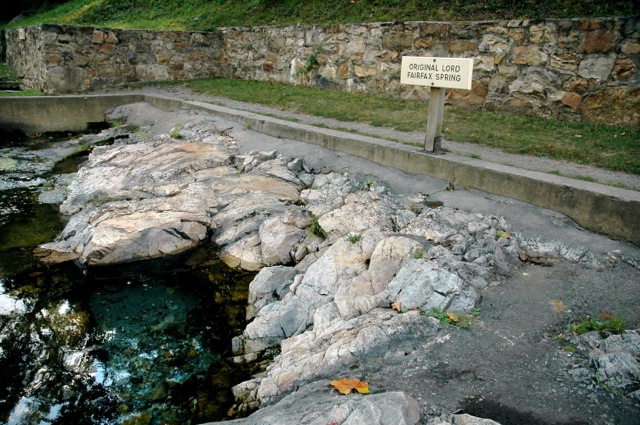
I grew up in a town that’s main industry was water. Berkeley Springs, West Virginia is named for the Fairfax Spring in the middle of the town of Bath. The smallest state park in West Virginia is only about two three blocks wide and a block across, but it has a source of life-giving water older than any settlement around it. The waters that flow out of that spring are an accident of geology. An aquifer that erosion slowly revealed over time. The water of the aquifer, replenished when the rain soaks through the earth and finds a place in the rocks below ground once again, is warmed underground and emerges at a lovely seventy-five degrees year-round.

Lord Fairfax Springs, Berkeley Springs, WV. Photo by Jeanne Mozier.

This kind of water, bubbling up from underground, is where the idea of “living water,” originates. While Jesus uses the term to describe the life-giving nature of faith, he describes it while standing next to a well. The idea then is that the living water he is offering is not only something that literally gives life, but that it is a spring you do not have to dig for. The water that Christ offers is something you can scoop up in your hand and take a big gulp of. It is not far away; it is close at hand.

The scripture we read today focuses on God bringing water to God’s people from on high. The rain falls and waters the fields, the snow that melts and fills the wadis. Isaiah describes the word of God as acting like those sources of life. When God speaks the words of God rush out and bring life to everything they touch. The words never fail to bring about something new, they never turn back to God and shrug their shoulders, the word of God always brings about something new – always fulfilling its purpose. When God speaks, the words always have something to offer.

The first day I preached in my first appointment, we sang a hymn together, “God hast Spoken by the Prophets,” and I believe that that hymn perfectly describes how God’s word finds its way to us. “God has spoken by the prophets,” giving us the words of scripture we depend upon. “God has spoken by Christ Jesus,” through the teachings of the apostles and the Gospels. The hymn concludes with a verse, “God is speaking by the Spirit,” and that verse reflects this passage best. The Spirit speaking to us now, through preachers and teachers, friends and family, and those mysterious happenstances that define a life of faith – that is the rain that falls and brings new life. That is God’s word raining down on us.

Sometimes the words take a while to sink in though. Sometimes it takes a lot in life to bring the life out of the words we have received. In these times, the word is like snow on a mountain, dripping slowly down until it becomes a great flood that washes and transforms the world below it. Still further back, the word may come to settle – in the pages of this book we call the Holy Bible, or in the traditions of the Church that have been passed down for centuries. These are the deep waters, the aquifers that we sometimes feel we need to dig deep down to find their truths. However, as Jesus promised the woman at the well, I think we will find that in scripture as well as in most of our life, the living waters we seek are much closer than we might even dream of them being.

The Word of God is the Water of life. If we seek after it and drink from it often, we will find ourselves transformed. Be willing to listen to what God is saying, and find that even a small whisper – the drip drop of some small stream – can make a big difference. The Grand Canyon was not formed all at once, but only because water flowed over it for millions of years. It is not enough to be near water, we have to be in it, and drink deep of it, to really be refreshed. I would encourage us all to think of God’s word that way.

We might consider it enough to get our weekly dose of scripture but take some time to really drink it now and then. You do not need a reading plan; you do not need some big goal with the project. Just pick up a bible and start reading. If you can only do one chapter a day, do it. If that is a chapter every few days, do it. Not every word you read will be the one that changes your life, but every word you read will make a difference. It will get you thinking, questioning, forming ideas and frameworks for the entirety of your life. We are never too old, or too young, to really take a leap and learn something about God. Life is all around us, falling from Heaven everyday and available too us if we just lean down and take a deep drink from what is right in front of us. Let us take that leap, let us drink deeply from that infinite spring, and let us see God giving us life, and life abundantly. – Amen.  


[1] Issar, Arie and Zohar, Mattanyah. Climate Change: Environment and History of the Near East. 2E. (New York, New York: Springer. 2007)

Words of Love – Sermon 07/09/2023

Song of Solomon 2:8-13

Listen! My beloved! Look! Here he comes, leaping across the mountains, bounding over the hills. My beloved is like a gazelle or a young stag. Look! There he stands behind our wall, gazing through the windows, peering through the lattice. My beloved spoke and said to me,

    “Arise, my darling, my beautiful one, come with me. See! The winter is past; the rains are over and gone. Flowers appear on the earth; the season of singing has come, the cooing of doves is heard in our land. The fig tree forms its early fruit; the blossoming vines spread their fragrance. Arise, come, my darling; my beautiful one, come with me.”

Sermon Text

A wise man once said that “love is a many-splendored thing.”[1] I am inclined to agree. It is hard to find, in any ten-minute stretch of radio or Spotify play, a song that is not in some way about love. From Chart Topping hits like “All You Need is Love,” to more obscure pieces like, “The Museum of Idiots,” love is a major underpinning of how we understand each other.[2],[3] That love takes many forms, but if we are true to our Christian ideas we have to acknowledge a single source for all love – God in all of God’s manifold splendor.

There is a fallacy that the Church has perpetuated for centuries, and that was popularized in our own century by people like C.S. Lewis, that there is a magical hierarchy of love in scripture. We speak of the divine agape of God and compare it to the way that we love each other. The reality, both etymologically and theologically is that love is not a bunch of diverse things, but a single force that takes forms relative to who is involved within the situation we find ourselves in. Yes, Greek has words for familial love and friendly love, romantic love, and a multitude of other categories, but those categories are all part of one singular love, agape. To say that God is agape is not to say God is a part of some otherworldly love we have to strain to understand, but that God is revealed in every love that we feel – as long as we pursue that love well and in truth.

Let’s break away from abstract concepts for a minute. I love my family in a way different from how I love my wife. I love my family, but I do not see them every day, and it would probably cause us all some issues if I did. I love my wife in a way that makes me happy to be with her every day – to actively choose day after day to be around her. Likewise, I love my friends in a way that is different from either my family or my wife. The ways I love these people are not ranked by the intensity of affection or care – I would argue I care for each as much as I can – the difference in the love expressed comes down to how we interact with one another, what the right kind of interaction for each kind of love is.

I love my friends, which means that I uplift them in every way I can. I will go out of my way to help them, travel many miles to see them, and celebrate them. I do not, however, interact with my friends as openly and frankly as I do with my wife – not because I cannot, but because that just isn’t the relationship we have. With my family, I might express myself in ways I never would to a friend, and in ways different to how I talk to my wife. I love my brother, for example, and that manifests in us being generally insulting and antagonistic to each other at family gatherings. We will move heaven and earth to help the other in a bind, but we express our love with as much maturity as two brothers ever would – which is to say, not with much.

Love in a Church context is likewise as intense as love for friends or family. However, the manifestation is different from either in many cases. While there are some people in the Church who become friends or as close as family, the wider association of Christians in a single building or across many is never as intimate as family or friends. Yet, we still do all we can to help each other, to promote the good of one another, and to make sure that everyone is able to thrive with the life that God has given them. Still, we treat each other a little differently than we would family, friends, or a spouse. There are always unique boundaries, signs of respect, and general decorum associated with any relationship, and they are all incredibly important to maintain.

I hope my point is clear at this point – love is one singular thing, but the way it expresses itself is contextual to the relationships we have. All relationships, if they are healthy and rooted in genuine care for each other are reflections of God’s love. As scripture says, we learn how to love from God loving us first![4] I love my friends because God first loved me. I love my wife because God first loved me. I love the people of the world because God first loved me!

Our scripture for today, or more properly the entire book it comes from, is often dressed up to be completely different than it actually is. In hundreds of study Bibles and books, Song of Songs is treated as a metaphor for God’s love for the believer. I am here to tell you that this is only true insomuch as we believe all love has its origin in God. No, Song of Songs is not a metaphor for God and humanity, it is a book dedicated only to expressing love between two lovers. It has some really graphic descriptions of the physical features of both parties and of acts between them. If it is a book only meant to express how God interacts with humanity, then the metaphor is a bit… unnecessarily thirsty, to draw from the vernacular.

Why would the Bible include a book just about love between two people? I think it is because, in a bizarre way, those trying to make this book a metaphor are on the right track. If all Love has its origin in God, then we can learn about God through loving others. When scripture gives us a whole book about romantic love and does not elaborate on why it is there, that tells me that romantic love is worth lifting up and celebrating on its own. Because while there are many ways to love, there is ultimately only the love we first learned about from God.

What if we loved everyone with the ferocity that God has loved us? How much more willing might we be to support our friends if we thought of our love for them as coming from God? For our family? For our spouses? It is a heavy example to live up to, but I think it is a very important one. The words of love we speak to one another, are rooted in the word of God itself, and the word of God says time and time again. Love is all you need.


[1] Fain, Sammy & Webster, Paul Francis. Love is a Many-Splendored Thing. 1955

[2] McCartney, Paul & Lennon, John. All You Need is Love. Abbey Roads Studios, 1965.

[3] Linnell, John & Flansburgh, John. Museum of Idiots. Idlewild, 2004.

[4] 1 John 4:19