Sermon 10/12/2025 – Skipping the Best Part

Jeremiah 29: 1-11

These are the words of the letter that the prophet Jeremiah sent from Jerusalem to the remaining elders among the exiles and to the priests, the prophets, and all the people whom Nebuchadnezzar had taken into exile from Jerusalem to Babylon. This was after King Jeconiah and the queen mother, the court officials, the leaders of Judah and Jerusalem, the artisans, and the smiths had departed from Jerusalem. The letter was sent by the hand of Elasah son of Shaphan and Gemariah son of Hilkiah, whom King Zedekiah of Judah sent to Babylon to King Nebuchadnezzar of Babylon. It said: Thus says the Lord of hosts, the God of Israel, to all the exiles whom I have sent into exile from Jerusalem to Babylon:

Build houses and live in them; plant gardens and eat what they produce. Take wives and have sons and daughters; take wives for your sons, and give your daughters in marriage, that they may bear sons and daughters; multiply there, and do not decrease. But seek the welfare of the city where I have sent you into exile, and pray to the Lord on its behalf, for in its welfare you will find your welfare. For thus says the Lord of hosts, the God of Israel: Do not let the prophets and the diviners who are among you deceive you, and do not listen to your dreams that you dream, for it is a lie that they are prophesying to you in my name; I did not send them, says the Lord.

For thus says the Lord: Only when Babylon’s seventy years are completed will I visit you, and I will fulfill to you my promise and bring you back to this place. For surely I know the plans I have for you, says the Lord, plans for your welfare and not for harm, to give you a future with hope.

Sermon Text

Jeremiah 29:11is probably one of the most quoted scriptures in American Christianity. The promise of God’s foreknowledge in our lives is comforting. That the plans God lays out ahead of us are good, all the better. It is on walls of churches and house decorations and many a twitter bio… The problem is that it is not a very good verse to style your life around.

If you look at it, it’s a specific verse for a specific people. God is not making a sweeping statement about plans for everyone’s life, though I am sure God has them. It is a promise to God’s people in exile, to trust that while things are currently bad for them, keeping to the counterintuitive instructions God has given them will be for their own good. The promise of the “plans,” being good is given not as a vague allusion to God having influence over their lives, but as a specific message about something God has already told them to do.

While I do not disagree with people’s desires to use this verse to reassure themselves that God cares about their wellbeing, I also believe that we do ourselves a disservice in ignoring what specific plans God is laying out for the people. As we have seen on other Sundays, Jeremiah is a book that consists largely of horrible news for the people of God – that this section takes such a sharp turn toward something positive should tell us that every word of it matters. We cannot just take Jeremiah 29:11, or any part of scripture, out of its fuller context and expect to really understand what it is telling us. Most of us, I have to say, have been skipping the best part of this chapter.

As a reminder of our Biblical History, the book of Jeremiah takes place during the Babylonian Conquest. Israel existed as a sovereign nation for a relatively short time during the reigns of King Saul, and then David and Solomon. After Solomon’s death, the country split in half between the Northern Kingdom of Israel and the Southern Kingdom of Judah. Israel would later fall to the Assyrian Empire, with Judah becoming a vassal-state. In time, Assyria would fall to the Neo-Babylonian empire, who would take over all their land.

The Babylonians first made a vassal-state of Judah, then destroyed it entirely after a failed coup. Jeremiah 29 captures the moment after the initial conquest and deportation of many Judahites to Babylon, but before the complete destruction of Jerusalem and the larger second deportation. Jeremiah has two goals – firstly to reassure the now scattered people of God that God is still caring for them, and secondly to chastise the leaders of the people and their prophets. The latter part of the chapter captures the prophecies against the kings and false prophets and spells out the destruction of the city and the removal of its people. The first section, however, the one we are talking about today, lays out something of how God works within a broken world.

The deportees in Babylon are living in a mixture of situations. Some, those who are literate or artisans, have been placed into jobs within the imperial machine. Those who make specific goods are now making them for Babylon, those who recorded legal matters are now doing it for the empire. These folks are not “free,” but they are granted certain benefits that come from their skills. They are being used by empire and have been inserted into the existing middle and ruling classes as the empire sees fit. Poorer folk were sent in as slaves and field workers, feeding the empire with their labor. Both faced troubles, both were uprooted from their home and their religious life, their unique circumstances only changed the severity and flavor of their torment.

To these people, Jeremiah writes the words we have plastered all over our lives. The plan of God to redeem them after their time in Babylon comes with specific instructions for how to live in the meantime. The instructions are revolutionary, they change the way God’s people are to live forever, and yet they are something that, within a few generations, God’s people would throw away for their own purposes.

God gives them the instruction to marry and give in marriage. The people are to put down roots! More than this, the implication comes that they are to marry into the people of Babylon.

At different stages in its history, Judah had different concepts of how intermarriage between ethnic groups could be done, but here we see a full endorsement of it. God also asks that the people support the cities that they have found themselves in, to labor for the good of their neighbors, for doing so will ultimately help them as well.

For we today, as American Christians, we do not suffer from displacement. Many people in this world do, and for them these teachings are immediately relevant. However, as citizens of Heaven who sojourn on the earth, as we all hope to be, then we must see a parallel. We are not called as Christians to distance ourselves from other people, to see them as something apart from ourselves. While I do think Christianity makes unique demands upon our lives, those demands are open to all people. Racial divides, for example, have no place in the Church. Despite our long history of segregation and our contribution to anti-miscegenation and integration throughout history, the Church is meant to be a place where all people become part of the same family.

Likewise, we are not truly citizens of this world, and yet we are meant to contribute to the good of the place where we live. I think Jeremiah is intentional in saying the people are to support the “city,” in which they live and not Babylon as a larger entity. The delicate support of upholding the laws and welfare of the place you live, while not absorbing the evils practiced within, is a tale as old as time within the Church. Christians lived, worked, and paid taxes to Rome while Rome was hunting and killing them. Today, our culture commits many evils, targets many vulnerable people, and often times with the sanction of those in power. We can support Keyser, West Virginia, even the United States, without blindly aligning ourselves to any evil which society perpetrates through them.

The biblical ethic of seeing all people as our “neighbor,” demands that we do some literal work for our literal neighbors. We are commanded to care for each other, because our mutual welfare is part of God’s plan.

We cannot despise the people around us and expect that any good will come of that. So many cities, towns, even smaller communities like churches, become lost in a deep sense of distrust with each other. We lose sight of the idea that we are meant to love one another, because it is far easier to fear each other. Everyone is seen as a potential threat, an obstacle to be overcome, and not as fellow human beings walking this earth together.

God does indeed have plans to prosper people, but that plan includes the simple act of working together for the general welfare. Today in our hyper partisan world, that is hard to imagine being possible. We have people who legitimately hate each other. Every problem is sourced to people groups – the republicans, the democrats, immigrants, trans people, gay people – anyone really, as long as the label can stick to an accusation. It is harder than ever to live a full life – costs are up, companies are getting record profits, jobs are down as AI and automation replaces humans – in a world where more and more people are suffering, more and more will be looking for people to blame.

There is blame of course. Tools of industry, businesses founded on stochastic incitement, and rampant consumption are just a few sources of our troubles. Nation uses each trouble against nation, and none have clean hands in the fight. However, the most powerful thing we can do to counter these forces, those who benefit from division and who want us to distrust one another, is to do the radical thing that sits in front of us at all times. Embrace God’s plan, see those around you as a neighbor, and live accordingly. That sort of plan, that can truly be for our good. – Amen.
Sermon 10/05/2025 – On Supererogation

Luke 17:5-10

The apostles said to the Lord, “Increase our faith!” The Lord replied, “If you had faith the size of a mustard seed, you could say to this mulberry tree, ‘Be uprooted and planted in the sea,’ and it would obey you.

“Who among you would say to your slave who has just come in from plowing or tending sheep in the field, ‘Come here at once and take your place at the table’? Would you not rather say to him, ‘Prepare supper for me; put on your apron and serve me while I eat and drink; later you may eat and drink’? Do you thank the slave for doing what was commanded? So you also, when you have done all that you were ordered to do, say, ‘We are worthless slaves; we have done only what we ought to have done!’ ”

Sermon Text

One of the ways that I know that people do not often actually read scripture is that I do not, as a pastor, get more questions about slavery. When you read through the scriptures, you see that throughout the Old Testament, the New Testament, and, if you’re feeling especially exotic, the Apocrypha, there is a lot of talk about slavery and very little discussion of how it is a bad thing. There’s a lot of reasons for this, entire books about it even, and we sadly do not have time to go into it today.

I am not going to spend a lot of time explaining, or explaining away, the Bible’s treatment of slavery. Obviously, as people who live in the modern era, we acknowledge the fact that slavery in any form is despicable. Yet. as people who have never in their lives suffered a loss of freedom because of this institution it can be easy for us to not take a moment to acknowledge its presence throughout scripture. Others in this world are not so lucky, whether they live in an area of the world where slavery is still very real or they are descendants of those who had lost their freedom, or been born into a system that never allowed them to have it. Today, we are discussing a parable of Jesus within its context and from it I hope we can understand a little bit more of how we interact with the world and if you’re interested, we can come back another time and talk about why that context makes us bristle as much as it does.

In our scripture, Jesus is talking to his disciples. Firstly, he looks at the group of them and says in response to their demand that he increases their faith, “If you all had faith the size of a mustard seed, you would be able to do, intense, but still basic gardening with it.” Something that is lost in the English translation is that Jesus is not saying if each individual had faith the size of a mustard seed they could do this, he is saying that if all of them together could muster up even that much faith it would be sufficient to rip up a single tree.

 This is very different from what Jesus tells us in Matthew. There we read that faith the size of a mustard seed would be able to move mountains.[1] In truth, I think Jesus probably gave his disciples both of these teachings at different times. Matthew’s version captures a moment of Jesus delivering this message out of hope for his disciples. After spending years with these people and seeing them grow very little, the messaging necessarily changes to a call for action on their part. Jesus, having faced his disciples constantly arguing with each other over who is the greatest and who is best at doing this or that, finally seems to have a moment where he looks them in the eye and calls their bluff about why they are doing what they’re doing.

Jesus looks at them and gives them a parable that for our modern eyes is uncomfortable and was probably equally so for his disciples, just in different ways. “Who among you,” Jesus asks, “would be willing to have your slave come into your house, set the table, and then pull up a seat next to you.” Jesus knows his disciples are more likely to be slaves than own them, but still he expects them to answer like any good Roman subject would. “A slave’s place is not at the dinner table. They eat only after the master is done eating and they eat in their own quarters.” Perhaps they are hoping Jesus is about to subvert their expectations, and so they remain silent. Jesus does not though, and instead tells them they should be like slaves, and not expect to be praised for doing what is expected of them.

Within theology there is a concept called supererogation. It means, “to work above,” and refers to the belief that a Christian can do something above and beyond what is asked of them by God. We in the United Methodist Church actually have a specific belief about supererogation within our Articles of Religion.[2] The language comes from the 1600s so it’s a little antiquated, so allow me to modernize it. “It is impossible for a Christian to work beyond what is asked of them by God because God asks for everything from a Christian. Therefore, no amount of work or devotion can exceed what is expected of them when God expects everything.”

Jesus’s parable of the worthless slave is not without irony. When we read through his other teachings, we know that Christ is actually the kind of person who sets a table for slaves. Reading through Jesus’s teachings, we know that when we enter Heaven, we will receive the words, “Well done, my good and faithful servant.”[3] However, Jesus’s harsher words here are necessary for us to understand something that we often forget about faith. We are not doing anything special by responding to Christ’s words with obedience and a desire to be good. Yes, it may not be everyone’s response to do these things, and yes, it may make us a far happier and holier person because we have done them, but in doing what we are supposed to do we have not earned ourselves any special favor.

If Christ was the kind of teacher, the kind of God, who looked at his disciples and lavished them with praise for each thing they did, I don’t think that we would exist as a Church today. The life that the disciples had to live, one in which they were constantly persecuted, denied basic human rights, sent out into the world to suffer the way they did, that kind of life can only happen because they did not expect anything for the work which they did. They were following the example of their savior after all, “who took on the form of a slave,” to save them.[4]

I often tell the story of my great uncle. He was an atheist. One day he was helping repair a roof on a church. As he was up on the ladder a Deacon of that church came out and told him to come down and talk to him for a while. The Deacon asked him how much the church was paying him to do the work and my uncle said, “I like what you all do, I’m doing this for free.” The Deacon looked at him and said, “Now you really ought to get some money out of this, I would never do this kind of work for free.” My uncle looked at him put his hand on his shoulder and said, “Sir, I don’t know how you Christians work, but I’m an atheist and we believe in doing things just cause they’re right.”

I tell that story because my uncle had a better understanding of what it means to do the right thing than most Christians. I do think that it’s important that we as individuals and as a church show people appreciation for the work they do. I think it would be very easy to abuse this teaching of Jesus to say that you should never give anyone a positive word because that’s not why they’re doing what they’re doing. However, as with so many things, we can’t throw out this teaching because it could be abused. The teaching is still good even if people have used it for evil. It is important to ask, what would the church be like if it took the attitude my uncle did more often? If we did good work, because it was right to do it, and asked for nothing else?

Today as the church celebrates World Communion Sunday, we acknowledge the fact that we are not the only Christians to exist. So often, we assume the only “good,” Christians are the ones just like us. The truth is more complicated than that. At this table, to all who earnestly seek it, there is more than enough grace, if only we can acknowledge how freely it is given, and how little we can contribute toward it. The worst thing we can do at this table, is presume that our seat at it has been earned, or that the grace we receive is something due to us.

I always find myself remembering the words of the old communion liturgy. Before the merger of ’68, Methodist and EUB churches would pray each Sunday before we took communion, saying, “We do not presume to come to this, Your Table, O Merciful Lord, trusting in our own righteousness, but in your many and great mercies. We are not worthy so much as to gather up the crumbs under your table but you are the same Lord whose mercy is unfailing.”[5]

Today this table, for those who truly wish to take it in earnest, is a chance to start over. If we can humble ourselves and acknowledge the fact that we are not special, not in the way we often want to be, it will bless us richly. We must acknowledge we are as dependent upon God’s grace as any other person in the world and just as liable to sin and as likely to fail. True freedom comes from the acknowledgement of our dependency, and when we can remove that presumption of righteousness from ourselves, then we find our faith producing fruit. The fruit of righteousness, the fruit of mercy, and the fruit of grace that we have earnestly received.

We are not special, not even one of us, but that does not mean that we are not beloved. It does not mean that we do not still have a place in this world that needs us. It simply means that we do not have a privilege over any other human being. For we are sinners all and all of us are dependent upon the feast which is set before us by a God who welcomes every humble heart with grace upon grace, joy upon joy, at the seat we never thought we could sit down at. – Amen.


[1] Matthew 17:20

[2] Articles of Faith of the Methodist Church. Article XI

[3] Matthew 25:21

[4] Philippians 2:7

[5] Adapted from “The Rite of The Lord’s Supper or Holy Communion” in The Methodist Hymnal. 1964

Sermon 09/28/2025 – Real Treasures

1 Timothy 6:6-19

Of course, there is great gain in godliness combined with contentment, for we brought nothing into the world, so that we can take nothing out of it, but if we have food and clothing, we will be content with these. But those who want to be rich fall into temptation and are trapped by many senseless and harmful desires that plunge people into ruin and destruction. For the love of money is a root of all kinds of evil, and in their eagerness to be rich some have wandered away from the faith and pierced themselves with many pains.

But as for you, man of God, shun all this; pursue righteousness, godliness, faith, love, endurance, gentleness. Fight the good fight of the faith; take hold of the eternal life to which you were called and for which you made the good confession in the presence of many witnesses. In the presence of God, who gives life to all things, and of Christ Jesus, who in his testimony before Pontius Pilate made the good confession, I charge you to keep the commandment without spot or blame until the manifestation of our Lord Jesus Christ, which he will bring about at the right time—he who is the blessed and only Sovereign, the King of kings and Lord of lords. It is he alone who has immortality and dwells in unapproachable light, whom no one has ever seen or can see; to him be honor and eternal dominion. Amen.

As for those who in the present age are rich, command them not to be haughty or to set their hopes on the uncertainty of riches but rather on God, who richly provides us with everything for our enjoyment. They are to do good, to be rich in good works, generous, and ready to share, thus storing up for themselves the treasure of a good foundation for the future, so that they may take hold of the life that really is life.

Sermon Text

Money truly makes the world go round. Don’t believe me, don’t believe Joel Grey, believe the writ of scripture itself. “Money answers all things,” is a lesson straight out of Ecclesiastes.[1] Are you hungry? Tired? Need friends? For a little bit of money, these and more can be yours! Money cannot buy happiness, but it should not surprise us that people’s happiness is usually correlated to their income.[2] When you have money, you have few things to worry about, but when you don’t life can be a struggle even just to keep a roof over your head.

There’s a story, Greek in origin, of a slave who longed for his master’s wealth. The master decided to allow him to have his wish for a day. The man enjoyed the lavish food and drink that his master had every day. He celebrated in the midst of it all… Until he looked up. Dangling on a small thread above him was a sword, spinning slightly in the draft of the room. The lesson of this parable, “The Sword of Damocles,” is that the wealthy constantly have to fear thieves and traitors, and so it is wrong to desire what they have, because it is so hard to have it… The Sword of Damocles is a piece of propaganda that has lodged deep into our psyche.

The simple fact is that money makes life easier. The more of it you have, the more likely you are to have your problems taken care of. A rich person has the time, the ability, and the power to exert their will on the world in a way that the average person would never have. Their children get access to better schools, better equipment, better chances compared to anyone else. The cycle carries from one generation to the next, the rich beget the rich, and they take and they take until there is nothing left for those beneath them. There are far more Dives in this world than there are repentant Scrooges.

Money, the messy thing that it is, is described as the “root of all kinds of evil,” in today’s scripture. Truthfully, the way it is usually quoted, “The root of all evil,” is also a fine translation. In Greek it is rendered “ ‘ριζα γαρ παντων των κακων” (hriza gar panton ton kakon.) This can mean, “Money is the root of all kinds of evil,” or “Money is the root of all evils.” Though I do endorse the traditional reading as valid, I think the idea that money can, and often is the source of every kind of evil is more accurate.

Evil predates the existence of money by hundreds of thousands of years. In the Garden, humanity did not disobey God because cash was offered to us. Evil predates money, so it cannot be its true source. However, I believe that wealth, whether monetary or otherwise, is indeed a nutritive source – a root – of every kind of evil there is. An evil-minded person, given the resources that wealth allows, can commit all manner of evil with very little effort. To have is to have opportunity, and to have opportunity is to face temptation. A heart that is not prepared for that temptation will live out a life of selfishness when given access to sufficient means to do so.

People say “power corrupts,” but monetary or social power does not truly corrupt – it enables. A good person, given the means to do good, will do more good. A person who is primarily invested in themself will spend their resources toward that goal of self-aggrandizement. We are meant to work on our goodness, our thriftiness, our gregariousness, at all times simply because we do not know what tomorrow may bring. Whether we are poor, rich, or thoroughly stuck in the middle, we are all of us at the whims of chance. Tomorrow we could have everything change for us, one direction or the other, and we must be prepared to do right regardless.

The “great gain,” which Paul describes in Timothy comes from “godliness combined with contentment.” The one aspect, Godliness, is meant to reflect that when we have excess resources in life, we use them according to godly principles. We do not waste our money, we save what we can when we can, but never to a point that we neglect to be charitable. The other aspect, contentment, means that we do not chase after more money regardless of where we are at. While money makes life easier, we are not made to accumulate it, we are made to live – and money is the tool by which we live our lives.

Now, here comes the kicker. Pretty much all of us in this room are wealthy. Now, give me a second here. I’m not saying all of us, but I am saying most of us have more money at our disposal than most people in the world, and a good chunk in this country. Who here owns their house? You have more square footage and more equity than most people could ever dream of. Who here has more than five thousand dollars in savings? You have more money than some people make in a year, just sitting there in case you need it. How many people here have no debt? How do you exist in the year 2025?

As we all have some amount of wealth, we are expected to contribute some of it to the good of others, especially those most in need. St. John Chrysostom, a fifth century preacher, put this idea quite well in several of his sermons. The shorter quote from Chrysostom is simple, “[N]ot to share our own riches with the poor is a robbery of the poor, and a depriving them of their livelihood; and that which we possess is not only our own, but also theirs.”[3] His longer quote is built off of the Gospel of Matthew, but it says in better words than I can muster exactly what I mean.
            “Do you wish to honor the Body of the Savior? Do not despise him when he is naked. Do not honor him in church with silk vestments while outside he is naked and numb with cold. He who said, “This is my body,” and made it so by his word, is the same that said, “You saw me hungry and you gave me no food. As you did it not to the least of these, you did it not to me.” Honor him then by sharing your property with the poor. For what God needs is not golden chalices but golden souls.

…It is such a slight thing I beg…nothing very expensive…bread, a roof, words of comfort. [If the rewards I promised hold no appeal for you] then show at least a natural compassion when you see me naked, and remember the nakedness I endured for you on the cross…I fasted for you then, and I suffer for you now; I was thirsty when I hung on the cross, and I thirst still in the poor, in both ways to draw you to myself to make you humane for your own salvation.”[4]

For the Christian, we have only one true treasure – salvation given freely by Christ. All other treasures are distractions. We must not cling to wealth, but willingly give as often as we can. We must not seek after money no matter the amount, because our fortune is not in dollars and cents, but in Heaven. We must not cling to worldly things, but know that real treasures come only from God. Look out on the world, see how broken it is. You can help with that brokenness, but only if you are of a generous spirit. Give richly to people in need, to charities that serve them, and find that you are less weighed down by the false wealth of this life. Find true freedom, through trusting in Christ, and contentment that comes from living without covetousness or greed.

People of God, count your blessings, and see that your wealth testifies against you. Find ways to expand your care for this world, at the expense of luxuries for yourself. In doing so, perhaps we all can find ourselves a little closer to the vision God has for us all. – Amen.


[1] Ecclesiastes 10:19

[2] Killingsworth, Matthew A., Daniel Kahneman, and Barbara Mellers. “Income and Emotional Well-Being: A Conflict Resolved.” Proceedings of the National Academy of Sciences 120, no. 10 (March 1, 2023). https://doi.org/10.1073/pnas.2208661120.

[3] John Chrysostom. Discourse 2 on the Rich Man and Lazarus.

[4] John Chrysostom. Homily 50 on Matthew.

Sermon 09/21/2025 – Consequence is Coming

Amos 8:4-14

This is what the Lord God showed me: a basket of summer fruit. He said, “Amos, what do you see?” And I said, “A basket of summer fruit.” Then the Lord said to me,

“The end has come upon my people Israel; I will spare them no longer. The songs of the temple shall become wailings on that day,” says the Lord God; “the dead bodies shall be many, cast out in every place. Be silent!”

Hear this, you who trample on the needy, and bring to ruin the poor of the land, saying, “When will the new moon be over so that we may sell grain, and the Sabbath, so that we may offer wheat for sale? We will make the ephah smaller and the shekel heavier and practice deceit with false balances, buying the poor for silver and the needy for a pair of sandals and selling the sweepings of the wheat.”

The Lord has sworn by the pride of Jacob: Surely I will never forget any of their deeds. Shall not the land tremble on this account, and everyone mourn who lives in it, and all of it rise like the Nile, and be tossed about and sink again, like the Nile of Egypt?

On that day, says the Lord God, I will make the sun go down at noon and darken the earth in broad daylight. I will turn your feasts into mourning and all your songs into lamentation; I will bring sackcloth on all loins and baldness on every head; I will make it like the mourning for an only son and the end of it like a bitter day.

The time is surely coming, says the Lord God, when I will send a famine on the land, not a famine of bread or a thirst for water, but of hearing the words of the Lord. They shall wander from sea to sea and from north to east; they shall run to and fro, seeking the word of the Lord, but they shall not find it.

On that day the beautiful young women and the young men shall faint for thirst. Those who swear by Ashimah of Samaria and say, “As your god lives, O Dan,” and, “As the way of Beer-sheba lives”— they shall fall and never rise again.

Sermon Text

The threat of punishment is considered to be one of the least effective means to prevent bad behavior. Teaching people to do something only because they might get punished for it tends to teach the wrong lesson. Instead of learning “Do not do this thing,” they learn, “Be good at hiding the fact you did.” The resulting ethics that this mindset creates is that anything is permissible as long as we can, “Get away with it.”

In our daily life we live this out constantly. “No one saw me leave the empty gallon of milk in the fridge, so there’s plausible deniability I did it.” “The road was empty when I was going 90 in a 50, so as long as a cop isn’t hiding behind the next turn, I’ll be fine.” Et cetera, et cetera, and so it goes. This kind of thinking is tied intrinsically to “Obligationism,” the idea that we do something because we are told to do it, and if we do not we are punished for our disobedience. In religious circles, Obligationism is one of the most common ways of understanding the way we are to live in this world, and I would argue it also grows most easily into legalism.

As I have already said, if I do the right thing so as to not break a rule, I will spend most of my time finding ways to do it that are technically correct. God says to honor the sabbath and keep it Holy, so I decide that that includes exceptions for the work I choose to do on the sabbath. Scripture says not to loan money for interest, but our economy is based upon interest so for the good of everyone within that economy, I cannot oppose usury, clearly. I find the ways to wiggle and worm out of every listed rule and as a result I create a patchwork ethical code. I become more invested in the appearance of holiness rather than its execution. The things I do are not for good or for love or for God, but for adherence to the rules set before me.

Counter to this idea of morality is the idea that a things ethical value is defined by its proximity to the absolute Good. As Christians we believe that the absolute standard for good is God, and that God and the Good are therefore synonymous. To be like God is to be Good, and to be Good is to be like God. For this reason, I think the best way to talk about “moral teachings,” in scripture, is always to talk about morality as the cultivation of virtue. The more we practice goodness, the better we are at being good. Rules help us to cultivate that goodness, but they are simply a means toward that good.

Ok, enough philosophy, let’s get to the meat of the issue. Our scripture is a long and scary list of all the different, fatal punishments that the people of God faced in the Babylonian conquest. More than that, it is a list of specific infractions that led to their punishment. Are we to believe then that God is an obligationist? That God sits and metes out punitive measures to enforce an ethical code, thereby encouraging people to sneak around those codes in an attempt to escape punishment?

Scripture seems to suggest this is not the case. God often expresses dissatisfaction with this simplistic idea of morality. Yes, there are commandments that God has given are violated and God points to them as reasons for the troubles God’s people face, but the focus is seldom on the rules themselves. A good example is in our scripture which we have read here today. Let’s look at this section again.

Hear this, you who trample on the needy, and bring to ruin the poor of the land, saying, “When will the new moon be over so that we may sell grain, and the Sabbath, so that we may offer wheat for sale? We will make the ephah smaller and the shekel heavier and practice deceit with false balances, buying the poor for silver and the needy for a pair of sandals and selling the sweepings of the wheat.”

            The first thing highlighted in the sins of God’s people is that they “trample the needy,” and the following offenses build on that theme. In other words, the individual offenses are less important than the virtue that has been violated. “I gave you laws to ensure you would care for each other,” God seems to say, “You have failed to care for each other, because you have kept the letter but not the spirit of my law.” The people keep the festivals and Sabbaths they are commanded, but only because they would be punished if they did not. “When will the [Sabbath,] be over so that we may offer wheat for sale?” The Sabbath is not being kept for the sake of devotion to God or care for their own health, but out of reluctant obligation.

            The corruption of God’s people was found in their abandoning the truth God gave them for a sense of righteousness that comes from following the rules in the strictest sense of the word. At the same time, they skirted any kind of regulation regarding the price of goods by changing the definition of their weights and measures. To put it in modern terms, the dollar kept being worth less, and the bags of flour kept weighing less, even though the bag still said “one pound,” on the corner. More than this, we’re told what was sold was poor quality, basically dust off the floor of the storehouse. Workers were treated as slaves, and those with the least were treated the absolute worst.

            God was not content that the people kept the Law, because the law was not an end to itself. The obligation of the Sabbath was to allow people to rest, the rules surrounding care of the poor to ensure everyone had what they needed to live. All of God’s teachings had a point and a purpose that pointed to something that nurtured goodness in the people. By being given guidelines for charity, they could learn to be charitable. By being given guidelines for rest, they could learn to be restful. God did not demand obedience simply out of an exercise of power and authority, but for the good of those who pursued that kind of faithful obedience.

            There is, nonetheless, a consequence for failing to be obedient to the deeper truths of what God instructs us to do. This idea is easily abused, but it remains true even if it is often taken to a harmful extreme. When we fail to take care of the poor, we court not only the degradation of society, but the wrath of God. When we live a life of legalism, devoted to the letter and not the spirit of the law, we break down our own hearts until we are left with only the image of propriety, and none of the substance of holiness.

            Scripture, both the Hebrew and Greek Testaments, are clear that a failure to pursue goodness in a life of faith has consequences. Out of fear of suggesting we are saved by works, we in the Church often downplay that fact. We do not talk about Christ describing the road to Heaven as narrow and straight, because it suggests more than just lip service is necessary for our salvation. When we read the prophets, we focus on idolatry as a sin, because it is far harder to imagine ourselves committing that than failing to care for the needy. We hope for a faith that allows us to dig only just deep enough, only just safe enough.

            It is also important to note that scripture does not direct these messages of doom to people outside the faith. Jesus speaks of the Kingdom of God as opening doors for folks who do not yet know God’s redemption, but for the people who are within the circle of the faith already his words are harsher. Failure to meet the expectation laid by Christ is expected of those who do not know them, but for those who have heard them, and yet chosen to pursue another road… Doom is inevitable.

            We are under an obligation to pursue goodness, because outside of goodness we will destroy ourselves. If we chase after evil, evil will consume us. If we chase after good, we will know growth and abundant life. We must care for those around us, we must care for ourselves, we must pursue a true and social holiness in all things. Consequence is coming, every second it draws near, if we do not cling to goodness, we will drown within falsehood. Do right, train yourself in virtue, and be the people of God for this world. – Amen.

Sermon 09/14/2025 – A Mind Toward Mercy

Exodus 32:7-14

The Lord said to Moses, “Go down at once! Your people, whom you brought up out of the land of Egypt, have acted perversely; they have been quick to turn aside from the way that I commanded them; they have cast for themselves an image of a calf and have worshiped it and sacrificed to it and said, ‘These are your gods, O Israel, who brought you up out of the land of Egypt!’ ” The Lord said to Moses, “I have seen this people, how stiff-necked they are. Now let me alone so that my wrath may burn hot against them and I may consume them, and of you I will make a great nation.”

But Moses implored the Lord his God and said, “O Lord, why does your wrath burn hot against your people, whom you brought out of the land of Egypt with great power and with a mighty hand? Why should the Egyptians say, ‘It was with evil intent that he brought them out to kill them in the mountains and to consume them from the face of the earth’? Turn from your fierce wrath; change your mind and do not bring disaster on your people. Remember Abraham, Isaac, and Israel, your servants, how you swore to them by your own self, saying to them, ‘I will multiply your descendants like the stars of heaven, and all this land that I have promised I will give to your descendants, and they shall inherit it forever.’ ” And the Lord changed his mind about the disaster that he planned to bring on his people.

Sermon Text

Our scripture today is something I alluded to back in July when we talked about the time that Abraham requested that God be merciful toward the people of Sodom and Gomorrah. Moses, in the face of God’s anger toward the Hebrew people, asks that God spare them. Specifically, Moses appeals to God’s reputation, saying that it would look bad for God to kill his people after bringing them out of Egypt. As an episode in the history of God’s people and as a presentation of divine will and theodicy and other theological questions, it’s a bit strange.

We did not talk about this too much with our previous discussion of prophets asking for God to be merciful, but the ability to convince God of anything opens up a lot of questions. If we believe that God is “that beyond which nothing greater can be conceived,” and that this manifests in God being all good, all powerful, and all knowing, then it is strange to imagine that God can just… change God’s own mind.[1] If God is perfect, and that includes a perfect cognition, then this should be outright impossible. Yet, repeatedly in scripture, we are told of God, relenting, or regretting, or turning away from a decision God had previously made.

Today, we are looking to understand the character of God’s mercy and how it can produce moments like this. While we are not going to uncover the mystery of God’s mind or the fullness of how moments like this can occur in the scriptures, we are going to establish some things we know about God, God’s actions, and ultimately the all-encompassing nature of God’s mercy.

To begin with this discussion of God’s retraction of a punishment, we must begin with the first prophecy of doom given in scripture. In Genesis 2 the first human is given specific instructions not to eat of the fruit of the Tree of the Knowledge of Good and Evil, lest they die. The human, later split into the first humans – Adam and Eve – fail in this prohibition. They do eat of the tree and are not, surprisingly, struck dead. While many interpreters, including John Wesley, point to the spiritual death they experienced as a consequence of this transgression, I think we can also see this as the first moment of mercy entering the story of God’s interactions with the world.

God denies the couple the Tree of Life because of their disobedience, establishing that they will some day face death. Sin naturally leads to death, this is echoed throughout scripture. However, God does not kill them outright, refusing to just restart this experiment in creation. God sends them out of the Garden, clothes them to keep them safe and warm, and then keeps close tabs on them. Their children still speak openly to God, God hears and knows their sorrow at the death of Abel, God does not abandon them – but loves them in the midst of their wrongdoing.

Despite God’s divine care, humanity continues to fall into deeper sin. We are told that the evil of humanity, especially their violence, was so great that God devises a flood to restart the entirety of creation. The description of God’s creation in Genesis 1 and 2 is reversed, water floods the earth, and God is ready to start all over again… Except that God did not make a clean sleight, God still loved what God made enough to preserve parts of the creation. Noah preserves humanity and other creatures along with him, allowing for a new start for the created order.

Again and again, God chooses to restrain the punishment that could be inflicted upon the world. The mercy of God in the face of legitimate evil is sometimes overwhelming. When we read the story of Abraham, Isaac, and Jacob – all of them do some downright awful things. Yet, God sustains them and gives them the chance to make things right. God wants to be merciful.

Whether scripture gives us these discussions as a narrative tool or God gives them as a lens into the divine nature, I could not really say. Either way, the moments when God expresses one emotion, only to act contrary to that emotion, seems to be a chance for us to see a different aspect of God than what we might have imagined God to have. I am talking in circles a bit, so let me steal an analogy from Paul.

Paul describes our faith as like looking, “Through a mirror, darkly.”[2] Mirrors in the Biblical period were made of polished brass, capable of producing surprisingly clear images. However, brass mirrors tarnish over time, when removed from light they lose their luster, in a thousand different ways the image can dim and distort. While we have unprecedented access to God through Christ, there is still an immensity to God’s character. In Scripture, in our life, and in our prayers we encounter moments of God, glimpses of the nature of something far beyond our comprehension.

Thus, in scripture, moments like this show us diverse aspects of God all at once. We can be shown God’s anger at idolatry, and God’s capacity toward mercy. That second aspect, the mercy, wins out because it is a more essential part of God’s character even than holiness. For in the midst of God’s holiness, the unapproachability of the numinous fire at the center of creation, there is the love of a God who desires to walk alongside that same creation. God who burns with a fire that cannot stand impurity, works time and time again to make pure the unclean things of this world. God has a mind toward mercy, and that is something expressed in tandem with and at the center of God’s desire for justice, holiness, and purity of Spirit.

Next week we will have an opportunity to look closer at the judgement of God, so do not take me for someone who does not think that God has the capacity or right to express anger or to punish it. However, I think that we need to ground all discussion of God in the reality of God’s gracious mercy. Even when anger, punishment, and consequences are deserved – God seeks a way to redeem rather than to wipe away. God wishes to wash rather than to burn. If we believe that, it should shape our walk in faith, because it reminds us that we do not worship a God who wishes to throw us away, but a God who has worked hard to bring us close.

Jonathan Edwards, a minister during the Colonial Era of the United (States and the grandfather of Aaron Burr,) famously wrote the sermon “Sinners in the Hands of an Angry God.” This sermon focuses on the wrath of God, serving as the prototypical “Turn or Burn,” style sermon. Yet, Edwards gives us one of the most powerful images of God’s grace. God, Edwards says, is under no obligation to be merciful – God after all is the only truly, fully free entity – but God sustains even the wicked, “by [God’s] mere pleasure…” Edwards uses this to emphasize the precarious nature of God’s mercy, but I think it paints a far more enduring image.

God holds in hands larger than space, the fullness of creation. The creation yearns for rebirth, it seeks to enter into a new way of being. Yet, God does not hold onto it out of obligation or necessity, but out of love. Mercy is the most essential character of our God, and we know this because in the midst of holiness, otherness, impossible distance, God continually moves to close the gap between us and the divine. God has a mind toward mercy, and that ought to inspire us toward the same. God has a mind toward mercy, and that ought to reassure us in our failings. God has a mind toward mercy, and that is the foundation of our faith, our trust, our hope in this life. – Amen.


[1] I often use this definition of “God,” and it comes from Anselm of Canterbury’s “Ontological Argument.” More about that available here: https://iep.utm.edu/anselm-ontological-argument

[2] 1 Corinthians 13:12

Sermon 09/07/2025 – Two Paths

Deuteronomy 30:15-20

See, I have set before you today life and prosperity, death and adversity. If you obey the commandments of the Lord your God that I am commanding you today, by loving the Lord your God, walking in his ways, and observing his commandments, decrees, and ordinances, then you shall live and become numerous, and the Lord your God will bless you in the land that you are entering to possess. But if your heart turns away and you do not hear but are led astray to bow down to other gods and serve them, I declare to you today that you shall certainly perish; you shall not live long in the land that you are crossing the Jordan to enter and possess. I call heaven and earth to witness against you today that I have set before you life and death, blessings and curses. Choose life so that you and your descendants may live, loving the Lord your God, obeying him, and holding fast to him, for that means life to you and length of days, so that you may live in the land that the Lord swore to give to your ancestors, to Abraham, to Isaac, and to Jacob.”

Sermon Text

As I have said many times, I am directionally challenged. While I can map out physical space fairly well, figuring out where North, South, East, and West are without issue, I am completely useless at figuring out where one road connects to another. It does not help that here is West Virginia, roads developed around hills – you cannot assume a grid layout for a town anymore than you can assume that a road that ends in one place does not start up several miles down the way.

If I can tell a story that will serve as our parable for the day, I would like to cast the vision of the road to Bridgeport – our metaphorical Heaven – and the road to Flemington – our metaphorical Hell (I do not feel strongly about either town, this is an appraisal of their respective roads.)

When I would go to visit the Bridgeport Nursing Home, I would inevitably come to a crossroad. At that crossroad, I could turn left toward Flemington, or drive straight ahead to Bridgeport. The road to Bridgeport would take me up to Emily Drive, where there were a bunch of stores and therefore a great deal of traffic. Going that route was never my ideal, and with the intense amount of roadwork happening at the time, I especially wanted to avoid it. Looking at the path I had ahead of me, I chose what I thought would be best – to drive down to Flemington and then cut across back into Clarksburg.

The problem is that, while Flemington did run parallel to Route 50, which was my goal to reach, it never actually connected to Route 50. I could drive for over an hour and I would only find myself on the interstate for my trouble, completely removed from my goal of reaching home. To follow the road to Flemington was to follow the road to being more lost than I ever could be if I just learned to deal with the road work.

In our walk of faith, we are also presented with two paths. One is the straight and narrow path that “few find.”[1] The other is broader, flatter, and much easier to saunter our way down. What I want us to understand, especially today as we launch our fall season here at Grace, is that the choice we make to follow one path or the other is not as simple as saying, “Yes,” once or “No,” once – but requires us to reevaluate our life again and again. For me on my way home I could go one way or the other, meanwhile we have a thousand roads that move us toward God or away from God, and sometimes we will drift slowly down the wrong path without even realizing it.

Every day we have thousands of interactions – digitally, physically, and even mentally – that shape our souls and the souls of people around us. When we stop into the gas station and look the attendant in the eye and treat them like a full person, that makes a difference. When we walk by the beggar on the street without even acknowledging they exist, that makes a difference. When we sit in our house and stew over something someone said or did, that makes a difference. Again and again and again, life gives us routes we can choose to take or not take, and the difference in the major ones are what we usually focus on. However, it is in those little byroads we get the most lost.

When I look back on my life, I see major departures I could have taken. If I accepted I was going to be a minister when I first felt that was my call, back in High School, what would have changed? If I had avoided the disastrous relationship I had in college that threatened to rip my family apart and that ended several key friendships in my life, what would that do? If I had known far earlier about my depression and had it treated, what might I have done?

These big turning points stand out to us, but they usually are more complicated than a “Good” or “Bad” choice. My call to ministry was put on hold by my unwillingness to accept it, but because I went into chemistry first, I was much better equipped to talk to folks throughout the pandemic because of my background in science – plus I have been able to tutor people! My disastrous relationship caused all kinds of trouble, but it also taught me an awful lot about myself, about forgiveness, about the need to be good to people and not accept when someone wants you to be something other than who you truly are. In every path that seems to me to be an obvious binary choice, I see that God took me down the road I needed to go down, that still led to the path I needed to take.

The key difference in the path that leads to life and death is that you can imperfectly do good, but there is never a good way to do something bad. Driving to Flemington would never bring me to Route 50, but going to Bridgeport I had two or three different roads to lead me home – some better than others. In the same way, we have to acknowledge which roads we take in life that lead us to greater life and fuller understanding of God, self, and neighbor – even imperfectly – and which ones only cause us harm.

Cruelty is the most obvious road that will not save us. If we ignore the needs of others, excuse injustice of any kind, and generally allow ourselves to hold onto disdain for our neighbors – even our enemies- we will destroy ourselves. Self-indulgence is another way to destroy the self. If we never tell ourselves “No,” then we will demand more and more and more. We do not always need a new phone, just cause an upgrade is available. We do not need to eat out every time we do not want to cook. We can spend our time, our money, our social battery a little better and suddenly find ourselves better at regulating our self and managing our world.

I do want to say that there are still obviously bad choices in life. If we struggle with addiction and refuse help, then we are setting ourselves up to continue to suffer. (The sin here I should say is not addiction, which is a medical issue, but denying the problem.) If we are edging our way toward infidelity – emotionally or otherwise – we will destroy our relationships. If we are actively working to harm people, to steal or defraud them, to do all manner of things we know to be wrong, then we are setting ourselves up for a fall.

The thing about our daily, incidental mistakes, is that we can usually recover from them. If I snap at my wife because I am frustrated about something, we can work that out after I apologize. However, if I feed into that decision to take things out on her, I will destroy our marriage given enough time. When we make mistakes habitually, such that they become conscious choices, we move away from detours and onto a deliberate and direct path toward oblivion. For some things the solution is just to turn around, to desist, to try something else.

The good news is that we are always able to turn around. Repentance in Hebrew is “Shuv,” which literally means to do an about-face. We go in the opposite direction and move back toward the right way of being. It is a long road back sometimes and repenting does not make us not have to face the consequences of our actions – in fact a true attitude of repentance will require us to make amends fully for the wrong we have caused. I was never going to get to my house by driving through Flemington, I had to turn back around, that is true for some things in our own life too.

Today, we are given the same choice that the Hebrews were given long ago. Take the path toward life and abundance, or the road that leads to destruction. The road toward life is a harder road, it requires honesty and repentance and all manner of goodness. The road to destruction will give you everything you want, when you want it, but leave you empty, for the “worm quenchest not.”[2] I pray we choose the right path, and turn from the ones we need to, which are leading us to destruction.


[1] Matthew 7:14

[2] This is a misquotation of “the worm diest not,” from Mark 9:48; combining the worm’s immortality with the unquenchable fire mentioned later in the verse. I find myself saying “the worm quenchest not,” more often, and so I have preserved my malapropism here.

Sermon 08/31/2025 – Mud Holes and Warm Springs

Jeremiah 2:4-13

Hear the word of the Lord, O house of Jacob, and all the families of the house of Israel. Thus says the Lord:

What wrong did your ancestors find in me that they went far from me and went after worthless things and became worthless themselves? They did not say, “Where is the Lord, who brought us up from the land of Egypt, who led us in the wilderness, in a land of deserts and pits, in a land of drought and deep darkness, in a land that no one passes through, where no one lives?”

I brought you into a plentiful land to eat its fruits and its good things. But when you entered you defiled my land and made my heritage an abomination. The priests did not say, “Where is the Lord?” Those who handle the law did not know me; the rulers transgressed against me; the prophets prophesied by Baal and went after things that do not profit.

Therefore once more I accuse you, says the Lord, and I accuse your children’s children. Cross to the coasts of Cyprus and look; send to Kedar and examine with care; see if there has ever been such a thing. Has a nation changed its gods, even though they are no gods? But my people have changed their glory for something that does not profit.

Be appalled, O heavens, at this; be shocked; be utterly desolate, says the Lord, for my people have committed two evils: they have forsaken me, the fountain of living water, and dug out cisterns for themselves, cracked cisterns that can hold no water.

Sermon Text

I am out of town on vacation this week. Which means I get to write a sermon that will pretty much just exist between me and the couple dozen who read this blog. I like these moments, because I get to think about the sermon as a thing which is read, and not something I will have to say.

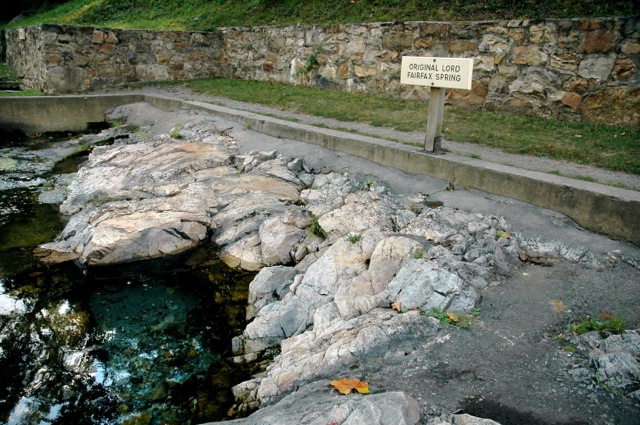
It is also an opportunity for me, as I get about once a year, to talk about the imagery of springs in Biblical Literature. Growing up in Berkeley Springs, WV, water bubbling up from underground is an essential part of my world. The springs, since the days of Francis Asbury, have been a place folks go to in search of peace, healing, and life itself. Within those tepid waters are a variety of microorganisms, tadpoles, guppies. The occasional bird flits down to visit the waters, to drink or to wet its feathers. Out of the aquifer just under the limestone, life itself is given to the surface.

Springs like this occur in most parts of the world. Wherever an underground water deposit happens to get too close to the surface, such that it can be pushed up by pressure into a small pool or stream, there a spring will form. Like many springs, the springs at Bath are “warm springs,” maintaining a temperature of about 75 degrees all year round. They are beautiful, they are carved out of the earth, and they are permanently part of my being.

The scripture out of Jeremiah can give many lessons. It gives us a lens to the status of cultic worship in Jerusalem – the presence of Baal alongside Adonai is just taken for granted. Likewise, we cans see the concept of sin “spoiling,” the land – God’s position as the source of fertility is confirmed when the land does not give produce due to the repeated sins of God’s people. Yet, for myself today, I think that the image of springs and cisterns, specifically in terms of God’s people choosing “no gods,” is compelling.

There is a tension within the scriptures regarding the existence of deities other than the God of Israel. Paul in some letters of the New Testament implies that idols are just empty stone shells, elsewhere he seems to imply a spiritual reality to the Greco-Roman pantheon. Likewise, God is described in the Hebrew Bible as being the chief of the “Gods,” having taken his place at the summit of the universe and divvying up nations between the other Gods, choosing Israel for his own. He fights with Chemash at one point, he actively opposes Dagon in his sanctuary, he appropriates and subverts the language of Marduk. Yet, as Jeremiah shows us here, many other times the foreign Gods are treated as non-existent, as phantoms, as “no Gods.”

While I do not think this would be a helpful thread to follow in discussions of interfaith dialogue, I do think that this can be helpful to understanding a persistent problem within Christianity. We adore creating other Gods, in establishing pantheons of fear, all so that we can feel more secure in our own strength and abilities. We empower the circumstances of the world around us with supernatural agency and power and create Gods to fight against our own. While some may argue this creates a more compelling narrative of a “conquering king,” image for our God and Messiah, I think it weakens our witness in an attempt to secure our own positions and hegemonies.

I speak directly against the idea that this world is inhabited by “Spirits.” Constantly you hear folks in Church contexts use the term “Spirit,” to instill personality in problems. Depression is difficult, it exists at the crossroads of mental, behavioral, and environmental causes. A “Spirit of Depression,” which is easily rebuked by a faithful person requires no questions. Add “Spirit of,” to just about any problem and suddenly the day to day struggles we face become Spiritual battles. More than that, they can become battles that you can win, if you just assert your positive affirmation of faith over them. It’s The Secret, baptized and dressed up for Sunday Service.

I believe that spiritualizing these matters is not inherently problematic. Depression, division, doubt, and all manner of evils beyond this have a spiritual element to them. The problem is that these Spiritual conditions are not personified conditions. My depression impacts my spirituality, but an evil smoke monster does not sit on my shoulders and whisper bad things to me. In my mind, the modern formula of, “I rebuke the Spirit of X,” is the creation of a new kind of magic. We are using the language of religion to try and make God act at our discretion. We have created enemies for God to knock down, but often times the enemy is simply something we have invented.

A Spirit of Division is easier to oppose than the complex web of misunderstandings, egos, and legitimate concerns that cause Church conflict. A Jezebel Spirit is more marketable than telling a woman you disagree with to sit down and shut-up. So on and so forth, et cetera, et cetera. We take the complex web of human experience, human relationships, human sin and outsource them to invisible phantoms that we can claim to chase away with a single word. Do I believe in Spiritual Forces of Evil? Yes, but I cannot accept this phenomena in the Church honestly deals with those forces.

In establishing a complex web of demonic, anti-social Spirits we are ultimately committing the same superstitious mistake that the Medieval Church did. We are making new “Maleus Malifarcarum”s to identify witches in our midst. We write out exhaustive grimoires so that we can name the Spirits of our own invention and make them bend to our will. We come up with ritual and with incantations, to defend against the Gods of this world… The God who we must honestly confess are, “no Gods.”

Superstition is one of the primary dangers faced in the Church today. Having lacked a true Spiritual core, Protestants, Catholics, and all streams otherwise have fallen into lesser manifestations of spirituality. We are in a never ending Satanic Panic that sees the devil in every book, movie, stage performance, or opening ceremony. We fear that by accidentally misspeaking or striking a yoga pose a dark creature may enter our hearts. Yet, there was already a creature in our heart all along working evil within us. We are our own worst enemy, “The heart is devious above all else…”[1] We do not need an evil spirit to lurk on our shoulders, because our own evil and sin-sick spirit is capable of plenty of evil.

The reality of God’s existence, of the power that we are given over evil in this world, is most powerfully reflected in two things. Acknowledging, firstly, that there is no other source of life and truth except God. We may delude ourselves, may create self-aggrandizing narratives and incantations, but at the end of the day we are wholly dependent upon the God from whom we come and to whom we earnestly seek to return. We do not need to invent conflicts, because the conflict of God fighting the forces of sin and death to reclaim our souls is more than enough. It plays out in our hearts every day, God fights back evil within us every moment. The truth of God’s struggle for our heart is enough.

The second thing we must acknowledge about God’s reality is that we are the antagonists of the story. Whatever Spiritual Wickedness there is in the world, it does not constitute hob-goblins tricking you into pacts. The evils of this world are fed by our own human will and cognition. We choose evil, constantly, and we are left the lesser because of it. Humanity is the core driver of wickedness in this world, not the false Gods we wish to blame for it. In the mirror every day you see the image of God reflected back to you, and every day you have the choice to live like that image or against that image. We are the villains, Christ is the protagonist, and all of life is the story of how villainous humanity is redeemed.

Back to the initial imagery of springs. God tells Jeremiah that in worshipping the Baals, the people have traded a spring of living water for a muddy cistern, cracked and incapable of even holding water. I maintain that this is true of our Christianity when we tack on superstition to it. We trade a sacrificial faith that asks us to examine ourselves, to chase after the lifegiving waters of God’s instruction, grace, forgiveness, and blessing – we trade all that away for a series of spells and superstitions that satisfy our daily ennui, but fail to grow us as people. If I think all my problems are external, the work of Spirits that I have to constantly watch out for and say spells of protection against, then I will never look inside, never correct my own faults, never seek the true belief and true repentance I need to find life, and life abundant.

I have cast my life upon the altar of the one God of Heaven and Earth. I shall not elevate artificial divinities to that same level. No Spirit of human invention can overcome the One Spirit that dwells within me.[2] No manufactured tulpa is worth worrying over when I am earnestly struggling to see that my name, written by God’s grace in the Lamb’s Book of Life, is not written with an asterisk beside it attesting to my inability to become worthy of the call to which I am called.[3] When true Spiritual Evil appears in my life, I want to truly be prepared to face it, not left to the mercy of my own half-baked hero narrative. God is in his Heaven, and above all the “no Gods,” he holds his court. I shall not create a graven image to oppose him, I have shown myself opposition enough, time and time again. I want the springs of life, not that muddy pit… Amen.


[1] Jeremiah 17:9

[2] Luke 10:20 c.f. 1 John 4:4

[3] Revelation 20:12 c.f. Ephesians 4:1

Sermon 08/24/2025 – Where no One has Gone Before

Hebrews 12:18-29

You have not come to something that can be touched, a blazing fire, and darkness, and gloom, and a tempest, and the sound of a trumpet, and a voice whose words made the hearers beg that not another word be spoken to them. (For they could not endure the order that was given, “If even an animal touches the mountain, it shall be stoned to death.” Indeed, so terrifying was the sight that Moses said, “I tremble with fear.”) But you have come to Mount Zion and to the city of the living God, the heavenly Jerusalem, and to innumerable angels in festal gathering, and to the assembly of the firstborn who are enrolled in heaven, and to God the judge of all, and to the spirits of the righteous made perfect, and to Jesus, the mediator of a new covenant, and to the sprinkled blood that speaks a better word than the blood of Abel.

See that you do not refuse the one who is speaking, for if they did not escape when they refused the one who warned them on earth, how much less will we escape if we reject the one who warns from heaven! At that time his voice shook the earth, but now he has promised, “Yet once more I will shake not only the earth but also the heaven.” This phrase, “Yet once more,” indicates the removal of what is shaken—that is, created things—so that what cannot be shaken may remain. Therefore, since we are receiving a kingdom that cannot be shaken, let us show gratitude, by which we may offer to God an acceptable worship with reverence and awe, for indeed our God is a consuming fire.

Sermon Text

In 1917 Rudolf Otto wrote a book that redefined the philosophy of religion. His book Das Heilige (Localized as: The Idea of the Holy,) is focused on the way that we as human beings experience the presence of God. Otto calls this experience with something greater than ourselves “the numinous,” and he takes for granted the reader knows what he means when he talks about experiencing the presence of God. After two chapters of introduction, he begins a new one with this instruction “The reader is invited to direct [their] mind to a moment of deeply-felt religious experience… Whoever cannot do this… is requested to read no farther; for it is not easy to discuss questions of religious psychology with one who can recollect [every part of their life,] but cannot recall any intrinsically religious feelings.”[1]

It is not usually a very productive method of selling books to tell your audience to stop reading on page eight, but for an author who does not want to waste your time I think I can appreciate it. Our faith is easily turned into something purely social. We are Christian less because we have met our risen savior, and more because we like the people who attend the church with us. Certainly, we are to like each other, called to be a family in the truest sense of the word, but we cannot just be a social group. Paul says that we are to be pitied if our faith is revealed to be false, but I would say it is also pitiable if our faith becomes just a reason we get together on Sunday mornings. If we believe we have seen God, and we believe that we have something to share with the world, we have to do more than just get together from time to time.

The writer of Hebrews was writing to his community at a time when they had to decide what their identity was after a significant shake-up. Though it is not exactly clear what lead to the writing of this letter, there are two likely situations. Firstly, the destruction of the Jerusalem temple and, secondly, the expulsion of the author’s community from their synagogue. It is unclear if one or both is involved, but the author is trying to explain to the people how to exist away from one they always knew to be the only way to serve God in their life.

Without a temple, how can you meet God? Without the synagogue, how do you connect with the people of God? For the first generation of Christians, those who were Jewish, existing in a space outside Jewish worship norms would have been incredibly uncomfortable. How do you worship God, when the way you have always worshipped God is suddenly locked away? The people needed assurance that they were doing something more than just existing as a social subset of Judaism. They needed to know that there was something beyond themselves that defined their faith.

The author of Hebrews answers these concerns by calling them to consider a life beyond the Temple, beyond worship as they once knew it. I personally lean to the destruction of the Temple as the trigger for Hebrews’ writing because of the emphasis upon the Temple throughout. The book constantly orbits the idea that Christ now acts as the High Priest of believers. Whereas other priests were born, only to die and be replaced, Christ was an eternal priest who stood in the presence of God as no one had ever done before. As is always the case, the person of Jesus had to be the center of the new life the Jewish Christians had been forced into.

In the person of Jesus we are have someone who stands before God, “with a loud voice and tears,” advocating for us. Christ prays unceasingly in the presence of the Father for the troubles that we face. Christ also, we are told, through his death, secured for us the means by which we can, through, faith, be redeemed from our sin. We need not succumb to our failings, we need not continue on causing harm to ourselves and others, we may truly escape the burden of wrongdoing within and around ourselves. Finally, in approaching the mystery of the faith, we meet the person of God. Beyond the mundanity of life, beyond the excesses of our sin, in the deep darkness of truest truth, there is God. This is the blazing fire, and darkness, and gloom, our scripture speaks of – the overwhelming presence of God – now freely available to be known.

If we believe that this is what we encounter as Christians, then we cannot just be another social group. We cannot allow ourselves to be lost in the sea of options people have. We must offer people what we truly have, and irreplaceable understanding of God and God’s presence in this world. If we believe we have come to the “thing that cannot be touched,” which Otto called Numinous and which we call Christ, then we need to share that revelation with others. It must mean more to us than just a group to be aligned with, a box to check, a surface level identity to separate ourselves from others.

Last week I shared a summary of census and research data with our Council on Ministries. It highlighted a few truths of people in our area. Firstly, that 75% of people in the Keyser area are not associated with a congregation. More than that, only about 5% of people in our area are likely to change that – either by joining or leaving congregations. Secondly, among those who are not presently in churches, the main opposition they have to attending is that Churches are too focused on money, and that they are too judgmental. Thirdly, despite not being affiliated with churches, about 70% or people do consider religious to be at least somewhat significant in their life. Finally, among that 70%, a majority believe these two things: Christians should act as Jesus did, and Church is not necessary for them to practice their faith.[2]

This paints an interesting picture of our ministry area. While we often project the main struggle in religion these days as between trendy non-denoms and mainline establishments, the data seems to suggest that we are facing a more nuanced landscape. When religion is turned into a social gathering, then it becomes optional, and so people naturally will choose non-participation. The majority of people in our area believe in God, they identify with the person of Christ, but they cannot see themselves as part of Christ’s Church, because the Church has failed to be a place that acts like its savior or that reveals the mystery of Christ to the world. Indeed, if we are no more than place people come to read scripture and hear a sermon, then why shouldn’t people just stay at home?

A strange artifact of this practice is that, while 75% of people say they are not affiliated with churches, an equal proportion claim to attend weekly worship. Yet, I believe firmly that we are not meant to be solitary creatures. I cannot worship at home and say that I have fully engaged with all God has to offer. The fullest expressions of who God is are found in the moments we learn to be God’s people together. How can I become a loving person without folks to love? How can I know I have grown in holiness unless I encounter temptation and overcome it? How can I be active in the world as the presence of God, if I flee to be alone at the first chance I get?

We are here together because we have all seen something we cannot neglect acknowledging. The Spirit of God moved in our life and we are not willing to ignore that movement. We feel it in our bones, in the midst of our flesh there is something enlivened by God’s very breath. We have a story to tell the nations, oh yes, but more than that we have the experience of it to offer. In gathering together, we are meeting mystery, in following Christ we go where no one has gone before. In being the Church, we discover what it means to truly thrive. Live with the truth, live with hope, break out of life’s mundanity. – Amen.


[1] Rudolf Otto. “The Elements in the ‘Numinous’” in The Idea of the Holy. Tr. John W. Harvery (Oxford University Press; London, England. 1958) 8

[2] All data provided through MissionInsite.

Sermon 08/17/2025 – Craving Falsehood

Jeremiah 23:23-29

Am I a God near by, says the Lord, and not a God far off? Who can hide in secret places so that I cannot see them? says the Lord. Do I not fill heaven and earth? says the Lord. I have heard what the prophets have said who prophesy lies in my name, saying, “I have dreamed! I have dreamed!” How long? Will the hearts of the prophets ever turn back—those who prophesy lies and who prophesy the deceit of their own heart? They plan to make my people forget my name by their dreams that they tell one another, just as their ancestors forgot my name for Baal. Let the prophet who has a dream tell the dream, but let the one who has my word speak my word faithfully. What has straw in common with wheat? says the Lord. Is not my word like fire, says the Lord, and like a hammer that breaks a rock in pieces?

Sermon Text

I am a strong advocate for truth. As obvious as that can seem, it often falls to the wayside in the rush of daily life in our world. All of us are prone, whether we want to admit it or not, to finding a version of reality that is more palatable than the one in which we live. We talked just two weeks ago about the fact that the cycles of life can exhaust us. In the midst of that exhaustion we can choose to chase after true hope or manufactured hope. Do we find our hope in the truth or do we create a false reality that offers its own false hope?

Despite my commitment to truth, I do acknowledge that many so-called “warriors,” of truth are just bullies. Growing up, I was blessed to have people on my television like Carl Sagan who explained concepts of science in terms that my five-year-old self could not quite understand, but which nonetheless opened me to the wonders of this universe. Now the people who are trying to educate people about deep truths of the universe are usually people who are trying to make money or build clout more so than people who truly wish to educate. We are a culture that is dependent upon bombasticity and upon people fighting each other for engagement, and so we do not often find people educating or revealing truth, so much as selling a narrative or offering confirmation of our own ideas.

As I’ve already said, the tactic of bullies is to take hold of this idea of an objective truth and then to beat people with what their perspective is. However, truth is separate from what we may have as a concept of what is right or wrong. A true situation can be good, or a true situation can be bad, the duty we have as interpreters of this world is to decide how we react to the truth. Truth, nonetheless, sits separate from our impression of it. A true thing might be good, or it might be bad, but it remains true.

What we read today out of the book of Jeremiah comes after a period of time in which Jeremiah has said some of his most devastating prophecies. If you read the book of Jeremiah, you will see a man who is constantly given the chance to advocate for his people and who constantly decides they weren’t worth the time. He stands in front of God and pleads saying that there must be righteous people in Jerusalem, there must be righteous people in Judah, and in the next chapter every time that he does this he is shown that there is in fact very little hope for the people he knows. The prophet is beaten down by the words that he has been given. He describes his bones as cracking, his stomach as boiling, his mouth as pouring out fire, even as his eyes are running out of tears to shed. Still, the whole time he is suffering under the weight of truth, there are other prophets selling a more convenient message.

We get a direct interaction with one of these prophets in Jeremiah 28. Jeremiah wore a wooden yoke around his neck to symbolize the oppression his people suffered under Babylon. A fellow prophet came in one day and broke that wooden yoke. He promises the people that, rather than suffering, they are going to be liberated through the work of their king. Jeremiah looks this prophet in the eye and says “Oh, that that would be true! However, the truth is that God has forecasted an even darker day for the people of Judah. I will be replacing this wooden yoke with one made of iron.” Jeremiah is proven right as the people are taken into exile and some of them forced to flee into Egypt rather than to face their annihilation. The prophet is not happy that he is correct, the message he brings is not a good one, but it is true.

I wish to put forward that there are two things we do to explain the state of the world that are harmful to truth. The first is that we deny when there are problems in this world and the second is that we create easy answers to explain the ones we do acknowledge. On one hand we look out at the broken things of the world and say, “They aren’t really that bad!” On the other hand, we say, “They are that bad! And its all because of those folks over there!” When we simplify the world and its problems, erasing them or making them someone else’s problem, we deny the truth that is plainly laid out around us.

When I was serving in Clarksburg, there was a fairly significant population of homeless folk. If you talked to people in authority in the city, they would tell you they were bussed in regularly by outside forces. They were people who were unwanted in the cities they came from and were sent to Clarksburg to become the city’s problem. This is a storyline many cities adopt, and it comes from a shred of truth. Some cities do choose not to help folk and instead move inconvenient populations in their midst. However, the truth in Clarksburg was harder to stomach. Of those surveyed during the shelter season, some 200 souls, a vast majority were locals. People who fell into a bad habit, or lost a job, or had rent raised above their means, and ended up on the street. The people out on the street were not someone else’s problem – they were our literal neighbors, pushed onto the streets.

Here we see a systemic denial of the truth and simultaneously an easy answer. “If we make it hard for these folks to live here, then they’ll just get on another bus!” That works if you assume people are maliciously being transited, but the reality that people fall into homelessness and poverty within our own community… That opens up responsibility on our part, on the community’s part, in order to make sure we’re doing all we can to care for one another.

The wider the circle, the more complicated the narrative becomes. When a Pandemic ravages the world it is easy to say, “It isn’t that bad!” or “I bet those people caused it!” When floods wipe out communities it is easier to say, “Those folks deserved it!” or “The planes caused it!” than to accept that disasters happen, and in preparation and execution to counter them, mistakes happen.

We are all participants in narratives: national, local, and personal. We will always pick narratives that make us have the least amount of culpability and discomfort with the way the world works around us is. At least, we will until we choose to pursue truth. Without a commitment to truth I will always assume that I was in the right in an argument, that my worldview is unimpeachable, that the people I disagree with are the root of every problem and the people I agree with have all the easy answers in the world… Unless I choose to search for truth, I will settle for something lesser.

Truth is made up of data and stories. It requires finding accurate reporting and reading through more than one article or report to understand a larger context. It requires meeting people from different groups, places, and perspectives rather than trusting stereotypes or assumptions. Truth is a gestalt of many pieces of life, and not just the pieces we decide are most palatable.

As Christians, we hold the most important truth in the universe in our hands. The life, death, and resurrection of Jesus Christ is yours to reveal to the world. If we are left at the mercy of the tides of narratives, and not rooted in a true pursuit of truth… Why should anyone believe us? We are just selling another perspective, another narrative, not dealing with truth in the absolute sense of the word.

Truth is furtive. It’s hard to keep alive because it constantly is shifting under our own pressure for it to look more like this or more like that. Worse still, in falsehood we find none of the ambiguity of doubt that truth can cause. Yet, we must remember, “no matter how tender, how exquisite… A lie will remain a lie.”[1] If we wish to serve the God of truth, we must commit ourselves to truly be people of truth. Abandon the notions you have created to prop up your own desires, egos, and worldviews – embrace the messy things of this life, and find that God is holding a mop and bucket for those who wish to acknowledge the mess. – amen.


[1] Toshifumi Nabeshima. Dark Souls II. V. 1.10. Bandai Namco. PC. 2011

Sermon 08/10/2025 – That Better Country

Hebrews 11:1-3, 8-16

Now faith is the assurance of things hoped for, the conviction of things not seen. Indeed, by faith our ancestors received approval. By faith we understand that the worlds were prepared by the word of God, so that what is seen was made from things that are not visible…

By faith Abraham obeyed when he was called to set out for a place that he was to receive as an inheritance, and he set out, not knowing where he was going. By faith he stayed for a time in the land he had been promised, as in a foreign land, living in tents, as did Isaac and Jacob, who were heirs with him of the same promise. For he looked forward to the city that has foundations, whose architect and builder is God. By faith, with Sarah’s involvement, he received power of procreation, even though he was too old, because he considered him faithful who had promised. Therefore from one person, and this one as good as dead, descendants were born, “as many as the stars of heaven and as the innumerable grains of sand by the seashore.”

All of these died in faith without having received the promises, but from a distance they saw and greeted them. They confessed that they were strangers and foreigners on the earth, for people who speak in this way make it clear that they are seeking a homeland. If they had been thinking of the land that they had left behind, they would have had opportunity to return. But as it is, they desire a better homeland, that is, a heavenly one. Therefore God is not ashamed to be called their God; indeed, he has prepared a city for them.

Sermon Text

Faith and Hope are two sides of the same coin. Through our faith in God, we are convinced that the things we do not presently see are nonetheless real and forthcoming. When we believe that God is active and that salvation is real, then we naturally believe that its benefits and consequences are likewise real and active. Faith is not a basic admittance of belief in something, but a firm stance we come through convincement – by God and through other faithful people – to the truth of our religion.

While some people are squeamish about the use of the term “religion,”, I am  not. Religion is, broadly speaking, any of the ways that we conduct ourselves in this life toward something bigger than ourselves. Whether we express our religious convictions in a legalistic way or with an eye toward a faith that frees us is a matter of choice. Religion is, therefore, not the end of our faith, but the way in which we express faith. The outpouring of what we believe into what we do, that is the essence of Christianity.

Faith is inseparably linked to hope, the anticipation of something unseen and yet promised. When we live out a life of faith, we do so because we believe that God is honest in projecting a future for us that is better than our current one. This “better country,” is not a temporal reality, but a spiritual and eschatological one. In the present age we are given assurance and strength to face the broken world around us. In the age to come all promises are fulfilled and all troubles cease. In the time between we live a life that makes the hope that our faith points toward break out in intermittent flashes. In our honoring of God’s covenant through faith in and Christ and our service to one another, we make the Kingdom of Heaven exist in the now, even as we wait for its fulfillment at the end of time.

As we talked about last week, the cycles of life can make it difficult to have hope. We get lost in the day-to-day hustle and bustle as well as the legitimate hardships that come from disease, and death, and greed. The systemic and personal evils of this world are such that I never begrudge a person who says they have struggled to find or keep it because of questions about the problem of evil. If I did not have a personal experience of Christ, I do not think that I would be able to come to faith naturally. Not raised in the Church, not brought up with a full understanding of who God is and what Christ reveals about God, I would have easily let my cynicism take me down the road of unbelief.

The thing that allows us to exist as people of faith is simply that we have met God. In our worship and our sacrament in our scripture and in our prayer, we have come again and again to the well of eternal life and found that its waters do not dry up. The only reason we can have faith is because of an act of God, through the person of Christ, and the indwelling presence of the Holy Spirit. Apart from these gifts of grace, we would not be able to look at this world with the hope that we carry. Faith is a belief, begun by convincement, that God means what God says. Without the blessing of God’s presence at the outset, we would never find our way to faith at all.

The stories in Genesis, which the author of Hebrews pulls upon in describing faith, shed light upon the messiness of belief and the foundational need for God’s presence to produce it. Abraham went into Canaan after God called him to do so. He also fled into Egypt at the first sign of danger. Isaac was born to Sarah and Abraham, but only after they got tired of waiting and forced a slave to carry a child in her place. They answered the call in faith, but they also frequently ran into a situation that challenged that faith. Most importantly for our own stumbling walk toward God’s promises, they frequently met that challenge and failed to act as they ought.

Whether in fleeing Canaan, or in first involving and then chasing away Hagar and her child, Abraham sinned abundantly in his pursuit of God’s covenant. Yet, through him a blessing was shared with the earth. The culmination of Abraham’s work was the person of Christ born from his descendants and out of Heaven. The savior of the whole earth, even of the whole creation, was at the end of a long road of mistake after mistake, and yet Abraham held on in the midst of his failings, trusting that something better was coming down the road.

In our own life, there are many times we encounter challenges that make us question our faith. I think we would be delusional if we did not look at the suffering in this world and not have the question of, “Why?” creep into our mouths. Someday we’ll look at Job and how God blessed his interrogation of divine mercy, but that book gives us a clear message – faith is not diminished through questions, but enhanced. We cannot be convinced of God’s goodness unless we look at God in the face, unless we ask “Why?” and “How long?” and “What are you doing?” To meet God is to meet with the known and the unknowable. To know God is to grow in understanding the hope that hides beyond the horizon of each dark day.

I find it hard to talk about Hope without quoting Emily Dickinson:

“Hope” is the thing with feathers
– That perches in the soul
– And sings the tune without the words
– And never stops – at all,

When we find our hope in Christ, it is not always a loud and triumphant thing. Like Abraham, it meets us in the midst of deep darkness and unknowing. It sings a tune we do not know the words of, but that we can follow faithfully as the beat echoes in our chest. We go forward to live the life we do, so that we might teach the tune to those we meet. In kindness shown to others and in hard lessons of love we have learned and in an endless march toward that better country we have seen only in dreams and deepest prayers, in all these things we proclaim our hope through faith. Listen to the song of Hope within you today and let that song bring you closer to home. – Amen.